Populations · 种群
| English | 中文 | Pinyin · 拼音 |
|---|---|---|
| population/ˌpɒpjʊˈleɪʃn/ | 种群 | zhǒng qún |
| exponential/ˌekspəˈnenʃl/ | 指数的 | zhǐ shù de |
| carrying capacity/ˈkæriɪŋ kəˈpæsɪti/ | 环境容纳量 | huán jìng róng nà liàng |
| limiting factors/ˈlɪmɪtɪŋ ˈfæktəz/ | 限制因素 | xiàn zhì yīn sù |
Booming, then balancing
- Put a few organisms in a good habitat and their numbers grow — but not forever.
- A population 种群 follows a characteristic growth curve.
繁荣,然后平衡
- 把几个生物放进一个好的栖息地,它们的数目就增长——但不是永远。
- 一个种群(population)遵循一条特有的增长曲线。
Put the phases of population growth in order. · 把种群增长的阶段按顺序排列。
Slow start, rapid growth, then a plateau. · 缓慢开始,快速增长,然后一个平台。
Population growth levels off at the ______ capacity. · 种群增长在______力处趋平。
The carrying capacity is the habitat's maximum. · 承载力是栖息地的最大值。
The population growth curve
- At first, slow growth (lag phase) while numbers are small.
- Then rapid (exponential 指数的) growth as there's plenty of food and space.
- Finally growth levels off at the carrying capacity 环境容纳量.
Numbers rise rapidly, then level off at the carrying capacity the habitat can support.
种群增长曲线
- 起初,缓慢增长(滞后期,lag phase),当数目小时。
- 然后快速(指数)增长(exponential growth),因为有大量食物和空间。
- 最后增长在承载力(carrying capacity)趋平。

数目快速上升,然后在栖息地能支持的承载力处趋平。
Populations · 种群
logistic growth → capacity K · 逻辑斯谛增长 → 环境容纳量 K
Growth is exponential at first, then levels off at the carrying capacity as resources run low. · 增长起初是指数的,然后随着资源耗尽在承载力处趋平。
The carrying capacity is: · 承载力是:
It is the maximum the habitat can sustain. · 它是栖息地能维持的最大值。
Which are limiting factors on a population? (Select all that apply.) · 哪些是对一个种群的限制因素?(选择所有适用项。)
Food, space and predators limit growth. · 食物、空间和捕食者限制增长。
Limiting factors 限制因素
- Growth slows because of limiting factors: food, space, water, predators and disease.
- These set the carrying capacity — the maximum the habitat can support.
A population in a limited space grows in four phases: lag, exponential, stationary, death
限制因素
- 增长减慢是因为限制因素:食物、空间、水、捕食者和疾病。
- 这些设定承载力——栖息地能支持的最大值。
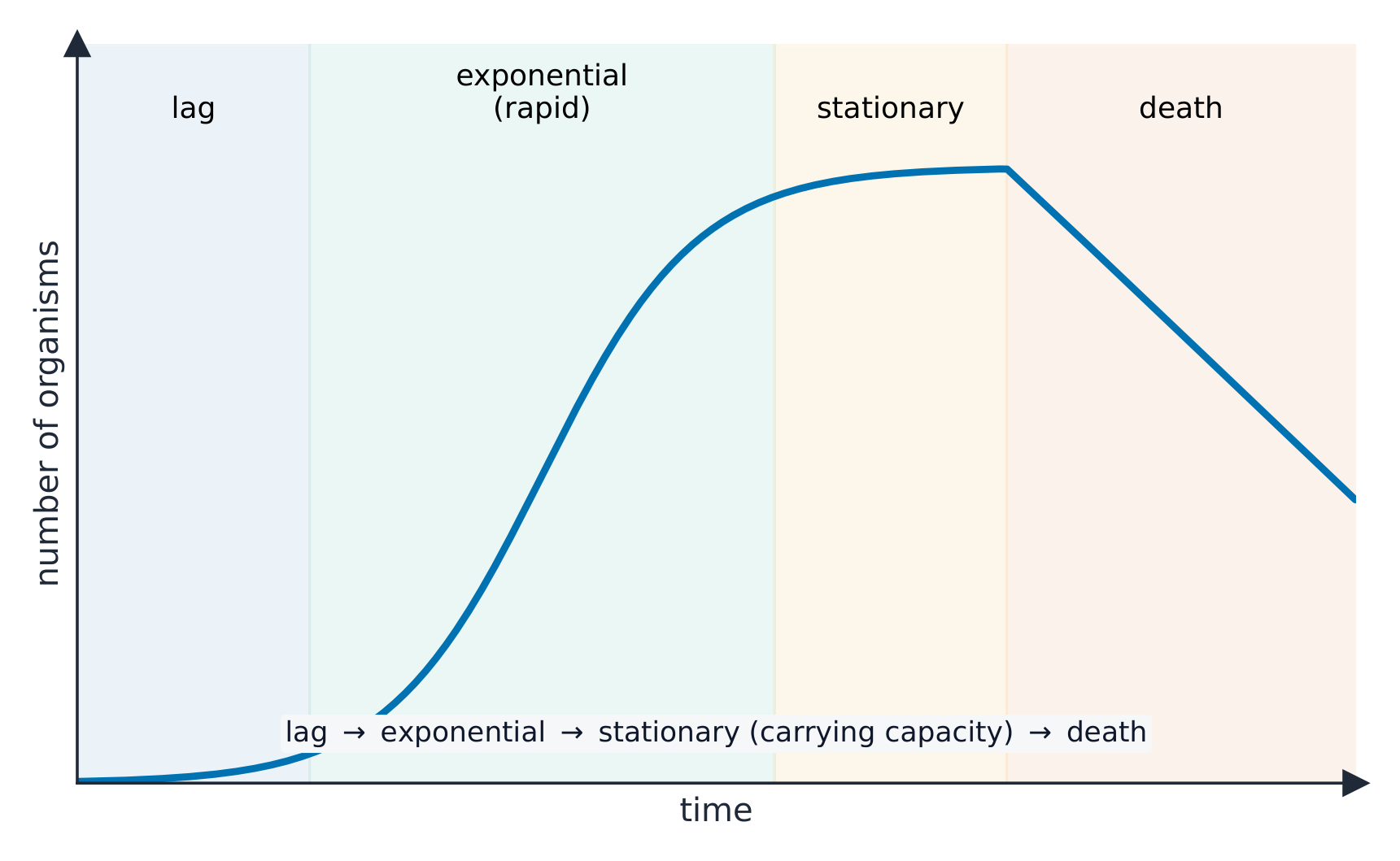
一个在有限空间中的种群以四个阶段增长:滞后、指数、稳定、死亡
A population increases through: · 一个种群通过以下哪种增加:
Births and immigration add to a population. · 出生和迁入增加一个种群。
What changes a population
- A population rises with births and immigration; it falls with deaths and emigration.
- Predators, disease and competition keep most populations near their carrying capacity.
Populations don't grow forever. The exponential phase can't last — food and space run out, and limiting factors bring the population to a plateau at the carrying capacity.
什么改变一个种群
- 一个种群随出生和迁入上升;随死亡和迁出下降。
- 捕食者、疾病和竞争把大多数种群保持在它们的承载力附近。
种群不永远增长。 指数阶段不能持续——食物和空间用尽,限制因素把种群带到承载力处的一个平台。
You've got it
- a population grows: lag → rapid (exponential) growth → plateau at the carrying capacity
- limiting factors (food, space, predators, disease) slow growth
- populations rise with births/immigration, fall with deaths/emigration
你掌握了
- 一个种群增长:滞后 → 快速(指数)增长 → 平台,在承载力处
- 限制因素(食物、空间、捕食者、疾病)减慢增长
- 种群随出生/迁入上升,随死亡/迁出下降