Physical digestion · 物理消化
| English | 中文 | Pinyin · 拼音 |
|---|---|---|
| incisors/ɪnˈsaɪzəz/ | 门齿 | mén chǐ |
| canines/ˈkeɪnaɪnz/ | 犬齿 | quǎn chǐ |
| molars/ˈməʊləz/ | 臼齿 | jiù chǐ |
| emulsification/ɪˌmʌlsɪfɪˈkeɪʃn/ | 乳化 | rǔ huà |
| lipase/ˈlɪpeɪs/ | 脂肪酶 | zhī fáng méi |
| physical digestion/ˈfɪzɪkl daɪˈdʒestʃn/ | 物理消化 | wù lǐ xiāo huà |
Breaking food apart — physically
- Before chemicals can act, big lumps of food must be broken into smaller pieces.
- This physical (mechanical) digestion doesn't change the food chemically — it just makes it smaller.
分开食物——物理地
- 在化学物质能起作用之前,大块的食物必须被分成更小的片。
- 这种物理(机械)消化(physical/mechanical digestion)不化学地改变食物——它只是把它弄得更小。
Which teeth are used for cutting? · 哪些牙齿用于切?
Incisors cut; canines tear; molars and premolars grind. · 门齿切;犬齿撕;臼齿和前臼齿磨。
Chewing food into smaller pieces helps digestion because it: · 把食物咀嚼成更小的片帮助消化,因为它:
Smaller pieces give enzymes more surface to act on. · 更小的片给酶更多表面来作用。
Teeth
- Incisors 门齿 cut, canines 犬齿 tear, premolars and molars 臼齿 grind.
- Chewing breaks food into smaller pieces with a larger surface area for enzymes.
Digestive enzymes break large molecules into small, soluble ones
牙齿
- 门齿(incisors)切,犬齿(canines)撕,前臼齿和臼齿(premolars and molars)磨。
- 咀嚼把食物分成更小的片,有一个给酶的更大表面积。
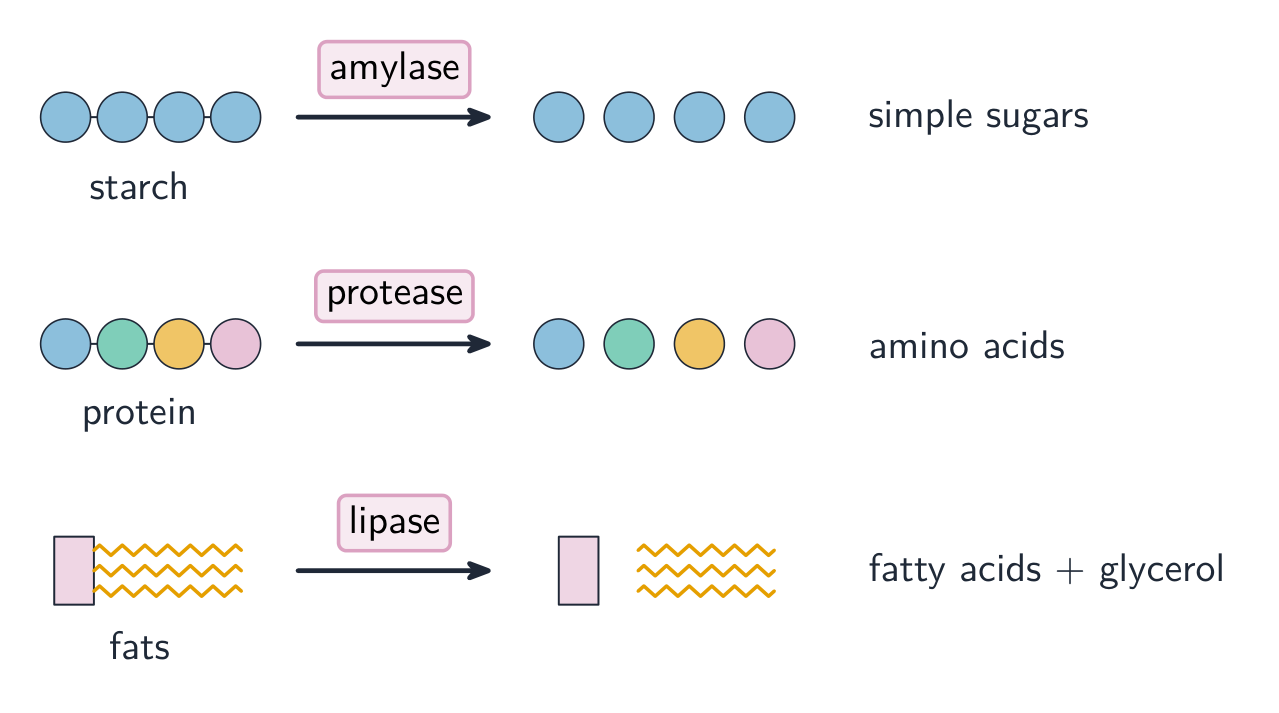
消化酶把大分子分解成小的、可溶的分子
Physical (mechanical) digestion · 物理(机械)消化
Physical digestion breaks food into smaller pieces WITHOUT changing it chemically — it just increases the surface area for enzymes. · 物理消化把食物分成更小的片,而不化学地改变它——它只是增加给酶的表面积。
Physical digestion changes the chemical structure of food molecules. · 物理消化改变食物分子的化学结构。
Physical digestion only makes food smaller; enzymes do the chemical change. · 物理消化只把食物弄得更小;酶做化学变化。
The stomach
- The stomach's muscular walls churn food, mixing it with acid and enzymes.
- This continues the physical breakdown.
胃
- 胃的肌肉壁搅拌食物,把它与酸和酶混合。
- 这继续物理分解。
Bile emulsifies fat, which means it: · 胆汁乳化脂肪,这意味着它:
Emulsification is physical: bigger surface area for lipase. · 乳化是物理的:给脂肪酶更大的表面积。
Breaking large fat droplets into smaller ones is called . · 把大脂肪滴分成更小的叫做。
Bile emulsifies fats to speed up lipase action. · 胆汁乳化脂肪以加快脂肪酶的作用。
Bile and emulsification 乳化
- Bile breaks large fat droplets into many tiny ones — emulsification.
- This greatly increases the fat's surface area for the enzyme lipase 脂肪酶.
Physical digestion 物理消化 doesn't change the molecules. Chewing and churning only make food smaller. The chemical change — breaking molecules into smaller ones — is done by enzymes (chemical digestion).
胆汁和乳化
- 胆汁把大脂肪滴分成许多微小的——乳化(emulsification)。
- 这大大增加脂肪给酶脂肪酶(lipase)的表面积。
物理消化不改变分子。 咀嚼和搅拌只是把食物弄得更小。化学变化——把分子分解成更小的——由酶(化学消化)完成。
You've got it
- physical digestion makes food smaller without changing it chemically
- teeth cut/tear/grind; the stomach churns food
- bile emulsifies fats — increasing surface area for lipase
你掌握了
- 物理消化把食物弄得更小,而不化学地改变它
- 牙齿切/撕/磨;胃搅拌食物
- 胆汁乳化脂肪——增加给脂肪酶的表面积