Polynomial Functions and End Behavior · 多项式函数与末端行为
| English | 中文 | Pinyin · 拼音 |
|---|---|---|
| end behavior/end bɪˈheɪvjə/ | 末端行为 | mò duān xíng wéi |
| degree/dɪˈɡriː/ | 次数 | cì shù |
| leading coefficient/ˈliːdɪŋ ˌkəʊɪˈfɪʃənt/ | 首项系数 | shǒu xiàng xì shù |
| leading term/ˈliːdɪŋ tɜːm/ | 首项 | shǒu xiàng |
What happens way out at the edges?
- Near the middle, a polynomial can wiggle up and down in complicated ways.
- But zoom far out to the left and far out to the right, and its story gets simple.
- Every polynomial eventually shoots off to $+\infty$ or $-\infty$ at each end.
- Just two facts about the rule decide which way each end goes.
最远的两端会发生什么?
- 在中间附近,多项式可以复杂地上下摆动。
- 但把视野拉到极左和极右,它的故事就变简单了。
- 每个多项式在两端最终都会冲向 $+\infty$ 或 $-\infty$。
- 只需要关于式子的两个事实,就能决定每一端往哪走。
End behavior, in words
- End behavior 末端行为 is what the output does as the input runs off to each side.
- Left end: what happens as $x \to -\infty$. Right end: what happens as $x \to +\infty$.
- Each end can only do one of two things: rise toward $+\infty$ or fall toward $-\infty$.
- So there are just four possible "end shapes" for any polynomial.
用话来说末端行为
- 末端行为(end behavior)是指当输入跑向两侧时,输出会怎样。
- 左端:$x \to -\infty$ 时会怎样。右端:$x \to +\infty$ 时会怎样。
- 每一端只能做两件事之一:冲向 $+\infty$ 或落向 $-\infty$。
- 所以任何多项式只有四种可能的"末端形状"。
End behavior describes what happens to $f(x)$ as $x \to +\infty$ and $x \to -\infty$. · 末端行为描述当 $x \to +\infty$ 和 $x \to -\infty$ 时 $f(x)$ 会怎样。
Exactly — it is the behavior far out at the two extreme ends of the x-axis. · 正是如此——它就是在 x 轴两个极端远处的走向。
Degree and leading coefficient decide it
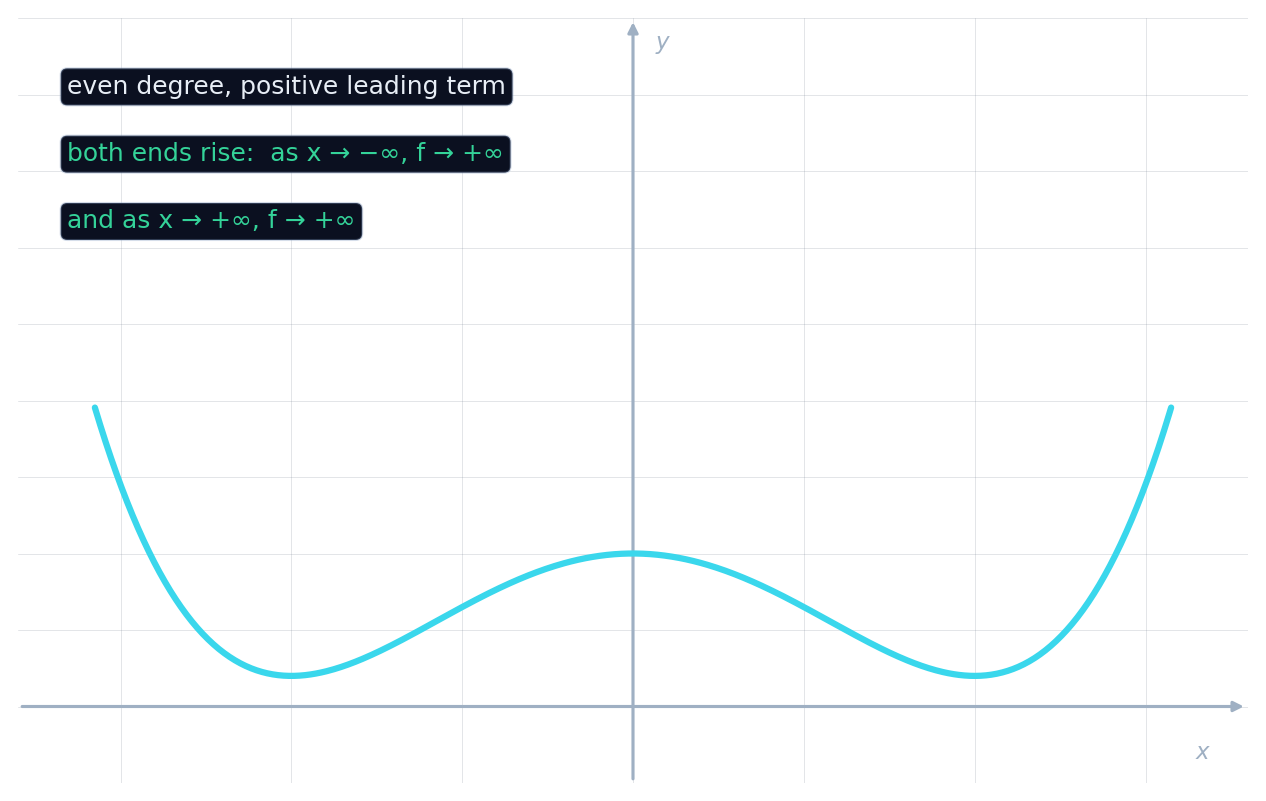
- The degree 次数 (even or odd) decides whether the two ends match or oppose.
- Even degree → both ends point the same way. Odd degree → ends point opposite ways.
- The leading coefficient 首项系数 (its sign) then decides up or down.
- Positive lead → the right end rises; negative lead → the right end falls.
次数与首项系数决定一切
- 次数(degree)(偶或奇)决定两端是相同还是相反。
- 偶数次 → 两端方向相同。奇数次 → 两端方向相反。
- 首项系数(leading coefficient)(的正负号)再决定向上还是向下。
- 正首项 → 右端上升;负首项 → 右端下降。
Flip the leading coefficient and watch the ends flip · 翻转首项系数,看两端跟着翻转
y = ax³ + bx² + cx + d
This is an odd-degree curve, so its ends point opposite ways. Make a negative and both ends swap direction. · 这是一条奇数次曲线,两端方向相反。把 a 变为负数,两端就会互换方向。
An odd-degree polynomial with a positive · positive(实证性) leading coefficient… · 一个奇数次、正首项系数的多项式……
Odd degree makes the ends point opposite ways; a positive lead sends the right end up (and so the left end down). · 奇数次让两端方向相反;正的首项让右端向上(于是左端向下)。
An even-degree polynomial with a negative · 负形 leading coefficient… · 一个偶数次、负首项系数的多项式……
Even degree makes the ends point the same · 相同 way; a negative lead sends both ends down. · 偶数次让两端方向相同;负的首项让两端都向下。
Which features decide a polynomial's end behavior? · 哪些特征决定一个多项式的末端行为?
Only the degree and the leading coefficient's sign matter for the ends; the constant and term-count do not. · 只有次数和首项系数的正负号影响两端;常数项和项数都无关。
Match each polynomial type to its end behavior. · 把每种多项式与它的末端行为配对。
Odd degree → opposite ends; even degree → matching ends. The lead sign then picks up-or-down. · 奇数次 → 两端相反;偶数次 → 两端相同。首项的正负再决定向上还是向下。
Writing it with limits
- Mathematicians record end behavior with limit notation.
- "The right end rises" is written $\lim_{x \to \infty} f(x) = \infty$.
- "The left end falls" is written $\lim_{x \to -\infty} f(x) = -\infty$.
- It is a compact way to say exactly where each end goes.
用极限来写
- 数学家用极限记号来记录末端行为。
- "右端上升"写作 $\lim_{x \to \infty} f(x) = \infty$。
- "左端下降"写作 $\lim_{x \to -\infty} f(x) = -\infty$。
- 这是一种简洁的方式,精确地说出每一端的去向。
Why the leading term wins
- Far from the origin, the highest-power term grows far faster than all the others.
- In $x^3 - 100x$, at $x = 1000$ the $x^3$ term is a billion while $100x$ is only a hundred thousand.
- So the leading term 首项 alone controls the end behavior — the rest becomes noise.
- That is why you never need the small terms to sketch the ends.
为什么首项获胜
- 在远离原点处,最高次的项增长得远远快于所有其他项。
- 在 $x^3 - 100x$ 中,当 $x = 1000$ 时,$x^3$ 项是十亿,而 $100x$ 只有十万。
- 所以单单首项(leading term)就控制了末端行为——其余的都成了噪音。
- 这就是为什么你从不需要那些小项来勾画两端。
For inputs of large magnitude, the ____ term dominates the value of a polynomial. · 对于绝对值很大的输入,____项主宰着多项式的值。
The highest-power (leading) term grows fastest, so it swamps all the others far from the origin. · 最高次的(首)项增长最快,所以在远离原点处它压过所有其他项。
End behavior depends only on the degree and the sign of the leading coefficient — never on the constant term or how many terms there are. A degree-5 polynomial and $x^5$ have identical end behavior, however messy the middle looks.
末端行为只取决于次数和首项系数的正负号——绝不取决于常数项或有多少项。一个五次多项式和 $x^5$ 有完全相同的末端行为,无论中间看起来多乱。
Describe the ends of $f(x) = -2x^4 + x^3 + 5$.
- Degree $4$ is even → both ends point the same way.
- Leading coefficient $-2$ is negative → both ends point down.
- So $\lim_{x \to \pm\infty} f(x) = -\infty$: the graph falls on both sides.
描述 $f(x) = -2x^4 + x^3 + 5$ 的两端。
- 次数 $4$ 是偶数 → 两端方向相同。
- 首项系数 $-2$ 是负的 → 两端都向下。
- 所以 $\lim_{x \to \pm\infty} f(x) = -\infty$:图像两侧都下降。
End behavior is set by two things: the degree (even → matching ends, odd → opposite ends) and the sign of the leading coefficient (up or down). Far out, the leading term dominates every other term, so only these two facts matter.
末端行为由两件事决定:次数(偶 → 两端相同,奇 → 两端相反)和首项系数的正负号(向上或向下)。在远处,首项压过其他所有项,所以只有这两个事实重要。