Circuits with Capacitors and Inductors (LC Circuits) · 含电容和电感的电路(LC电路)
| English | 中文 | Pinyin · 拼音 |
|---|---|---|
| oscillate/ˈɒsɪleɪt/ | 振荡 | zhèn dàng |
| resonance/ˈrezənəns/ | 共振 | gòng zhèn |
Energy sloshing back and forth — an electrical pendulum
- Charge a capacitor, connect it to an inductor, and something surprising happens.
- The energy doesn't just drain away — it swings back and forth.
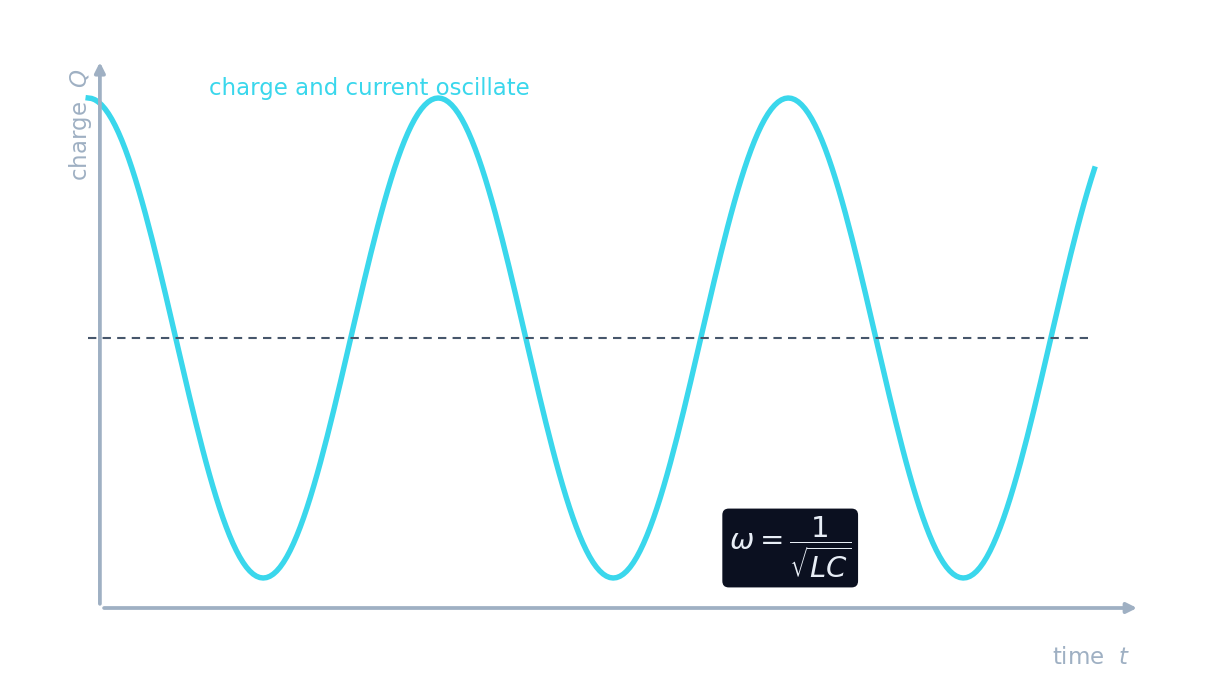
- The charge and current oscillate 振荡, like a pendulum swinging.
- A capacitor and inductor together make an LC circuit — the heart of a radio.
能量来回晃荡——一个电学摆
- 给电容器充电,把它连到电感器,某种令人惊讶的事发生了。
- 能量不只是流走——它来回摆动。
- 电荷和电流振荡,像摆在摆动。
- 电容器和电感器合在一起构成一个 LC 电路——收音机的核心。
Energy trades between C and L
- The capacitor starts full: all the energy is in its electric field.
- It discharges through the inductor, driving a current.
- Now the energy is in the inductor's magnetic field.
- The inductor keeps the current going, recharging the capacitor the other way — and it repeats.
能量在 C 和 L 之间往返
- 电容器起初满的:所有能量都在它的电场里。
- 它通过电感器放电,驱动一个电流。
- 现在能量在电感器的磁场里。
- 电感器让电流继续,把电容器往反方向重新充电——然后重复。
In an LC circuit, energy trades between: · 在LC电路中,能量在:之间交换
Energy sloshes between the capacitor's E field and the inductor's B field. · 能量在电容器的E场和电感器的B场之间来回振荡。
The oscillation frequency
- The charge swings sinusoidally at angular frequency $\omega = \dfrac{1}{\sqrt{LC}}$.
- A bigger $L$ or $C$ means slower oscillation (a lower frequency).
- With no resistance the oscillation, in principle, never dies out.
- The current is largest just as the capacitor is empty, and vice versa.
振荡频率
- 电荷以角频率 $\omega = \dfrac{1}{\sqrt{LC}}$ 正弦地摆动。
- 更大的 $L$ 或 $C$ 意味着更慢的振荡(更低的频率)。
- 没有电阻时,振荡原则上永不停息。
- 电流在电容器恰好为空时最大,反之亦然。
The angular frequency of an LC circuit is: · LC电路的角频率为:
$\omega = 1/\sqrt{LC}$ sets the oscillation rate. · $\omega = 1/\sqrt{LC}$决定了振荡速率。
An LC circuit has $L = 4\ \text{H}$ and $C = 1\ \text{F}$. Find $\omega$ (in rad/s). · LC电路具有$L = 4\ \text{H}$和$C = 1\ \text{F}$。求$\omega$(单位rad/s)。
$\omega = 1/\sqrt{LC} = 1/\sqrt{4} = 0.5\ \text{rad/s}$.
Just like a mass on a spring
- The LC circuit is the exact electrical twin of a mass–spring oscillator.
- Charge $Q$ plays the role of position; current $I$ plays the role of velocity.
- Inductance $L$ is like mass (inertia); $1/C$ is like the spring constant.
- Both obey the same equation, so both give simple harmonic motion.
就像弹簧上的物块
- LC 电路是弹簧-物块振子的精确电学孪生。
- 电荷 $Q$ 扮演位置的角色;电流 $I$ 扮演速度的角色。
- 电感 $L$ 像质量(惯性);$1/C$ 像弹簧劲度系数。
- 两者遵循相同的方程,所以都给出简谐运动。
LC circuit oscillations · LC电路振荡
In an LC circuit energy sloshes between the capacitor and the inductor - the electrical version of simple harmonic motion. · 在LC电路中,能量在电容器和电感之间来回转移——这是简谐运动的电学版本。
An LC circuit is the electrical analogue of a mass oscillating on a spring. · LC电路是质量在弹簧上振动的电学类比。
Charge ~ position, current ~ velocity, L ~ mass, 1/C ~ spring constant. · 电荷 ~ 位置,电流 ~ 速度,L ~ 质量,1/C ~ 弹簧劲度系数。
Select all · 所有 true statements about LC circuits. · 选出关于LC电路的所有正确陈述。
Oscillation, ω = 1/√(LC), SHM analogy. An ideal LC loses no energy — it just swaps. · 振荡,ω = 1/√(LC),简谐运动类比。理想LC电路不损耗能量——只是交换。
Why it matters: tuning a radio
- Every radio station broadcasts at its own frequency.
- An LC circuit resonates 共振 strongly at $\omega = 1/\sqrt{LC}$ and ignores the rest.
- Turning the tuning dial changes $C$, shifting which station you pick up.
- LC resonance is how a receiver plucks one signal from the air.
为什么它重要:调谐收音机
- 每个电台以它自己的频率广播。
- LC 电路在 $\omega = 1/\sqrt{LC}$ 处强烈共振,并忽略其余的。
- 转动调谐旋钮改变 $C$,移动你收到哪个电台。
- LC 共振就是接收机如何从空中挑出一个信号。
A radio uses an LC circuit's strong ____ at one frequency to pick a station. · 收音机利用LC电路在某一频率下的强烈____来选台。
LC resonance at $\omega = 1/\sqrt{LC}$ selects one station. · LC共振在$\omega = 1/\sqrt{LC}$处选择电台。
An LC circuit has $L = 1\ \text{H}$ and $C = 0.25\ \text{F}$. Find its angular frequency.
- $\omega = \dfrac{1}{\sqrt{LC}} = \dfrac{1}{\sqrt{1 \times 0.25}} = \dfrac{1}{0.5}$.
- $\omega = 2\ \text{rad/s}$.
一个 LC 电路 $L = 1\ \text{H}$,$C = 0.25\ \text{F}$。求它的角频率。
- $\omega = \dfrac{1}{\sqrt{LC}} = \dfrac{1}{\sqrt{1 \times 0.25}} = \dfrac{1}{0.5}$。
- $\omega = 2\ \text{rad/s}$。
In an ideal LC circuit the energy is never lost — it just swaps between the capacitor and inductor forever. The current is largest when the capacitor is empty (all magnetic energy), not when it is full. Line up energy and charge carefully.
在理想 LC 电路中,能量从不损失——它只在电容器和电感器之间永远交换。电流在电容器为空时(全是磁能)最大,而不是在它满的时候。仔细对齐能量和电荷。
An LC circuit oscillates as energy trades between the capacitor's electric field and the inductor's magnetic field, at $\omega = 1/\sqrt{LC}$. It is the electrical twin of a mass on a spring (SHM), and its resonance is how a radio tunes to one station.
LC 电路振荡,能量在电容器的电场和电感器的磁场之间往返,频率 $\omega = 1/\sqrt{LC}$。它是弹簧上物块(简谐运动)的电学孪生,它的共振就是收音机如何调到一个电台。