Electromagnetic Induction · 电磁感应
| English | 中文 | Pinyin · 拼音 |
|---|---|---|
| electromagnetic induction/ɪˌlektrəʊməɡˈnetɪk ɪnˈdʌkʃn/ | 电磁感应 | diàn cí gǎn yìng |
| Faraday's law/ˈfærədeɪz lɔː/ | 法拉第定律 | fǎ lā dì dìng lǜ |
Move a magnet near a coil and you make electricity from nothing
- Push a magnet into a coil and a current appears — with no battery.
- Pull it out and the current reverses.
- A changing magnetic flux drives the current: electromagnetic induction 电磁感应.
- This single effect powers almost every generator on Earth.
把磁体移近线圈,你就凭空造出电
- 把磁体推进线圈,一个电流就出现了——不用电池。
- 把它拉出来,电流反向。
- 一个变化的磁通量驱动这个电流:电磁感应。
- 这一个效应为地球上几乎每一台发电机提供动力。
Faraday's law
- The induced EMF equals how fast the flux changes: $\varepsilon = -N\dfrac{d\Phi_B}{dt}$.
- $N$ is the number of turns; the faster $\Phi_B$ changes, the bigger the EMF.
- A steady flux ($d\Phi_B/dt = 0$) induces nothing.
- This is Faraday's law 法拉第定律 — the heart of the unit.
法拉第定律
- 感应电动势等于通量变化的快慢:$\varepsilon = -N\dfrac{d\Phi_B}{dt}$。
- $N$ 是匝数;$\Phi_B$ 变化得越快,电动势越大。
- 稳定的通量($d\Phi_B/dt = 0$)感应出零。
- 这就是法拉第定律——本单元的核心。
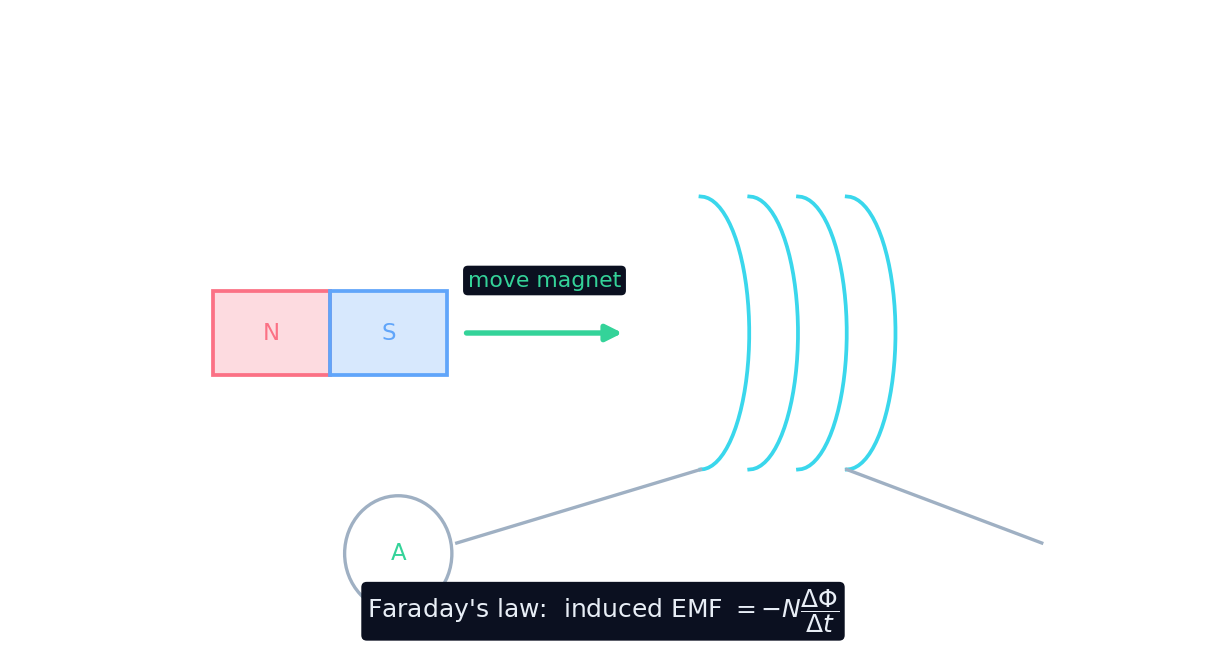
Induce a current · 感应电流
Move the magnet faster or slower and watch the induced current grow and reverse. · 加快或减慢移动磁铁的速度,观察感应电流增大并反向。
Faraday's law says the induced EMF depends on: · 法拉第定律指出感应电动势取决于:
$\varepsilon = -N\,d\Phi_B/dt$ — the rate of change of flux. · $\varepsilon = -N\,d\Phi_B/dt$ — 即磁通量的变化率。
A coil in a strong but steady magnetic field has zero induced EMF. · 处于强但恒定磁场中的线圈感应电动势为零。
No change in flux means no induced EMF, however strong the field. · 磁通量无变化则无感应电动势,无论场有多强。
A single loop's flux changes by $0.6\ \text{Wb}$ in · 入 $0.3\ \text{s}$. Find the average EMF (in V). · 单匝线圈的磁通量变化了 $0.6\ \text{Wb}$ 在 $0.3\ \text{s}$。求平均电动势(单位:V)。
$\varepsilon = \Delta\Phi_B/\Delta t = 0.6/0.3 = 2\ \text{V}$.
What makes a bigger EMF
- More turns $N$ in the coil — each loop adds its own EMF.
- A stronger magnet — more flux to change.
- A faster motion — a quicker change of flux.
- Slow, weak, or few-turn setups give only a tiny EMF.
什么造就更大的电动势
- 线圈里更多的匝数 $N$——每个回路加上自己的电动势。
- 更强的磁体——更多可变的通量。
- 更快的运动——通量变化更迅速。
- 慢的、弱的或匝数少的装置只给出微小的电动势。
Select all · 所有 the ways to get a bigger induced EMF. · 选择获得更大感应电动势的所有方法。
More turns, faster motion, stronger field all raise the EMF. Holding still gives zero. · 更多匝数、更快运动、更强磁场都会提高电动势。静止不动则电动势为零。
Many ways to change the flux
- Move a magnet toward or away from the coil.
- Move the coil through a field.
- Rotate the coil in the field (this makes AC generators work).
- Change a nearby current, whose field threads the coil.
改变通量的许多方式
- 移动磁体靠近或远离线圈。
- 移动线圈穿过一个场。
- 在场中旋转线圈(这让交流发电机工作)。
- 改变邻近的电流,它的场穿过线圈。
Which of these does not · 不 induce an EMF in a coil? · 以下哪项不会在线圈中感应出电动势?
A steady field with no motion gives no flux change — no EMF. · 恒定场且无运动意味着无磁通量变化——无电动势。
This is how generators work
- Spin a coil in a magnetic field and its flux changes continuously.
- That induces an alternating EMF — the mains electricity in your home.
- Wind, water, and steam turbines all just spin such coils.
- Induction turns motion into electrical energy.
发电机就是这样工作的
- 在磁场中旋转线圈,它的通量连续变化。
- 那感应出交变电动势——你家里的市电。
- 风力、水力和蒸汽涡轮都只是旋转这样的线圈。
- 感应把运动变成电能。
A device that spins a coil in a field to make electricity is a . · 一种在磁场中旋转线圈以发电的装置是。
A generator uses induction to turn motion into electricity. · 发电机利用感应原理将机械运动转化为电能。
A single loop's flux changes by $0.4\ \text{Wb}$ in $0.2\ \text{s}$. Find the average EMF.
- $\varepsilon = \dfrac{\Delta\Phi_B}{\Delta t} = \dfrac{0.4}{0.2}$.
- $\varepsilon = 2\ \text{V}$ (magnitude).
单个回路的通量在 $0.2\ \text{s}$ 内变化 $0.4\ \text{Wb}$。求平均电动势。
- $\varepsilon = \dfrac{\Delta\Phi_B}{\Delta t} = \dfrac{0.4}{0.2}$。
- $\varepsilon = 2\ \text{V}$(大小)。
It is the rate of change of flux that matters, not the flux itself. A coil sitting in a huge but steady field has a large flux and yet zero induced EMF. No change, no EMF.
重要的是通量的变化率,不是通量本身。一个待在巨大但稳定场中的线圈有很大的通量,却有零感应电动势。没有变化,就没有电动势。
Electromagnetic induction: a changing magnetic flux drives an EMF, given by Faraday's law $\varepsilon = -N\,d\Phi_B/dt$. A bigger EMF comes from more turns, a stronger field, or faster change. A steady flux induces nothing — this is how generators make electricity.
电磁感应:变化的磁通量驱动电动势,由法拉第定律 $\varepsilon = -N\,d\Phi_B/dt$ 给出。更大的电动势来自更多匝数、更强的场或更快的变化。稳定的通量感应出零——发电机就是这样发电的。