Magnetic Fields of Current-Carrying Wires and the Biot-Savart Law · 载流导线的磁场与毕奥-萨伐尔定律
| English | 中文 | Pinyin · 拼音 |
|---|---|---|
| permeability/ˌpɜːməˈbɪlɪti/ | 磁导率 | cí dǎo lǜ |
| Biot–Savart law/ˈbɪɒt ˈsævɑːt lɔː/ | 毕奥-萨伐尔定律 | bì ào - sà fá ěr dìng lǜ |
| solenoid/ˈsəʊlənɔɪd/ | 螺线管 | luó xiàn guǎn |
A wire carrying current becomes a magnet
- In 1820 Oersted saw a compass twitch beside a live wire.
- A moving charge — a current — makes its own magnetic field.
- So electricity and magnetism are two sides of one thing.
- This lesson finds the field a current creates.
通电的导线变成一块磁体
- 1820 年,奥斯特看到一根通电导线旁的指南针抖动。
- 一个移动的电荷——一个电流——产生它自己的磁场。
- 所以电和磁是同一件事的两面。
- 这一课求出电流产生的场。
A current-carrying wire produces its own magnetic field. · 载流导线会产生自身的磁场。
Oersted showed a current deflects a compass — it makes a field. · 奥斯特展示了电流能使指南针偏转——这说明它产生了磁场。
The field circles a straight wire
- Around a long straight wire the field forms circles: $B = \dfrac{\mu_0 I}{2\pi r}$.
- $\mu_0$ is the permeability 磁导率 of free space.
- The field is stronger near the wire and fades as $1/r$.
- Point your right thumb along the current; your fingers curl the way $\vec B$ goes.
场绕着直导线成圈
- 在长直导线周围,场形成圆圈:$B = \dfrac{\mu_0 I}{2\pi r}$。
- $\mu_0$ 是真空的磁导率。
- 场在导线附近更强,随 $1/r$ 减弱。
- 用右手拇指沿电流方向;手指弯曲的方向就是 $\vec B$ 的走向。
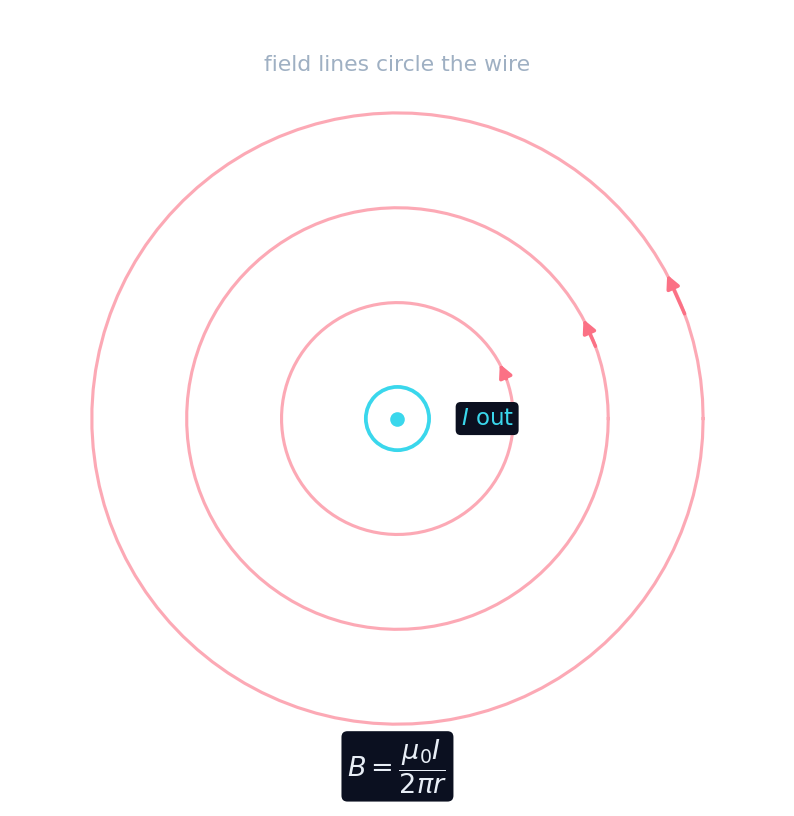
The magnetic field around a long straight wire forms: · 长直导线周围的磁场形成:
Field lines circle the wire; $B = \mu_0 I/2\pi r$. · 磁感线环绕导线;$B = \mu_0 I/2\pi r$。
The straight-wire field strength falls off with distance as: · 直导线磁场强度随距离衰减如下:
$B = \mu_0 I/2\pi r$ — a $1/r$ falloff. · $B = \mu_0 I/2\pi r$ — 呈$1/r$衰减。
A wire carries $10\ \text{A}$. At $r = 0.2\ \text{m}$, $B = \mu_0 I/2\pi r$ with $\mu_0 = 4\pi\times10^{-7}$. Find $B$ (in μT). · 一根导线承载$10\ \text{A}$。在$r = 0.2\ \text{m}$处,$B = \mu_0 I/2\pi r$,其中$\mu_0 = 4\pi\times10^{-7}$。求$B$(单位μT)。
$B = \dfrac{(4\pi\times10^{-7})(10)}{2\pi(0.2)} = 1\times10^{-5}\ \text{T} = 10\ \mu\text{T}$.
The Biot–Savart law
- To find the field from any shape, add up tiny current bits.
- Each element $I\,d\vec\ell$ makes a small field $d\vec B$ — the Biot–Savart law 毕奥-萨伐尔定律.
- It falls off as $1/r^2$ from each element, like Coulomb's law.
- Integrate over the whole wire to get the total field.
毕奥-萨伐尔定律
- 要求出任意形状产生的场,把许多微小电流段加起来。
- 每个元 $I\,d\vec\ell$ 产生一小份场 $d\vec B$——这就是毕奥-萨伐尔定律。
- 它从每个元随 $1/r^2$ 减弱,就像库仑定律。
- 对整根导线积分得到总场。
Loops and solenoids concentrate the field
- Bend the wire into a loop and the field lines gather through its centre.
- Stack many loops into a solenoid 螺线管 and the inside field becomes strong and uniform.
- A solenoid behaves just like a bar magnet, with N and S ends.
- More turns or more current makes a stronger electromagnet.
线圈与螺线管把场集中
- 把导线弯成一个环,磁感线就穿过它的中心聚集。
- 把许多环叠成一个螺线管,内部的场变得又强又均匀。
- 螺线管的行为就像一块条形磁体,有 N 和 S 两端。
- 更多的匝数或更大的电流造出更强的电磁铁。
Magnetic field of a wire · 直导线的磁场
The magnetic field around a long straight wire weakens as one over the distance from it. · 长直导线周围的磁场随距离的增加而减弱,呈反比关系。
Many current loops stacked together form a , which acts like a bar magnet. · 许多电流环堆叠在一起形成,其作用如同条形磁铁。
A solenoid concentrates the field into a strong, uniform interior. · 螺线管将磁场集中在内部,形成强且均匀的磁场。
Select all · 所有 true statements about a current's magnetic field. · 选择关于电流磁场的所有正确陈述。
Circular lines, Biot–Savart integration, solenoid = bar magnet. The field wraps around, not outward. · 圆形磁感线、毕奥-萨伐尔积分、螺线管=条形磁铁。磁场是环绕的,而非向外辐射。
Fields add as vectors
- When several currents are near, their fields superpose.
- Add the $\vec B$ vectors from each source at the point of interest.
- Two parallel wires can reinforce or cancel between them.
- This superposition is how we build up any real field.
场按矢量相加
- 当几个电流靠近时,它们的场叠加。
- 在关注点把每个源的 $\vec B$ 矢量相加。
- 两根平行导线之间可以相互增强或抵消。
- 这种叠加就是我们如何建立起任何真实的场。
Find the field $0.1\ \text{m}$ from a wire carrying $5\ \text{A}$. ($\mu_0 = 4\pi\times10^{-7}$.)
- $B = \dfrac{\mu_0 I}{2\pi r} = \dfrac{(4\pi\times10^{-7})(5)}{2\pi(0.1)}$.
- $B = 1\times10^{-5}\ \text{T}$, circling the wire.
求距一根携带 $5\ \text{A}$ 的导线 $0.1\ \text{m}$ 处的场。($\mu_0 = 4\pi\times10^{-7}$。)
- $B = \dfrac{\mu_0 I}{2\pi r} = \dfrac{(4\pi\times10^{-7})(5)}{2\pi(0.1)}$。
- $B = 1\times10^{-5}\ \text{T}$,绕着导线成圈。
The straight-wire field falls off as $1/r$ (not $1/r^2$), and it wraps around the wire rather than pointing away from it. Don't picture magnetic field lines shooting outward like electric field lines from a charge — they form closed circles.
直导线的场随 $1/r$(不是 $1/r^2$)减弱,而且它绕着导线缠绕,而不是从它指向外。别把磁感线想象成像电荷的电场线那样向外射出——它们形成闭合的圆圈。
A current makes a magnetic field: a straight wire gives circular lines with $B = \mu_0 I / 2\pi r$ (right-hand grip, permeability $\mu_0$). The Biot–Savart law adds up each current element; solenoids concentrate the field into a bar-magnet shape. Fields superpose.
电流产生磁场:直导线给出圆形磁感线 $B = \mu_0 I / 2\pi r$(右手握法,磁导率 $\mu_0$)。毕奥-萨伐尔定律把每个电流元加起来;螺线管把场集中成条形磁体的形状。场叠加。