Electric Charge and the Process of Charging · 电荷与起电过程
| English | 中文 | Pinyin · 拼音 |
|---|---|---|
| electrons/ɪˈlektrɒnz/ | 电子 | diàn zi |
| insulators/ˈɪnsjuːleɪtəz/ | 绝缘体 | jué yuán tǐ |
| conductor/kənˈdʌktə/ | 导体 | dǎo tǐ |
| polarises/ˈpəʊləraɪzɪz/ | 极化 | jí huà |
| ground/ɡraʊnd/ | 接地 | jiē dì |
| conservation of charge/ˌkɒnsəˈveɪʃn ɒv tʃɑːdʒ/ | 电荷守恒 | diàn hè shǒu héng |
Three ways to move charge — none of them make new charge
- You can charge an object, but you never create charge.
- Charging just moves electrons 电子 from one place to another.
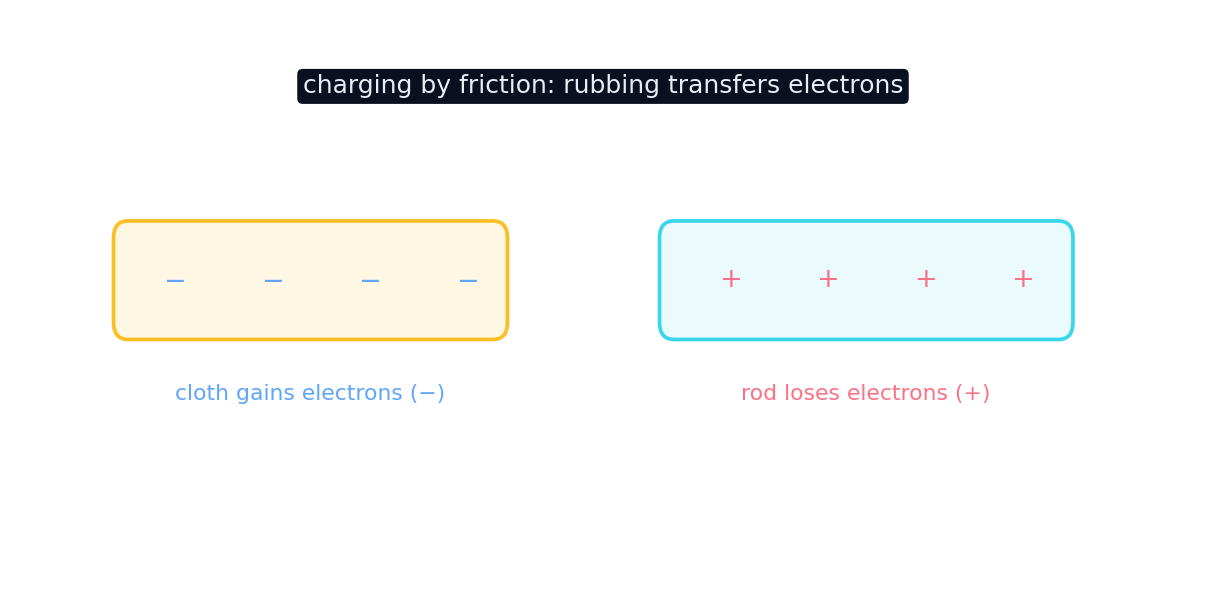
- One object gains electrons (goes negative); the other loses them (goes positive).
- There are three ways to do it: friction, conduction, and induction.
让电荷移动的三种方式——都不产生新电荷
- 你可以给物体充电,但你从不产生电荷。
- 起电只是把电子从一个地方移到另一个地方。
- 一个物体得到电子(变负);另一个失去电子(变正)。
- 有三种做法:摩擦、传导和感应。
When you charge an object, what actually moves? · 当你给物体充电时,实际移动的是什么?
Charging moves electrons; protons stay locked in the nuclei. · 起电移动的是电子;质子被锁定在原子核内。
Charging by friction
- Rub two different materials together and electrons rub off one onto the other.
- The material that grabs electrons becomes negative; the other becomes positive.
- This works best on insulators 绝缘体 like plastic or hair.
- The charge stays put where it was rubbed — insulators don't let it flow.
摩擦起电
- 把两种不同材料互相摩擦,电子就从一个上蹭到另一个上。
- 抓住电子的材料变负;另一个变正。
- 这在塑料或头发这类绝缘体上效果最好。
- 电荷停留在被摩擦处——绝缘体不让它流动。
Rub and charge · 摩擦起电
Rub the materials and watch electrons transfer, leaving equal and opposite charges. · 摩擦材料并观察电子转移,产生等量异种电荷。
A material that does not let charge flow through it is called an . · 不允许电荷通过的物质称为。
Insulators (plastic, hair, glass) hold charge where it is placed. · 绝缘体(塑料、头发、玻璃)使电荷停留在放置的位置。
Charging by conduction
- Touch a charged object to a neutral conductor 导体 and charge flows across.
- They share the charge, so both end up with the same sign.
- Conductors let charge move freely, so it spreads over the surface.
- Break contact and the conductor keeps its share.
传导起电
- 让带电物体接触中性导体,电荷就流过去。
- 它们分享电荷,所以两者最终同号。
- 导体让电荷自由移动,于是电荷铺展在表面上。
- 断开接触,导体保留它分到的那份。
Charging by conduction (direct contact) leaves the object with the same sign as the source. · 传导起电(直接接触)使物体带有与源相同的电荷符号。
Contact shares charge, so both end with the same sign. · 接触共享电荷,因此两者最终带有相同符号。
Charging by induction
- Bring a charged rod near (not touching) a conductor.
- The rod's field pushes like charges away and pulls opposite charges near — the conductor polarises 极化.
- Now ground 接地 the far side: unwanted charge escapes to the earth.
- Remove the ground, then the rod — the conductor keeps the opposite sign.
感应起电
- 把带电棒靠近(不接触)导体。
- 棒的场把同种电荷推开、把异种电荷拉近——导体发生极化。
- 现在把远端接地:不需要的电荷跑到大地里。
- 移走接地,再移走棒——导体保留相反的符号。
A positive rod charges a sphere by induction (with grounding). The sphere ends up: · 带正电的棒通过感应(接地)使球体带电。球体最终带有:
Induction leaves the opposite sign — a positive rod leaves a negative sphere. · 感应产生异号电荷——正电棒使球体带负电。
Select all · 所有 correct statements about charging. · 选择关于起电的所有正确陈述。
Friction suits insulators, induction is contactless, conduction shares sign. Charging never creates charge. · 摩擦适合绝缘体,感应无接触,传导共享符号。起电从不创造电荷。
Charge is always conserved
- Add up the charge before and after: the total never changes.
- Electrons only move; they are not made or destroyed.
- This is the law of conservation of charge 电荷守恒.
- It holds for every charging method and every circuit.
电荷总是守恒
- 把充电前后的电荷加起来:总量从不改变。
- 电子只是移动;它们不被产生也不被消灭。
- 这就是电荷守恒定律。
- 它对每种起电方法、每个电路都成立。
The total charge before and after any charging process is the same — charge is ____. · 任何起电过程前后的总电荷保持不变——电荷是____的。
Charge is conserved; electrons only move. · 电荷守恒;只有电子移动。
You hold a negative rod near a metal sphere and ground the far side.
- The rod repels electrons to the far side, which then flow to ground.
- Remove the ground, then the rod: the sphere is left positive — opposite to the rod.
你把一根负棒靠近金属球,并把远端接地。
- 棒把电子排斥到远端,电子随后流入大地。
- 移走接地,再移走棒:球最终带正电——与棒相反。
Conduction leaves the same sign as the source; induction leaves the opposite sign. Mixing these up is the classic charging mistake — check whether the source actually touched the object.
传导留下与源相同的符号;感应留下相反的符号。混淆这两点是经典的起电错误——检查源到底有没有接触物体。
Charging moves electrons, never creates them. Friction and conduction leave the same sign as the source; induction (polarise, then ground) leaves the opposite sign. In every case, charge is conserved.
起电移动电子,从不产生电子。摩擦和传导留下与源相同的符号;感应(先极化,再接地)留下相反的符号。任何情况下,电荷都守恒。