Types of Radioactive Decay · 放射性衰变类型
| English | 中文 | Pinyin · 拼音 |
|---|---|---|
| alpha/ˈælfə/ | 阿尔法 | ā ěr fǎ |
| beta/ˈbiːtə/ | 贝塔 | bèi tǎ |
| gamma/ˈɡæmə/ | 伽马 | gā mǎ |
| half-life/hɑːf laɪf/ | 半衰期 | bàn shuāi qī |
Some atoms are unstable — and throw out particles to fix it
- A few kinds of atom have nuclei that are simply too unstable to last.
- To settle down, they decay, hurling out a particle or a burst of energy at random.
- The three flavours are alpha, beta and gamma radiation.
- Knowing which is which tells you how dangerous and how penetrating the radiation is.
有些原子不稳定——通过抛出粒子来自我修正
- 有几种原子的核就是太不稳定,无法维持。
- 为了安定下来,它们衰变,随机抛出一个粒子或一阵能量。
- 三种类型是阿尔法、贝塔和伽马辐射。
- 知道哪个是哪个,就告诉你这种辐射有多危险、穿透力有多强。
Alpha, beta, gamma
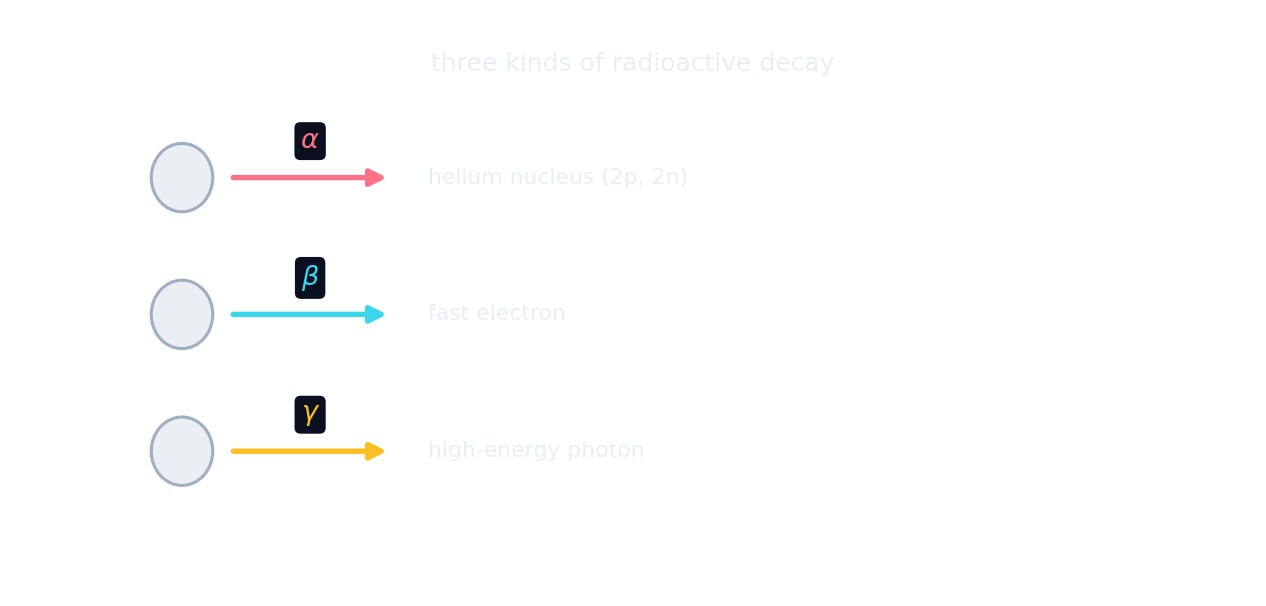
- Alpha 阿尔法 ($\alpha$) — a heavy helium nucleus (2 protons, 2 neutrons); slow and highly ionising.
- Beta 贝塔 ($\beta$) — a fast electron flung from the nucleus as a neutron turns into a proton.
- Gamma 伽马 ($\gamma$) — a burst of high-energy photon, no mass or charge, from a nucleus settling down.
- Each is emitted by an unstable nucleus trying to reach a stable state.
阿尔法、贝塔、伽马
- 阿尔法($\alpha$)——一个重的氦核(2 质子、2 中子);慢而高度电离。
- 贝塔($\beta$)——一个快速的电子,当中子变成质子时从核中甩出。
- 伽马($\gamma$)——一阵高能光子,无质量无电荷,来自安定下来的核。
- 每一种都由试图达到稳定态的不稳定核发出。
Balance a decay · 平衡衰变方程
Choose alpha, beta or gamma and see how the nucleus changes and the equation balances. · 选择α、β或γ,查看原子核如何变化以及方程如何平衡。
An alpha particle is: · α粒子是:
An alpha particle is a helium nucleus — 2 protons and 2 neutrons. · α粒子是氦原子核——2个质子和2个中子。
A beta particle is a fast ____ emitted from the nucleus. · β粒子是从原子核射出的快速 ____。
Beta decay flings out a fast electron as a neutron becomes a proton. · β衰变将快速电子抛出,此时中子变为质子。
Penetration and danger
- Alpha is stopped by paper or skin — but dangerous if swallowed (it ionises heavily).
- Beta passes through paper but is stopped by a few millimetres of aluminium.
- Gamma is the most penetrating, needing thick lead or concrete to reduce it.
- The most penetrating is the hardest to shield, but alpha does the most damage once inside.
穿透力与危险
- 阿尔法被纸或皮肤挡住——但若被吞下则危险(它强烈电离)。
- 贝塔穿过纸,但被几毫米的铝挡住。
- 伽马穿透力最强,需要厚铅或混凝土来削弱它。
- 穿透力最强的最难屏蔽,但阿尔法一旦进入体内破坏最大。
Which radiation is the most penetrating? · 哪种辐射穿透力最强?
Gamma is the most penetrating, needing thick lead or concrete to stop. · γ射线穿透力最强,需要厚铅或混凝土才能阻挡。
Select all · 所有 true statements about radioactive decay. · 选择关于放射性衰变的所有正确陈述。
Alpha = helium nucleus, stopped by skin; gamma = most penetrating. But alpha (not gamma) is the most damaging inside. · α=氦原子核,被皮肤阻挡;γ=穿透力最强。但α(而非γ)是在身体内部造成最大伤害的。
Half-life
- Radioactive decay is random, but on average a sample halves its activity in a fixed half-life 半衰期.
- After one half-life, half the unstable nuclei have decayed; after two, a quarter remain.
- Half-lives range from fractions of a second to billions of years.
- Carbon-dating and nuclear-waste storage both hinge on the half-life.
半衰期
- 放射性衰变是随机的,但平均而言一个样品在固定的半衰期内活度减半。
- 一个半衰期后,一半不稳定核已衰变;两个后,剩四分之一。
- 半衰期从几分之一秒到几十亿年不等。
- 碳定年和核废料储存都取决于半衰期。
A sample of $80$ unstable nuclei has a half-life of $2$ years. How many remain after $4$ years? · 一份含有 $80$ 个不稳定核素的样品半衰期为 $2$ 年。经过 $4$ 年后还剩多少?
$4$ years = two half-lives: $80 \to 40 \to 20$. · $4$ 年 = 两个半衰期:$80 \to 40 \to 20$。
Radioactive decay is random, but a sample halves its activity each half-life on average. · 放射性衰变是随机的,但样本的平均活性每经过一个半衰期减半。
Individual decays are random; the half-life is the average time to halve. · 个体衰变是随机的;半衰期是活性减半的平均时间。
The most penetrating radiation (gamma) is not the same as the most damaging inside the body. Gamma passes right through, so it often does less local damage; alpha, though stopped by skin, is the most ionising and most harmful if it gets inside you.
穿透力最强的辐射(伽马)与在体内破坏最大的不相同。伽马径直穿过,所以往往局部破坏较小;阿尔法虽被皮肤挡住,却是电离最强的,若进入你体内危害最大。
A radioactive sample has a half-life of $2$ years and starts with $80$ unstable nuclei. How many remain after $4$ years?
- $4$ years is two half-lives.
- After one: $40$; after two: $20$ nuclei remain.
一个放射性样品半衰期为 $2$ 年,开始有 $80$ 个不稳定核。$4$ 年后剩多少?
- $4$ 年是两个半衰期。
- 一个后:$40$;两个后:剩 $20$ 个核。
Unstable nuclei decay by emitting alpha (helium nucleus), beta (fast electron) or gamma (photon) radiation. Gamma is the most penetrating; alpha the most ionising (dangerous inside). Decay is random, but a sample halves its activity each half-life — the basis of carbon dating.
不稳定核通过发出阿尔法(氦核)、贝塔(快速电子)或伽马(光子)辐射而衰变。伽马穿透力最强;阿尔法电离最强(在体内危险)。衰变是随机的,但样品每个半衰期活度减半——碳定年的基础。