Compton Scattering · 康普顿散射
| English | 中文 | Pinyin · 拼音 |
|---|---|---|
| Compton scattering/ˈkɒmptn ˈskætərɪŋ/ | 康普顿散射 | kāng pǔ dùn sǎn shè |
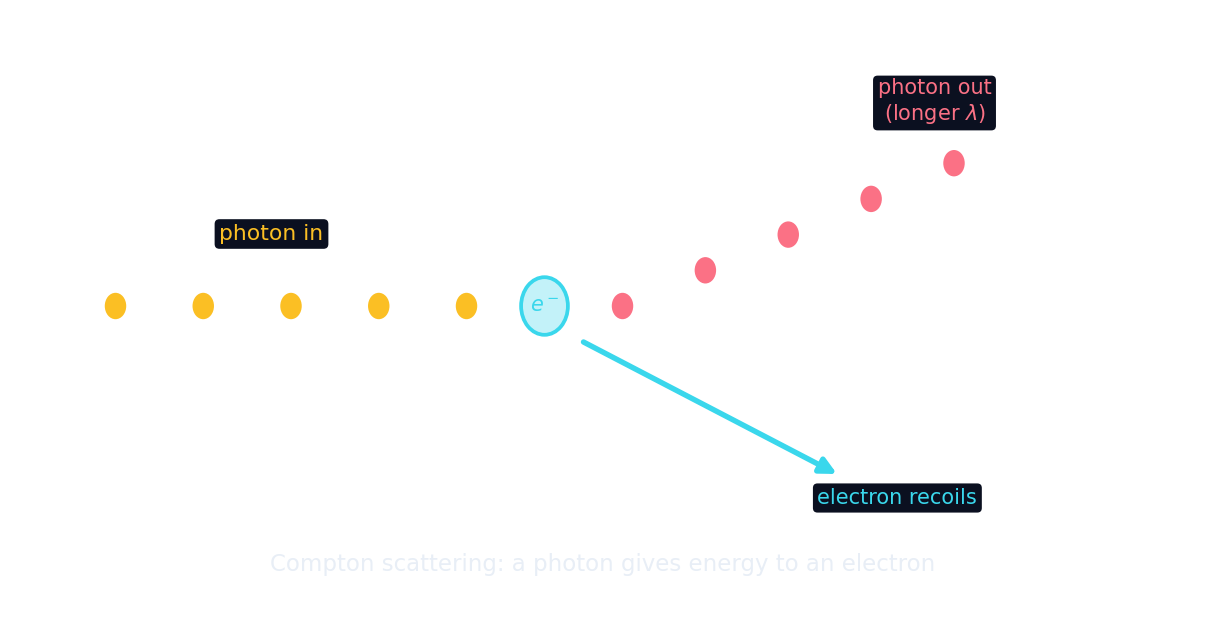
A photon bounces off an electron — like billiard balls
- Fire a high-energy photon at an electron and it bounces off, exactly like two balls colliding.
- The photon comes away with less energy; the electron recoils, taking the difference.
- This is Compton scattering 康普顿散射, and it clinched the case that light carries momentum.
- If a photon can collide like a ball, it must be a particle in every sense.
光子从电子上弹开——像台球一样
- 把高能光子射向电子,它会弹开,完全像两个球相撞。
- 光子带着更少的能量离开;电子反冲,带走这个差额。
- 这就是康普顿散射,它确证了光携带动量这一点。
- 如果光子能像球一样碰撞,它在各种意义上都必是粒子。
A photon has momentum
- A photon carries not just energy but also momentum: $p = \dfrac{h}{\lambda}$.
- In the collision, both energy and momentum are conserved — just like a normal collision.
- The photon transfers some of both to the electron, which recoils away.
- Treating the photon as a particle with momentum predicts the outcome exactly.
光子有动量
- 光子携带的不只是能量,还有动量:$p = \dfrac{h}{\lambda}$。
- 在碰撞中,能量和动量都守恒——就像普通碰撞。
- 光子把两者的一部分转移给电子,电子反冲离开。
- 把光子当作有动量的粒子,精确预测了结果。
A photon's momentum is given by: · 光子的动量由以下公式给出:
A photon carries momentum $p = h/\lambda$. · 光子携带动量 $p = h/\lambda$。
In Compton scattering, which quantities are conserved? · 在康普顿散射中,哪些量守恒?
It is a genuine collision — both energy and momentum are conserved. · 这是一个真正的碰撞——能量和动量均守恒。
The scattered photon is redder
- Since the photon gives energy to the electron, the scattered photon has less energy.
- Less energy means a lower frequency and a longer wavelength — a shift toward red.
- The bigger the scattering angle, the more energy is handed over.
- Measuring this wavelength shift confirmed the photon's momentum.
散射后的光子更红
- 因为光子把能量给了电子,散射后的光子有更少的能量。
- 更少的能量意味着更低的频率和更长的波长——向红移动。
- 散射角越大,交出的能量越多。
- 测量这个波长偏移证实了光子的动量。
After scattering off an electron, the photon's wavelength is: · 散射电子后,光子的波长为:
The photon loses energy to the electron, so its wavelength gets longer. · 光子将能量传递给电子,因此其波长变长。
A larger scattering angle means the photon transfers more energy to the electron. · 较大的散射角意味着光子向电子传递了更多能量。
The bigger the angle, the more energy (and momentum) is handed to the electron. · 角度越大,给予电子的能量(和动量)越多。
Why it mattered
- The photoelectric effect showed photons carry energy; Compton showed they carry momentum.
- Together they made the particle nature of light undeniable.
- The clean billiard-ball maths (conserving energy and momentum) only works if photons are real particles.
- Compton scattering is used today in gamma-ray astronomy and medical imaging.
它为何重要
- 光电效应显示光子携带能量;康普顿显示它们携带动量。
- 两者一起让光的粒子性无可否认。
- 干净的台球数学(守恒能量和动量)只有在光子是真实粒子时才成立。
- 康普顿散射今天被用于伽马射线天文学和医学成像。
Compton scattering · 康普顿散射
An X-ray photon collides with an electron. Sort each outcome. · X射线光子与电子碰撞。对每个结果进行分类。
Compton scattering shows that photons carry ____ as well as energy. · 康普顿散射表明光子除了能量外还携带 ____。
The collision only makes sense if photons carry momentum. · 只有在光子携带动量的情况下,碰撞才有意义。
Select all · 所有 true statements about Compton scattering. · 选择关于康普顿散射的所有正确陈述。
The photon loses energy (longer wavelength), and the collision conserves energy and momentum. It never gains energy. · 光子失去能量(波长变长),且碰撞中能量和动量守恒。它从不获得能量。
In Compton scattering the photon loses energy to the electron, so the scattered light has a longer wavelength (redder), not a shorter one. It is a genuine collision: both energy and momentum are conserved, exactly as for colliding balls.
在康普顿散射中,光子把能量给了电子,所以散射光的波长更长(更红),而非更短。这是一次真正的碰撞:能量和动量都守恒,正如相撞的球一样。
A photon scatters off a stationary electron. What happens to the photon's wavelength?
- The photon gives energy to the electron, so it leaves with less energy.
- Less energy means a longer wavelength — the scattered photon is shifted toward red.
一个光子从静止的电子上散射。光子的波长会怎样?
- 光子把能量给了电子,所以它带着更少的能量离开。
- 更少的能量意味着更长的波长——散射后的光子向红移动。
Compton scattering is a photon colliding with an electron like a billiard ball, conserving energy and momentum. The photon has momentum $p = h/\lambda$; after the collision it has less energy and a longer wavelength, and the electron recoils. It proved light carries momentum — confirming the photon particle.
康普顿散射是光子像台球一样与电子碰撞,守恒能量和动量。光子有动量 $p = h/\lambda$;碰撞后它有更少的能量和更长的波长,电子反冲。它证明了光携带动量——确证了光子粒子。