Refraction · 折射
| English | 中文 | Pinyin · 拼音 |
|---|---|---|
| refraction/rɪˈfrækʃn/ | 折射 | zhé shè |
| refractive index/rɪˈfræktɪv ˈɪndeks/ | 折射率 | zhé shè lǜ |
A straw in a glass looks snapped in half
- Drop a straw into a glass of water and it appears bent at the surface.
- The straw is fine — it's the light that bends as it crosses from water to air.
- Light changes direction when it moves between materials — refraction 折射.
- It happens because light travels at different speeds in different media.
玻璃杯里的吸管看起来断成了两半
- 把吸管放进一杯水里,它在水面处看起来弯了。
- 吸管好好的——是光在从水进入空气时拐了弯。
- 光在材料之间移动时改变方向——折射。
- 这是因为光在不同介质中以不同的速率传播。
Why light bends
- Light moves slower in a denser medium (glass, water) than in air.
- Entering a slower medium, a ray bends toward the normal; leaving it, away from the normal.
- The bending is set by each material's refractive index 折射率 $n$ (higher $n$ = slower light).
- Air is about $n = 1$; water $\approx 1.33$; glass $\approx 1.5$.
光为何拐弯
- 光在较密的介质(玻璃、水)中比在空气中移动得更慢。
- 进入较慢的介质,光线偏向法线;离开它时偏离法线。
- 拐弯的程度由每种材料的折射率 $n$ 决定($n$ 越高 = 光越慢)。
- 空气约 $n = 1$;水 $\approx 1.33$;玻璃 $\approx 1.5$。
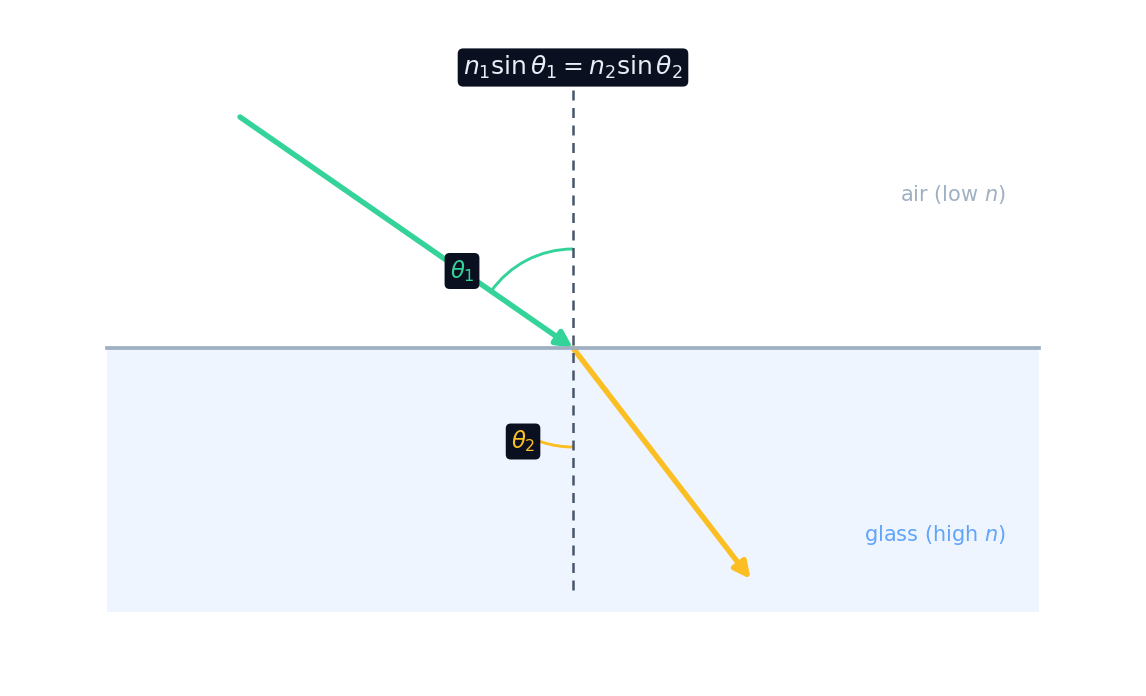
Bend a ray at a boundary · 在边界处弯曲光线
Change the angle and medium and watch the ray bend toward or away from the normal. · 改变角度和介质,观察光线向法线靠近或远离。
Entering a denser medium (like glass), a light ray bends: · 进入较密介质(如玻璃)时,光线弯曲:
Slower in a denser medium, the ray bends toward the normal. · 在较密介质中光速变慢,光线向法线弯曲。
The property $n$ that measures how much a material slows light is its . · 衡量材料减缓光程度的属性$n$是其。
A higher refractive index means light travels slower in that material. · 较高的折射率意味着光在该材料中传播较慢。
Snell's law
- The angles and indices are linked by Snell's law: $n_1\sin\theta_1 = n_2\sin\theta_2$.
- Angles are measured from the normal, as always in optics.
- Going into a denser medium ($n_2 > n_1$) makes $\theta_2 < \theta_1$ — the ray bends toward the normal.
- Snell's law predicts exactly how much a ray bends at any boundary.
斯涅尔定律
- 角度和折射率由斯涅尔定律联系:$n_1\sin\theta_1 = n_2\sin\theta_2$。
- 角度从法线量起,光学中一向如此。
- 进入较密介质($n_2 > n_1$)使 $\theta_2 < \theta_1$——光线偏向法线。
- 斯涅尔定律精确预测光线在任何边界上拐多少。
Light goes from air ($n_1 = 1$) into glass ($n_2 = 1.5$) at $\theta_1 = 30^\circ$ ($\sin 30^\circ = 0.5$). What is $\sin\theta_2$? (Give a decimal.) · 光从空气($n_1 = 1$)进入玻璃($n_2 = 1.5$),入射角为$\theta_1 = 30^\circ$($\sin 30^\circ = 0.5$)。求$\sin\theta_2$?(保留小数。)
$\sin\theta_2 = n_1\sin\theta_1 / n_2 = 0.5 / 1.5 = 0.33$.
Which expresses Snell's law? · 哪个表达式表示斯涅尔定律?
Snell's law: · 斯涅尔定律: $n_1\sin\theta_1 = n_2\sin\theta_2$. · 斯涅尔定律:$n_1\sin\theta_1 = n_2\sin\theta_2$。
Total internal reflection
- Going the other way (dense to less dense), the ray bends away from the normal.
- Past a critical angle, it can't escape at all and reflects entirely back inside.
- This total internal reflection traps light in optical fibres and sparkles in diamonds.
- It is refraction taken to its extreme — no light gets out.
全内反射
- 反过来走(从密到疏),光线偏离法线。
- 超过一个临界角,它根本无法逸出,完全反射回内部。
- 这种全内反射把光困在光纤里,并让钻石闪光。
- 它是折射走到极端——没有光逸出。
Past the critical angle, light going from glass to air is totally internally reflected. · 超过临界角时,光从玻璃射向空气会发生全内反射。
Beyond the critical angle the ray can't escape and reflects entirely — total internal reflection. · 超过临界角后,光线无法逃逸并完全反射——全内反射。
Select all · 所有 true statements about refraction. · 选择关于折射的所有正确陈述。
Refraction is a speed effect obeying Snell's law; a ray along the normal ($\theta = 0$) does not bend at all. · 折射是速度效应并遵循斯涅尔定律;沿法线入射的光线($\theta = 0$)完全不弯曲。
Refraction bends light because its speed changes between media — not because it "wants to". Light bends toward the normal entering a denser (slower, higher-$n$) medium, and away from it leaving one. A ray hitting the boundary straight along the normal ($\theta_1 = 0$) does not bend.
折射使光拐弯,是因为它的速率在介质之间改变——而非因为它"想"拐。光进入较密(更慢、$n$ 更高)的介质时偏向法线,离开时偏离法线。沿法线直打到边界($\theta_1 = 0$)的光线不拐弯。
Light passes from air ($n_1 = 1$) into glass ($n_2 = 1.5$) at $\theta_1 = 30^\circ$. Find $\sin\theta_2$.
- Snell: $1 \times \sin 30^\circ = 1.5 \times \sin\theta_2 \Rightarrow \sin\theta_2 = \dfrac{0.5}{1.5} = 0.33$.
Since $\sin\theta_2 < \sin\theta_1$, the ray bends toward the normal, as expected for a denser medium.
光以 $\theta_1 = 30^\circ$ 从空气($n_1 = 1$)进入玻璃($n_2 = 1.5$)。求 $\sin\theta_2$。
- 斯涅尔:$1 \times \sin 30^\circ = 1.5 \times \sin\theta_2 \Rightarrow \sin\theta_2 = \dfrac{0.5}{1.5} = 0.33$。
因为 $\sin\theta_2 < \sin\theta_1$,光线偏向法线,正如较密介质所预期的。
Refraction bends light at a boundary because its speed changes; it bends toward the normal entering a denser (higher-$n$) medium. Snell's law: $n_1\sin\theta_1 = n_2\sin\theta_2$. Past a critical angle, dense-to-rare light undergoes total internal reflection — the basis of optical fibres.
折射在边界处弯折光,是因为它的速率改变;进入较密($n$ 更高)介质时偏向法线。斯涅尔定律:$n_1\sin\theta_1 = n_2\sin\theta_2$。超过临界角,从密到疏的光发生全内反射——光纤的基础。