Magnetic Fields · 磁场
| English | 中文 | Pinyin · 拼音 |
|---|---|---|
| magnetic field/mæɡˈnetɪk fiːld/ | 磁场 | cí chǎng |
A compass needle always finds north
- Set a compass anywhere and its needle swings to point north, guided by something unseen.
- That something is a magnetic field 磁场 — Earth's, filling the space around it.
- Every magnet has one, reaching out invisibly to push and pull other magnets.
- Learning to picture it is the first step into all of magnetism.
罗盘的指针总能找到北方
- 把罗盘放在任何地方,它的指针都摆向北方,被某种看不见的东西引导。
- 那东西就是磁场——地球的磁场,充满它周围的空间。
- 每块磁铁都有磁场,无形地伸展开去,推拉其他磁铁。
- 学会想象它,是进入整个磁学的第一步。
Poles and forces
- Every magnet has a north pole and a south pole — they always come in pairs.
- Like poles repel; opposite poles attract — the magnetic version of the charge rule.
- You can never isolate a single pole: cut a magnet and each piece has both N and S.
- The poles are where the magnet's field is strongest.
磁极与磁力
- 每块磁铁都有一个北极和一个南极——它们总是成对出现。
- 同名极相斥;异名极相吸——电荷规则的磁学版本。
- 你永远无法孤立单个磁极:切开磁铁,每一块都同时有 N 和 S。
- 磁极是磁铁磁场最强的地方。
Magnets attract and repel · 磁铁吸引和排斥
Bring two magnets together and see whether they attract or repel and how the field looks. · 将两块磁铁靠近,观察它们是吸引还是排斥以及磁场外观。
Two north poles are brought together. They: · 两个北极被靠近。它们:
Like poles repel, just as like charges do. · 同名磁极相互排斥,就像同种电荷一样。
Magnetic poles always come in ____. · 磁极总是成____出现。
Every magnet has both a north and a south pole. · 每个磁体都有北极和南极。
Reading field lines
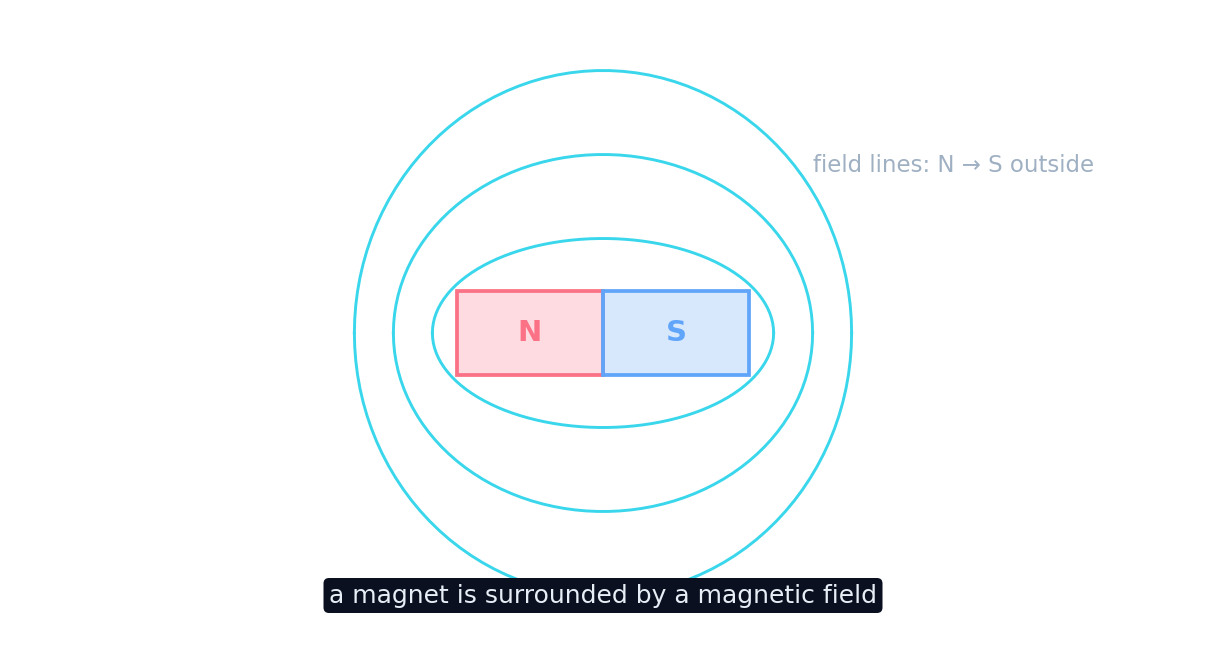
- Field lines show the field's direction — the way a compass north would point.
- Outside a magnet they run from the north pole to the south pole.
- Where lines are closer together, the field is stronger (near the poles).
- Lines never cross, and they always form closed loops.
读磁感线
- 磁感线显示磁场的方向——罗盘北极会指的方向。
- 在磁铁外部,它们从北极走向南极。
- 磁感线越靠近的地方,磁场越强(在磁极附近)。
- 磁感线绝不相交,并且总是形成闭合回路。
Outside a magnet, field lines point: · 在磁铁外部,磁感线指向:
Outside a magnet, field lines run from the north pole to the south pole. · 在磁铁外部,磁感线从北极指向南极。
Select all · 所有 true statements about magnetic field lines. · 选择关于磁感线的所有正确陈述。
Field lines run N → S, crowd near strong field, and never cross. They form closed loops, not single poles. · 磁感线从N极指向S极,在强场处密集且永不相交。它们形成闭合回路,而非始于或止于单个磁极。
Earth is a giant magnet
- Earth behaves like a huge bar magnet, which is why compasses work.
- Its field also shields us from harmful particles streaming from the Sun.
- Magnetic materials like iron can be magnetised to make their own field.
- The magnetic field, like the electric field, is a vector at every point.
地球是一块巨大的磁铁
- 地球表现得像一块巨大的条形磁铁,这就是罗盘能工作的原因。
- 它的磁场还保护我们免受来自太阳的有害粒子流。
- 铁这类磁性材料可以被磁化,产生自己的磁场。
- 磁场和电场一样,在每一点都是矢量。
You can cut a bar magnet to obtain a single, isolated north pole. · 你可以切割条形磁铁以获得一个单独的、孤立的北极。
Poles always come in pairs; each piece of a cut magnet has both N and S. · 磁极总是成对出现;切割后的每一块磁铁都有N和S两极。
Earth behaves like a giant bar magnet, which is why compasses work. · 地球表现得像一个巨大的条形磁体,这就是指南针能工作的原因。
Earth's magnetic field aligns compass needles toward the poles. · 地磁场使指南针的指针指向两极。
Magnetic poles always come in pairs — you can never have a lone north or south pole (unlike electric charge, where a single + or − exists). Cut a magnet in half and each half instantly has both an N and an S pole.
磁极总是成对出现——你永远不可能有一个孤立的北极或南极(不像电荷,单个 + 或 − 是存在的)。把磁铁切成两半,每一半立刻都有两个极,一个 N 一个 S。
You bring the north pole of one magnet near the north pole of another. What happens?
- Like poles repel, so the magnets push apart.
- Turn one around so N faces S, and they attract instead.
你把一块磁铁的北极靠近另一块磁铁的北极。会发生什么?
- 同名极相斥,所以两块磁铁推开。
- 把一块转过来,让 N 对着 S,它们就相吸了。
A magnetic field surrounds every magnet, with a north and south pole (always in pairs). Like poles repel, opposites attract. Field lines run N → S outside the magnet, are denser where the field is stronger, and never cross. Earth itself is a giant magnet.
磁场包围每块磁铁,有一个北极和一个南极(总是成对)。同名极相斥,异名极相吸。磁感线在磁铁外部从 N → S,场越强越密,且绝不相交。地球本身就是一块巨大的磁铁。