Kirchhoff's Junction Rule · 基尔霍夫节点定律
| English | 中文 | Pinyin · 拼音 |
|---|---|---|
| Kirchhoff's junction rule/ˈkɜːkhɒfs ˈdʒʌŋkʃn ruːl/ | 基尔霍夫节点定律 | jī ěr huò fū jié diǎn dìng lǜ |
A river splits — but not a drop is lost
- A river reaches a fork and splits into two streams; add the two flows and you get the original.
- At a wire junction, current splits the same way — and none of it vanishes.
- Whatever charge flows in must flow out — charge is never created or lost.
- This is Kirchhoff's junction rule 基尔霍夫节点定律, the partner of the loop rule.
河流分叉——但一滴也没丢
- 一条河到了岔口分成两股;把两股水流相加,就得到原来的量。
- 在导线的节点处,电流也这样分开——而且一点都不消失。
- 流进多少,就必须流出多少——电荷从不被创造或丢失。
- 这就是基尔霍夫电流定律,回路定律的搭档。
The junction rule
- At any junction (a point where wires meet), the current in equals the current out.
- In symbols: $\sum I_{\text{in}} = \sum I_{\text{out}}$.
- It is really conservation of charge — charge can't pile up at a point.
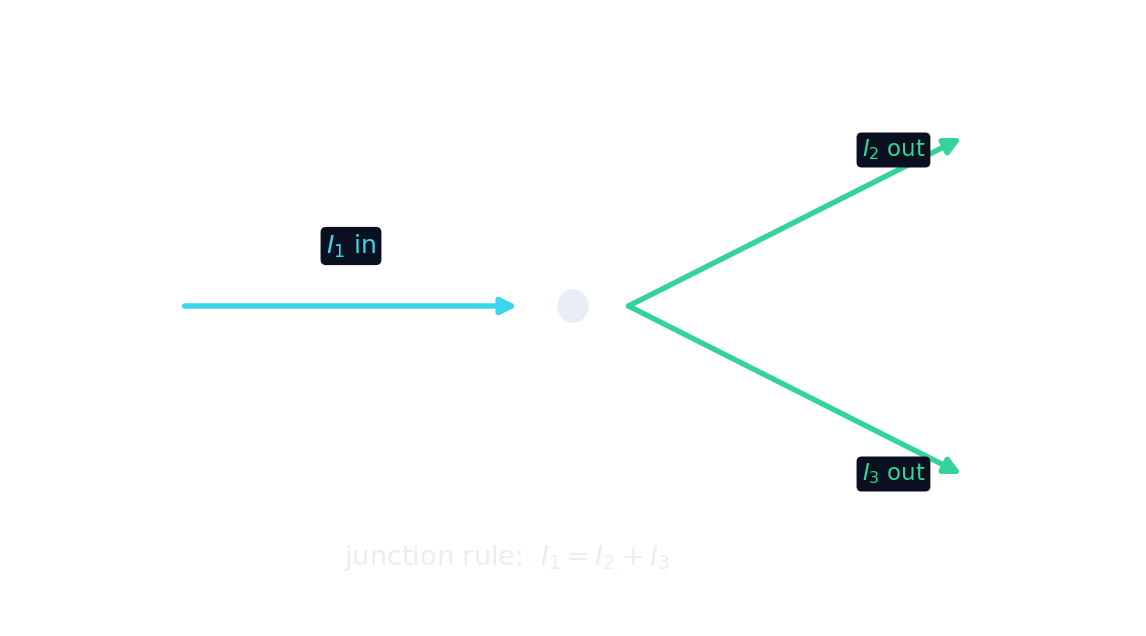
- So if $I_1$ flows in and splits into $I_2$ and $I_3$, then $I_1 = I_2 + I_3$.
节点定律
- 在任何节点(导线相汇的点),流进的电流等于流出的电流。
- 用符号:$\sum I_{\text{in}} = \sum I_{\text{out}}$。
- 它其实是电荷守恒——电荷不能在一点堆积。
- 所以若 $I_1$ 流进并分成 $I_2$ 和 $I_3$,那么 $I_1 = I_2 + I_3$。
$5\ \text{A}$ reaches a junction and splits into two branches; one carries $2\ \text{A}$. What does the other carry, in $\text{A}$? · $5\ \text{A}$到达节点并分成两个分支;一个承载$2\ \text{A}$。另一个承载多少,单位为$\text{A}$?
$5 = 2 + I \Rightarrow I = 3\ \text{A}$.
Kirchhoff's junction rule is a statement of the conservation of: · 基尔霍夫节点定律是关于守恒的表述:
Charge can't pile up at a point, so current in equals current out. · 电荷不能在一点堆积,所以流入电流等于流出电流。
At a junction, the current in equals the current . · 在节点处,流入电流等于流出电流。
$\sum I_{\text{in}} = \sum I_{\text{out}}$.
How current splits in parallel
- At the start of a parallel section, the total current divides among the branches.
- More current takes the path of lower resistance (the easier route).
- At the far end, the branch currents rejoin and add back to the total.
- The junction rule keeps the books balanced at every split and merge.
并联中电流如何分流
- 在并联段的起点,总电流在各支路间分配。
- 更多电流走电阻较低的路径(更容易的路)。
- 在末端,支路电流重新汇合,加回总电流。
- 节点定律在每个分流和汇合处都让账目平衡。
At a split into parallel branches, more current flows through the branch with: · 在分叉成并联支路时,更多电流流过具有:
Current favours the easier path — the branch of lower resistance. · 电流倾向于更容易的路径——即电阻较低的支路。
Select all · 所有 true statements about the junction rule. · 选择所有关于节点定律的正确陈述。
The junction rule conserves charge: current divides and rejoins, never used up. · 节点定律守恒电荷:电流分流并汇合,永远不会被消耗。
Solving with both rules together
- The junction rule gives equations about currents; the loop rule gives equations about voltages.
- Together they turn any DC circuit into a set of equations you can solve.
- Write junction equations at the nodes, loop equations around the loops, and solve.
- These two rules are all you need for even the most tangled resistor network.
两条定律一起解题
- 节点定律给出关于电流的方程;回路定律给出关于电压的方程。
- 两者一起把任何直流电路变成一组你能解的方程。
- 在节点处写节点方程,绕回路写回路方程,然后求解。
- 即便最复杂的电阻网络,你也只需要这两条定律。
Kirchhoff's junction rule · 基尔霍夫节点定律
Charge cannot pile up at a junction. Sort each current as flowing in or out. · 电荷不能在节点堆积。将每个电流分类为流入或流出。
Current is used up as it passes through a junction. · 电流在穿过节点时被消耗掉。
Current divides but is never used up — what flows out equals what flows in. · 电流分流但不会被消耗——流出的量等于流入的量。
The junction rule is about charge, not energy (that's the loop rule). Current does not get "used up" at a junction — it only divides. The amounts flowing out must add up exactly to the amount flowing in.
节点定律讲的是电荷,而非能量(那是回路定律)。电流在节点处不会被"用掉"——它只是分流。流出的量必须恰好加起来等于流入的量。
A current of $5\ \text{A}$ reaches a junction and splits into two branches. One branch carries $2\ \text{A}$. What does the other carry?
- Junction rule: $5 = 2 + I \Rightarrow I = 3\ \text{A}$.
The two branch currents ($2\ \text{A}$ and $3\ \text{A}$) add back to the $5\ \text{A}$ that came in.
$5\ \text{A}$ 的电流到达一个节点,分成两条支路。一条支路载 $2\ \text{A}$。另一条载多少?
- 节点定律:$5 = 2 + I \Rightarrow I = 3\ \text{A}$。
两条支路电流($2\ \text{A}$ 和 $3\ \text{A}$)加回到流入的 $5\ \text{A}$。
Kirchhoff's junction rule: at any junction, current in equals current out ($\sum I_{\text{in}} = \sum I_{\text{out}}$) — conservation of charge. Current divides at a split (favouring lower resistance) and rejoins later. With the loop rule, it solves any DC circuit.
基尔霍夫电流定律:在任何节点,流入等于流出($\sum I_{\text{in}} = \sum I_{\text{out}}$)——电荷守恒。电流在分叉处分流(偏向低电阻)并在稍后汇合。与回路定律一起,它能解任何直流电路。