Capacitors · 电容器
| English | 中文 | Pinyin · 拼音 |
|---|---|---|
| capacitor/kəˈpæsɪtə/ | 电容器 | diàn róng qì |
| farad/ˈfæræd/ | 法拉 | fǎ lā |
A camera flash: store charge slowly, dump it all at once
- A camera charges up quietly, then fires a burst of light in an instant.
- Behind it is a capacitor 电容器 — a device that stores electric charge and releases it fast.
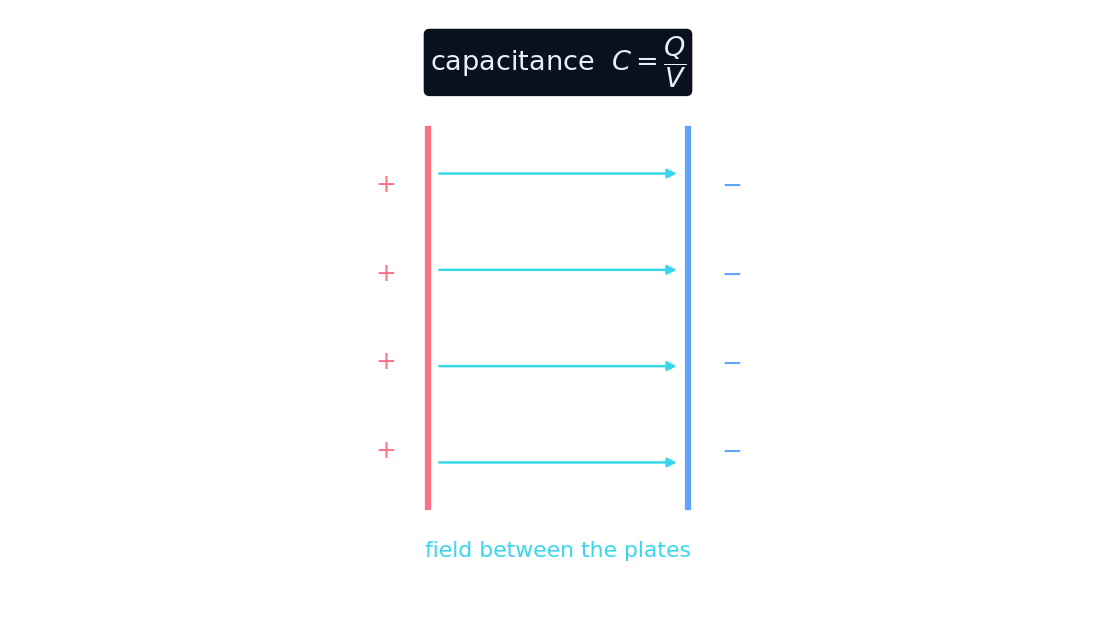
- It is two conductors holding opposite charge, with a field trapped between them.
- Capacitors run flashes, smooth power supplies, and time circuits.
相机闪光灯:慢慢储存电荷,一下全部倒出
- 相机悄悄地充电,然后在一瞬间射出一束光。
- 它背后是一个电容器——一种储存电荷并快速释放它的器件。
- 它是两个带异号电荷的导体,中间困着一个场。
- 电容器驱动闪光灯、平滑电源、并给电路计时。
What a capacitor is
- A capacitor is two conducting plates separated by a small gap.
- Connect it to a voltage and one plate gains + charge, the other −.
- The capacitance $C = \dfrac{Q}{V}$ measures how much charge it stores per volt.
- Capacitance is measured in farads 法拉 ($1\ \text{F} = 1\ \tfrac{\text{C}}{\text{V}}$).
什么是电容器
- 电容器是两块由一个小间隙隔开的导电极板。
- 把它接到电压上,一块极板获得 + 电荷,另一块获得 −。
- 电容 $C = \dfrac{Q}{V}$ 量度它每伏特储存多少电荷。
- 电容以法拉($1\ \text{F} = 1\ \tfrac{\text{C}}{\text{V}}$)量度。
Charge up a capacitor · 给电容器充电
Watch charge build on the plates as the capacitor charges, then discharge. · 观察电容器充电时极板上电荷的积累,然后放电。
A $2\ \text{F}$ capacitor is charged to $3\ \text{V}$. How much charge does it store, in $\text{C}$? · 一个$2\ \text{F}$电容器被充至$3\ \text{V}$。它储存了多少电荷,单位为$\text{C}$?
$Q = CV = 2 \times 3 = 6\ \text{C}$.
Capacitance is defined as: · 电容的定义为:
$C = Q/V$ — charge stored per volt. · $C = Q/V$ — 每伏特储存的电荷。
Capacitance is measured in ____. · 电容以____为单位测量。
$1\ \text{F} = 1\ \tfrac{\text{C}}{\text{V}}$.
Storing energy
- A charged capacitor stores energy $U = \tfrac12 C V^2$ in the field between its plates.
- Bigger capacitance or higher voltage means more stored energy.
- Unlike a battery, it can release its energy almost instantly — hence camera flashes.
- Charging and discharging take time, set by the circuit (next in RC circuits).
储存能量
- 充了电的电容器在极板间的场中储存能量 $U = \tfrac12 C V^2$。
- 更大的电容或更高的电压意味着储存更多能量。
- 与电池不同,它几乎能瞬间释放能量——所以有相机闪光灯。
- 充电和放电需要时间,由电路决定(接下来的 RC 电路)。
The same $2\ \text{F}$ capacitor at $3\ \text{V}$ stores how much energy, in $\text{J}$? · 同一个$2\ \text{F}$电容器在$3\ \text{V}$下储存多少能量,单位为$\text{J}$?
$U = \tfrac12 CV^2 = \tfrac12 (2)(9) = 9\ \text{J}$.
What sets the capacitance
- Bigger plates store more charge, so larger area ⇒ more capacitance.
- A smaller gap between plates ⇒ more capacitance (the charges attract more strongly).
- An insulating dielectric between the plates boosts capacitance further.
- So geometry, not voltage, decides a capacitor's capacitance.
什么决定电容
- 更大的极板储存更多电荷,所以面积越大 ⇒ 电容越大。
- 极板间间隙越小 ⇒ 电容越大(电荷相互吸引更强)。
- 极板间的绝缘电介质进一步增大电容。
- 所以决定电容器电容的是几何形状,而非电压。
A capacitor's capacitance changes when you raise the voltage across it. · 当你增加电容器两端的电压时,其电容会发生变化。
Capacitance is fixed by geometry; raising $V$ stores more $Q$ but keeps $C = Q/V$ the same. · 电容由几何形状决定;升高$V$会储存更多$Q$,但保持$C = Q/V$不变。
Select all · 所有 changes that increase a capacitor's capacitance. · 选择所有能增加电容器电容的变化。
Bigger area, smaller gap and a dielectric all raise $C$. Voltage does not change $C$. · 更大的面积、更小的间隙和介质都会提升$C$。电压不会改变$C$。
Capacitance $C = Q/V$ is a fixed property of the capacitor itself (its plates and gap) — it does not change when you change the voltage. Raising $V$ stores more charge $Q$, keeping the ratio $C$ the same.
电容 $C = Q/V$ 是电容器本身的固定性质(它的极板和间隙)——当你改变电压时它不变。升高 $V$ 会储存更多电荷 $Q$,保持比值 $C$ 不变。
A capacitor of $C = 2\ \text{F}$ is charged to $V = 3\ \text{V}$.
- Charge stored: $Q = CV = 2 \times 3 = 6\ \text{C}$.
- Energy stored: $U = \tfrac12 CV^2 = \tfrac12 (2)(3^2) = 9\ \text{J}$.
一个 $C = 2\ \text{F}$ 的电容器充电到 $V = 3\ \text{V}$。
- 储存的电荷:$Q = CV = 2 \times 3 = 6\ \text{C}$。
- 储存的能量:$U = \tfrac12 CV^2 = \tfrac12 (2)(3^2) = 9\ \text{J}$。
A capacitor stores charge on two plates; its capacitance $C = \dfrac{Q}{V}$ (in farads) is fixed by its geometry, not the voltage. It stores energy $U = \tfrac12 CV^2$ and can release it very fast — the basis of camera flashes and smoothing circuits.
电容器把电荷储存在两块极板上;它的电容 $C = \dfrac{Q}{V}$(单位法拉)由几何形状决定,而非电压。它储存能量 $U = \tfrac12 CV^2$,并能非常快地释放——这是相机闪光灯和平滑电路的基础。