Electric Potential Energy · 电势能
| English | 中文 | Pinyin · 拼音 |
|---|---|---|
| electric potential energy/ɪˈlektrɪk pəˈtenʃl ˈenədʒi/ | 电势能 | diàn shì néng |
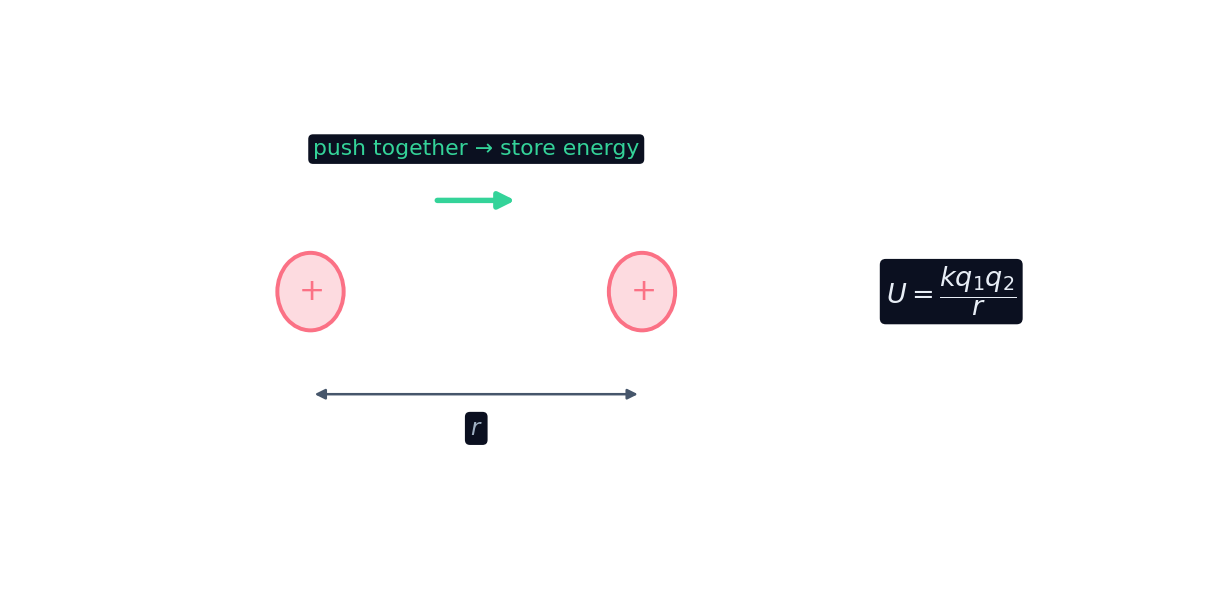
Pushing two like charges together is like squeezing a spring
- Push two positive charges toward each other and they resist harder and harder.
- You are doing work against their repulsion, and that work is stored.
- The stored energy is electric potential energy 电势能 — released the moment you let go.
- It is the electric cousin of a compressed spring or a lifted weight.
把两个同种电荷推到一起,就像压缩弹簧
- 把两个正电荷朝彼此推,它们的抵抗越来越强。
- 你在克服它们的斥力做功,而那份功被储存起来。
- 储存的能量是电势能——你一松手它就释放。
- 它是被压缩的弹簧或被举起的重物的电学表亲。
The stored-energy formula
- For two point charges, the electric potential energy is $U = \dfrac{k q_1 q_2}{r}$.
- Note it falls off as $\dfrac{1}{r}$ — one power of distance, unlike the $\dfrac{1}{r^2}$ force.
- For like charges $U$ is positive (you did work to push them together).
- For opposite charges $U$ is negative (they pulled together on their own).
储能公式
- 对两个点电荷,电势能是 $U = \dfrac{k q_1 q_2}{r}$。
- 注意它按 $\dfrac{1}{r}$ 衰减——距离的一次方,不像力的 $\dfrac{1}{r^2}$。
- 对同种电荷,$U$ 为正(你做了功把它们推到一起)。
- 对异种电荷,$U$ 为负(它们自己就拉到了一起)。
Energy in the field · 场中的能量
See the field a charge builds; moving another charge through it stores or releases energy. · 查看电荷建立的场;将另一电荷移入其中会储存或释放能量。
Two $+1\ \text{C}$ charges are $2\ \text{m}$ apart ($k = 9\times10^9$). What is their potential energy, in $\text{J}$? (Give the coefficient of $10^9$.) · 两个$+1\ \text{C}$电荷相距$2\ \text{m}$($k = 9\times10^9$)。它们的电势能是多少,单位为$\text{J}$?(给出$10^9$的系数。)
$U = kq_1q_2/r = 9\times10^9 / 2 = 4.5\times10^9\ \text{J}$.
Electric potential energy between two point charges depends on distance as: · 两个点电荷间的电势能随距离的变化关系为:
$U = kq_1q_2/r$ falls as $1/r$ — one power, unlike the $1/r^2$ force. · $U = kq_1q_2/r$随$1/r$下降——一次幂,不同于$1/r^2$力。
For two like charges, the electric potential energy is: · 对于两个同种电荷,电势能为:
You must do positive work to push like charges together, so $U > 0$. · 你必须做正功才能推动同种电荷靠近,因此$U > 0$。
For two point charges, halving their separation doubles their electric potential energy. · 对于两个点电荷,将其间距减半会使电势能加倍。
$U \propto 1/r$, so halving $r$ doubles $U$. · $U \propto 1/r$,因此将$r$减半会使$U$加倍。
Work and energy
- The work you do moving a charge equals the change in its potential energy.
- Move a charge to where the field pushes it, and its PE drops (energy released).
- Move it against the field, and its PE rises (energy stored).
- Only changes in potential energy matter, so you may set any convenient zero.
功与能
- 你移动一个电荷所做的功等于它势能的变化。
- 把电荷移到场推它去的地方,它的 PE 下降(能量释放)。
- 逆着场移动它,它的 PE 升高(能量储存)。
- 只有势能的变化才重要,所以你可以任选一个方便的零点。
The work done moving a charge equals the ____ in its potential energy. · 移动电荷所做的功等于其势能的____。
Work · 功 $= \Delta U$ — only changes in PE matter. · 功$= \Delta U$——只有势能的变化才重要。
Just like gravity
- Electric PE mirrors gravitational PE: both store energy in a configuration.
- Lifting a mass raises gravitational PE; separating opposite charges raises electric PE.
- Release either and the stored energy becomes kinetic energy.
- The same energy-conservation tools apply to both.
就像引力
- 电势能对应重力势能:两者都把能量储存在一种排布中。
- 举起质量抬高重力势能;分开异种电荷抬高电势能。
- 释放任一,储存的能量就变成动能。
- 相同的能量守恒工具对两者都适用。
Select all · 所有 correct statements about electric potential energy. · 选择所有关于电势能的正确陈述。
Electric PE mirrors gravitational PE, goes as $1/r$, and is positive for like charges. The force (not PE) goes as $1/r^2$. · 电势能类比重力势能,按$1/r$变化,且同种电荷时为正。力(而非势能)按$1/r^2$变化。
Electric potential energy goes as $\dfrac{1}{r}$, while the force goes as $\dfrac{1}{r^2}$ — don't confuse the two powers. And watch the signs: like charges have positive $U$, opposite charges negative $U$.
电势能按 $\dfrac{1}{r}$,而力按 $\dfrac{1}{r^2}$——别把这两个幂次弄混。并注意符号:同种电荷 $U$ 为正,异种电荷 $U$ 为负。
Two $+1\ \text{C}$ charges are $2\ \text{m}$ apart, with $k$ taken as $9\times10^9$.
- $U = \dfrac{kq_1q_2}{r} = \dfrac{9\times10^9 \times 1 \times 1}{2} = 4.5\times10^9\ \text{J}$.
Bring them to $1\ \text{m}$ apart and $U$ doubles to $9\times10^9\ \text{J}$ — you must do that much extra work.
两个 $+1\ \text{C}$ 的电荷相距 $2\ \text{m}$,取 $k$ 为 $9\times10^9$。
- $U = \dfrac{kq_1q_2}{r} = \dfrac{9\times10^9 \times 1 \times 1}{2} = 4.5\times10^9\ \text{J}$。
把它们移到相距 $1\ \text{m}$,$U$ 加倍到 $9\times10^9\ \text{J}$——你必须多做这么多功。
Electric potential energy is the energy stored in an arrangement of charges: $U = \dfrac{kq_1q_2}{r}$ (note $1/r$, not $1/r^2$). Like charges give positive $U$, opposites negative. Moving a charge does work equal to the change in $U$, just like gravitational PE.
电势能是储存在一种电荷排布中的能量:$U = \dfrac{kq_1q_2}{r}$(注意是 $1/r$,而非 $1/r^2$)。同种电荷 $U$ 为正,异种为负。移动电荷所做的功等于 $U$ 的变化,就像重力势能。