Entropy and the Second Law of Thermodynamics · 熵与热力学第二定律
| English | 中文 | Pinyin · 拼音 |
|---|---|---|
| entropy/ˈentrəpi/ | 熵 | shāng |
| second law of thermodynamics/ˈsekənd lɔː ɒv ˌθɜːməʊdaɪˈnæmɪks/ | 热力学第二定律 | rè lì xué dì èr dìng lǜ |
A shattered cup never leaps back together
- Drop a cup and it shatters. Wait forever and the pieces will never spontaneously reassemble.
- Milk stirred into coffee never un-mixes. Heat never flows from cold to hot on its own.
- Nature has a preferred direction: things run from order toward disorder.
- The measure of that disorder is entropy 熵, and it always grows.
摔碎的杯子永远不会自己拼回去
- 摔一个杯子,它碎了。等上无穷久,碎片也永远不会自发地重新拼起来。
- 搅进咖啡的牛奶永远不会自己分开。热永远不会自己从冷流向热。
- 自然有一个偏好的方向:事物从有序奔向无序。
- 那种无序的量度就是熵,而它总是增长。
Entropy measures disorder
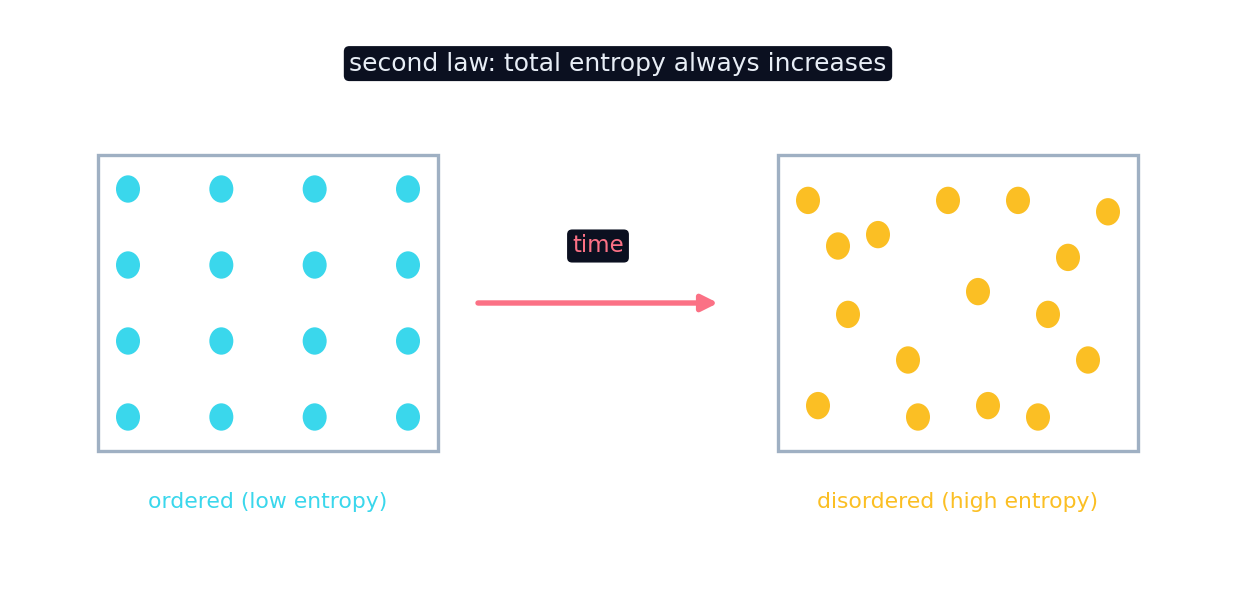
- Entropy is a measure of how spread-out and disordered a system's energy is.
- A neat, ordered arrangement has low entropy; a jumbled, spread-out one has high entropy.
- There are vastly more disordered arrangements than ordered ones, so disorder is overwhelmingly likely.
- Left alone, systems drift toward their most probable (most disordered) state.
熵量度无序
- 熵量度一个系统的能量有多分散、多无序。
- 整齐、有序的排布熵低;杂乱、分散的排布熵高。
- 无序的排布远远多于有序的,所以无序压倒性地更可能。
- 任其自然,系统朝它最可能(最无序)的状态漂移。
Entropy is a measure of a system's: · 熵是系统____的度量:
Entropy measures how spread-out and disordered a system's energy is. · 熵衡量系统能量的分散程度和无序程度。
The second law
- The second law of thermodynamics 热力学第二定律: the total entropy of the universe always increases.
- That is why heat flows hot → cold, not the reverse — it spreads energy out.
- You can lower entropy locally (a fridge, a living cell), but only by raising it more elsewhere.
- The second law gives time its direction — the "arrow of time".
第二定律
- 热力学第二定律:宇宙的总熵总是增大。
- 这就是为什么热从热流向冷,而非反过来——它把能量摊开。
- 你可以在局部降低熵(冰箱、活细胞),但只能靠在别处更多地提高熵。
- 第二定律给了时间方向——"时间之箭"。
The second law of thermodynamics says the total entropy of the universe: · 热力学第二定律指出宇宙的总熵:
The total entropy of the universe always increases — the second law. · 宇宙的总熵总是增加的——这是第二定律。
Heat flows from hot to cold because that spreads energy out and increases total entropy. · 热量从热处流向冷处,因为这会分散能量并增加总熵。
Spreading energy raises entropy, which is why the natural flow is hot → cold. · 分散能量会提高熵,这就是为什么自然流向是热→冷。
No perfect engines
- Because entropy must rise, no heat engine can turn all its heat into work.
- Some energy always spreads out as low-grade waste heat.
- This is why car engines and power plants are never $100\%$ efficient.
- The second law sets a hard ceiling that no clever design can beat.
没有完美的引擎
- 因为熵必须增大,没有热机能把它全部的热变成功。
- 总有一些能量作为低品位的废热摊开。
- 这就是为什么汽车引擎和电厂从不 $100\%$ 高效。
- 第二定律设下了一个再巧妙的设计也无法突破的硬上限。
The second law of thermodynamics · 热力学第二定律
Natural processes increase the total entropy. Sort each process. · 自然过程会增加总熵。对每个过程进行分类。
Because entropy must rise, no heat engine can be ____% efficient. · 由于熵必须增加,没有任何热机可以达到 ____% 的效率。
Some energy always spreads out as waste heat, so $100\%$ efficiency is impossible. · 总有一些能量以废热的形式散失,因此$100\%$效率是不可能的。
Select all · 所有 consequences of the second law of thermodynamics. · 选择所有热力学第二定律的后果。
The second law gives heat flow, engine limits and time's arrow. A cup reassembling would lower total entropy — forbidden. · 第二定律解释了热流、热机限制和时间之箭。杯子自行重组会降低总熵——这是被禁止的。
The second law is about the total entropy of a system and its surroundings. You can create order locally — a freezer makes ice, cells build structure — but always by dumping more disorder (waste heat) into the surroundings. The universe's total entropy still rises.
第二定律讲的是一个系统及其环境的总熵。你可以在局部创造秩序——冰柜制冰、细胞构建结构——但总是靠把更多无序(废热)倾倒进环境。宇宙的总熵仍然增大。
A freezer making ice violates the second law because it lowers entropy. · 制冰机制造冰违反了第二定律,因为它降低了熵。
It lowers entropy locally but dumps more disorder (waste heat) into the room, so total entropy still rises. · 它在局部降低了熵,但向房间排放了更多的混乱(废热),因此总熵仍然上升。
Why does a hot cup of tea never spontaneously get hotter by drawing heat from the cooler room?
- It would decrease the total entropy (concentrate energy), which the second law forbids.
- Heat instead flows tea → room, spreading energy out and raising total entropy.
为什么一杯热茶永远不会靠从较凉的房间吸热而自发变得更热?
- 那会减小总熵(集中能量),而这是第二定律所禁止的。
- 热反而从茶流向房间,把能量摊开、提高总熵。
Entropy measures disorder, and the second law of thermodynamics says the total entropy of the universe always increases. This sets the direction of natural processes (hot → cold), forbids perfect engines, and gives time its arrow. Local order costs more disorder elsewhere.
熵量度无序,而热力学第二定律说宇宙的总熵总是增大。这决定了自然过程的方向(热 → 冷)、禁止完美的引擎,并给了时间以箭头。局部的秩序要以别处更多的无序为代价。