Thermal Energy Transfer and Equilibrium · 热能传递与热平衡
| English | 中文 | Pinyin · 拼音 |
|---|---|---|
| heat/hiːt/ | 热量 | rè liàng |
| thermal equilibrium/ˈθɜːml ˌiːkwɪˈlɪbrɪəm/ | 热平衡 | rè píng héng |
| conduction/kənˈdʌkʃn/ | 传导 | chuán dǎo |
| convection/kənˈvekʃn/ | 对流 | duì liú |
| radiation/ˌreɪdɪˈeɪʃn/ | 辐射 | fú shè |
Hot coffee cools, cold soda warms — both meet in the middle
- Leave a hot coffee and an iced soda on the table. The coffee cools; the soda warms.
- Both drift toward the same room temperature and then stop changing.
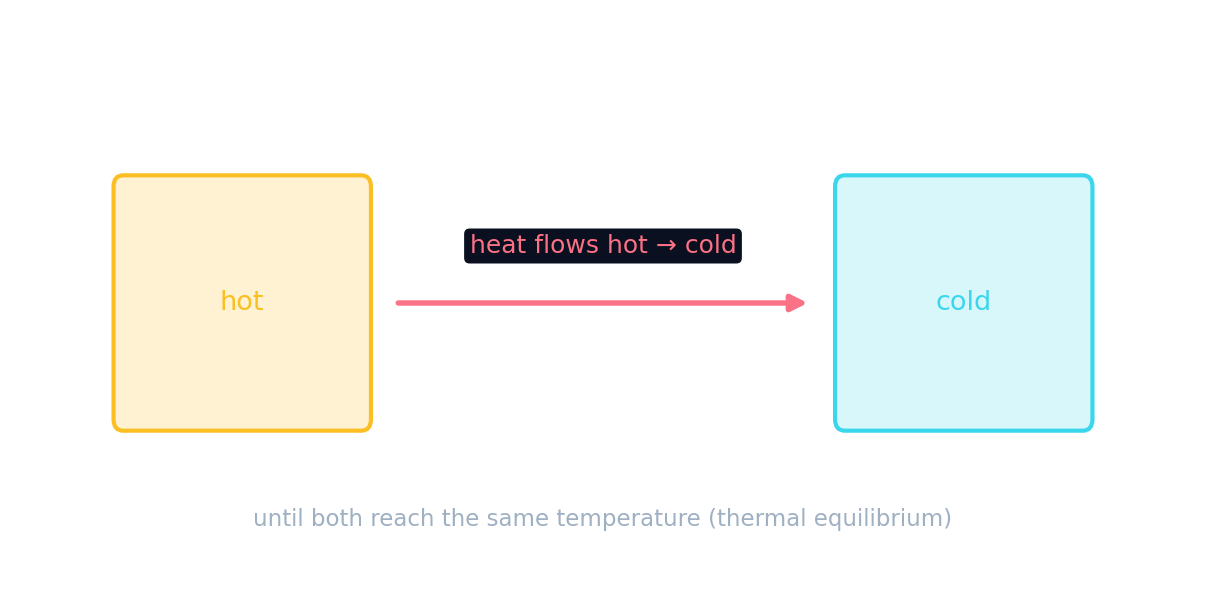
- Heat 热量 always flows on its own from hot to cold, never the other way.
- When everything reaches one temperature, the flow stops — thermal equilibrium 热平衡.
热咖啡变凉,冷汽水变暖——两者在中间相遇
- 把一杯热咖啡和一杯冰汽水放在桌上。咖啡变凉;汽水变暖。
- 两者都朝同一个室温漂移,然后不再改变。
- 热总是自发地从热流向冷,绝不反过来。
- 当一切都达到同一温度时,流动停止——热平衡。
Heat flows hot to cold
- Heat is thermal energy moving because of a temperature difference.
- It flows from the hotter object to the colder one, spontaneously.
- The bigger the temperature difference, the faster the heat flows.
- Heat is energy in transit — an object doesn't "contain heat", it contains internal energy.
热从热流向冷
- 热是因温度差而移动的热能。
- 它自发地从较热的物体流向较冷的物体。
- 温度差越大,热流得越快。
- 热是正在传递中的能量——物体不"含有热",它含有内能。
Heat changes the state · 热量改变物质状态
Raise the temperature and watch thermal energy speed up particles and change the state of matter. · 升高温度并观察热能如何加速粒子并改变物态。
Left on their own, in which direction does heat flow? · 自发地,热量流向哪个方向?
Heat flows spontaneously from the hotter object to the colder one. · 热量自发地从较热的物体流向较冷的物体。
Three ways heat travels
- Conduction 传导 — through direct contact, as fast particles jostle slower neighbours (metals excel).
- Convection 对流 — warm fluid rises and circulates, carrying energy with it.
- Radiation 辐射 — infrared waves that need no medium (how the Sun warms Earth).
- All three move energy from hot to cold.
热传播的三种方式
- 传导——通过直接接触,快粒子推挤较慢的邻居(金属最擅长)。
- 对流——温暖的流体上升并循环,带着能量一起走。
- 辐射——不需要介质的红外波(太阳就是这样温暖地球)。
- 三者都把能量从热移向冷。
Heat transfer through direct contact between materials is called . · 通过材料直接接触进行的热量传递称为。
Conduction moves heat by contact; metals conduct especially well. · 传导通过接触传递热量;金属的导热性能尤其好。
Radiation is the only one of the three heat-transfer methods that needs no medium. · 辐射是三种传热方式中唯一不需要介质的。
Radiation travels as infrared waves through empty space — that is how the Sun warms Earth. · 辐射以红外波的形式穿过真空传播——这就是太阳温暖地球的方式。
Select all · 所有 genuine methods of heat transfer. · 选择所有真实的传热方式。
Conduction, convection and radiation carry heat. Gravitation is not a heat-transfer method. · 传导、对流和辐射传递热量。引力不是一种传热方式。
Reaching equilibrium
- When two objects touch, heat flows until they share one temperature.
- At that point the net heat flow is zero — they are in thermal equilibrium.
- Equilibrium means equal temperature, not equal energy.
- A thermometer works by coming to equilibrium with whatever it measures.
达到平衡
- 当两个物体接触时,热流动直到它们共享一个温度。
- 到那一点,净热流为零——它们处于热平衡。
- 平衡意味着温度相等,而非能量相等。
- 温度计通过与所测之物达到平衡来工作。
Two objects are in thermal equilibrium when they have the same: · 当两个物体具有相同的____时,它们处于热平衡状态。
Equal temperature means no net heat flow — thermal equilibrium. · 温度相等意味着没有净热流——即热平衡。
Thermal equilibrium means the objects reach the same temperature, not the same amount of energy. A large cool object can still hold far more internal energy than a small hot one — temperature and total energy are different things.
热平衡意味着物体达到相同的温度,而非相同的能量。一个大的凉物体仍可能比一个小的热物体含有多得多的内能——温度和总能量是不同的东西。
Thermal equilibrium means the two objects hold the same amount of internal energy. · 热平衡意味着两个物体具有相同的内能量。
It means equal temperature, not equal energy — a large cool object can still hold more energy. · 这意味着温度相等,而非能量相等——一个巨大的低温物体仍可能储存更多能量。
A metal spoon at $80\ ^\circ\text{C}$ is placed in water at $20\ ^\circ\text{C}$.
- Heat flows from the hot spoon into the cooler water.
- The spoon cools and the water warms until both sit at one in-between temperature — equilibrium.
一把 $80\ ^\circ\text{C}$ 的金属勺放进 $20\ ^\circ\text{C}$ 的水中。
- 热从热勺流入较凉的水。
- 勺变凉、水变暖,直到两者停在一个中间温度——平衡。
Heat is energy that flows spontaneously from hot to cold because of a temperature difference — by conduction, convection or radiation. It stops when everything reaches one temperature: thermal equilibrium, which means equal temperature, not equal energy.
热是因温度差而自发地从热流向冷的能量——通过传导、对流或辐射。当一切达到同一温度时它停止:热平衡,意味着温度相等,而非能量相等。