Work · 功
| English | 中文 | Pinyin · 拼音 |
|---|---|---|
| work/wɜːk/ | 功 | gōng |
| joule/dʒuːl/ | 焦耳 | jiāo ěr |
Sweat to carry a box — yet transfer nothing to it?
- Hold a heavy box and walk across a flat floor. Tiring, yes — but in physics you do no work on the box.
- Work needs a force and movement in the force's direction.
- Your upward hold is perpendicular to your sideways walk, so it transfers no energy to the box.
- Getting this right is the key to the whole energy story.
抱着箱子横穿房间——却没做功?
- 抱着一个沉重的箱子在平地上走。很累,没错——但在物理里你对箱子没做功。
- 功需要一个力并且沿力的方向发生位移。
- 你向上的托举与你横向的行走相互垂直,所以没有能量传给箱子。
- 弄清这一点是整个能量故事的关键。
The definition of work
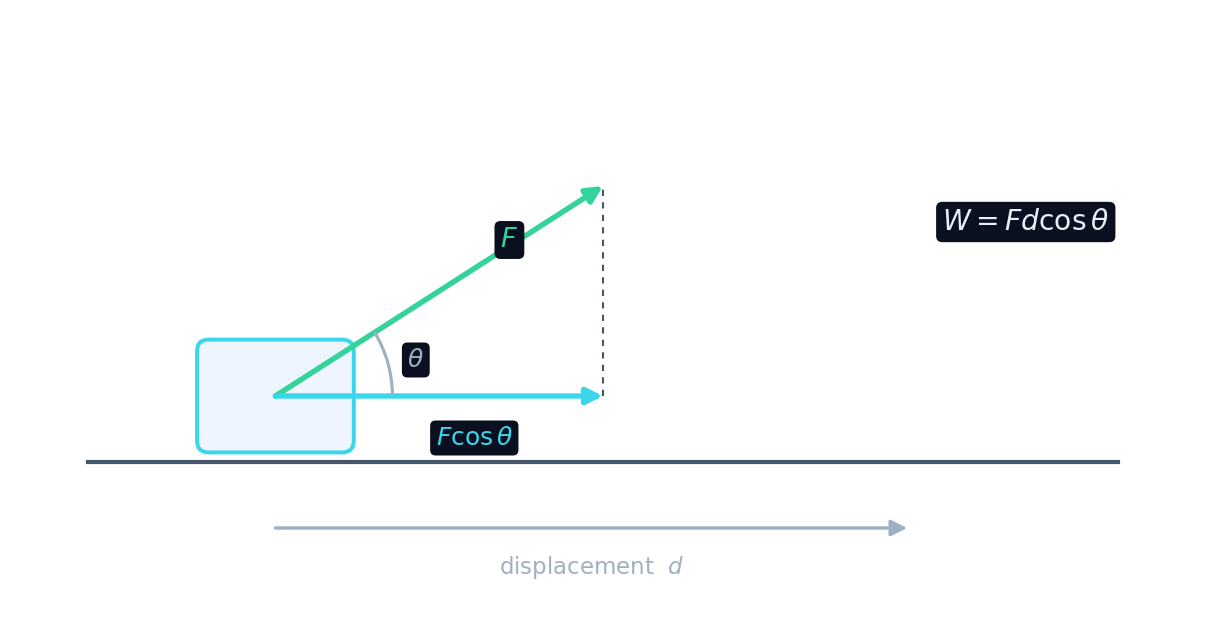
- Work 功 is force times the distance moved along the force: $W = F d \cos\theta$.
- $\theta$ is the angle between the force and the displacement.
- It is a scalar, measured in joules 焦耳 ($1\ \text{J} = 1\ \text{N}\cdot\text{m}$).
- Work is how energy is transferred to or from an object.
功的定义
- 功是力乘以沿力方向移动的距离:$W = F d \cos\theta$。
- $\theta$ 是力与位移之间的夹角。
- 它是一个标量,单位是焦耳($1\ \text{J} = 1\ \text{N}\cdot\text{m}$)。
- 功是能量向物体传递或从物体取出的方式。
A rope pulls a sled $5\ \text{m}$ with $20\ \text{N}$ at $60^\circ$ ($\cos 60^\circ = 0.5$). How much work is done, in joules? · 一根绳子以$5\ \text{m}$的力拉动雪橇$20\ \text{N}$,移动距离为$60^\circ$($\cos 60^\circ = 0.5$)。所做的功是多少焦耳?
$W = Fd\cos\theta = 20 \times 5 \times 0.5 = 50\ \text{J}$.
Work is measured in ____ (the same unit as energy). · 功以____为单位测量(与能量相同的单位)。
$1\ \text{J} = 1\ \text{N·m}$ — work and energy share the joule. · $1\ \text{J} = 1\ \text{N·m}$J — 功和能量共用焦耳。
Only the aligned part counts
- Split the force into a part along the motion and a part perpendicular to it.
- Only the along-the-motion part, $F\cos\theta$, does work.
- A force at $90^\circ$ to the motion ($\cos 90^\circ = 0$) does zero work.
- That is why carrying the box level, or a satellite's circular orbit, involves no work.
只有对齐的分量算数
- 把力分解为沿运动方向的部分和垂直于它的部分。
- 只有沿运动方向的部分 $F\cos\theta$ 做功。
- 与运动成 $90^\circ$ 的力($\cos 90^\circ = 0$)做零功。
- 这就是为什么水平托着箱子、或卫星的圆轨道,都不做功。
Work on a slope · 斜面上的功
Change the slope and mass to see how much work must be done to move the block along it. · 改变斜率和质量,观察沿斜面移动滑块必须做的功。
A force acts at $90^\circ$ to an object's motion. How much work does it do? · 力与物体的运动方向成 $90^\circ$ 角。它做了多少功?
$\cos 90^\circ = 0$, so $W = Fd\cos 90^\circ = 0$. A perpendicular force does no work. · $\cos 90^\circ = 0$,因此 $W = Fd\cos 90^\circ = 0$。垂直于运动的力不做功。
Positive, negative, and zero work
- Positive work: force has a component along the motion (a push that speeds you up).
- Negative work: force opposes the motion (friction, or catching a falling ball).
- Zero work: force is perpendicular, or there is no movement at all.
- Negative work removes energy; positive work adds it.
正功、负功和零功
- 正功:力有沿运动方向的分量(使你加速的推力)。
- 负功:力反抗运动(摩擦力,或接住下落的球)。
- 零功:力垂直,或者根本没有移动。
- 负功取走能量;正功增加能量。
Which situation involves negative · 负形 work being done on a moving box? · 以下哪种情况涉及对运动中的箱子做负功?
Friction points opposite the motion ($\theta = 180^\circ$, $\cos = -1$), so it does negative work — removing energy. · 摩擦力指向运动的反方向($\theta = 180^\circ$,$\cos = -1$),因此做负功——消耗能量。
Select all · 所有 cases where a force does zero · 零 work on an object. · 选择所有力对物体做功为零的情况。
Zero work needs $\cos\theta = 0$ (perpendicular) or $d = 0$ (no motion). A force along the motion does positive work. · 做功为零需要$\cos\theta = 0$(垂直)或$d = 0$(无位移)。沿运动方向的力做正功。
No movement means no work, however hard you strain. Pushing on an immovable wall does zero work in physics. And a force perpendicular to the motion — like the tension in a whirling string — also does zero work.
没有移动就没有功,无论你多么用力。推一堵推不动的墙在物理里做零功。而与运动垂直的力——比如旋转绳中的张力——也做零功。
Pushing hard on a wall that does not move still does a lot of work in the physics sense. · 用力推一堵不动的墙,在物理学意义上确实做了很多功。
No displacement means $W = 0$, no matter how hard you push. · 没有位移意味着 $W = 0$,无论你推得多用力。
A rope pulls a sled $5\ \text{m}$ with a force of $20\ \text{N}$ at $60^\circ$ above the ground ($\cos 60^\circ = 0.5$).
- $W = Fd\cos\theta = 20 \times 5 \times 0.5 = 50\ \text{J}$.
Only the horizontal part of the pull, $20\cos 60^\circ = 10\ \text{N}$, does the work over the $5\ \text{m}$.
一根绳以 $20\ \text{N}$ 的力、与地面成 $60^\circ$($\cos 60^\circ = 0.5$)拉动雪橇 $5\ \text{m}$。
- $W = Fd\cos\theta = 20 \times 5 \times 0.5 = 50\ \text{J}$。
只有拉力的水平部分 $20\cos 60^\circ = 10\ \text{N}$ 在这 $5\ \text{m}$ 上做功。
Work transfers energy: $W = Fd\cos\theta$ (a scalar, in joules). Only the force component along the motion does work, so a perpendicular force does zero work. Work is positive when it adds energy, negative when it removes it.
功传递能量:$W = Fd\cos\theta$(标量,单位焦耳)。只有沿运动方向的力分量做功,所以垂直的力做零功。功在增加能量时为正,在取走能量时为负。