Price Discrimination · 价格歧视
| English | 中文 | Pinyin · 拼音 |
|---|---|---|
| price discrimination/praɪs dɪˌskrɪmɪˈneɪʃn/ | 价格歧视 | jià gé qí shì |
| market power/ˈmɑːkɪt ˈpaʊə/ | 市场势力 | shì chǎng shì lì |
| willingness to pay/ˈwɪlɪŋnəs tə peɪ/ | 支付意愿 | zhī fù yì yuàn |
| resale/ˈriːseɪl/ | 转售 | zhuǎn shòu |
| perfect price discrimination/ˈpɜːfekt praɪs dɪˌskrɪmɪˈneɪʃn/ | 完全价格歧视 | wán quán jià gé qí shì |
| first-degree/fɜːst dɪˈɡriː/ | 一级 | yī jí |
| allocatively efficient/ˈæləkətɪvli ɪˈfɪʃənt/ | 配置有效率 | pèi zhì yǒu xiào lǜ |
| consumer surplus/kənˈsuːmə ˈsɜːpləs/ | 消费者剩余 | xiāo fèi zhě shèng yú |
| producer surplus/prəˈdjuːsə ˈsɜːpləs/ | 生产者剩余 | shēng chǎn zhě shèng yú |
Same seat, different prices
- The person next to you on the plane may have paid half what you did.
- Students, seniors, and early bookers all get their own price.
- This is no accident — it is a deliberate strategy to squeeze out more profit.
- It is called price discrimination 价格歧视.
同一个座位,不同的价格
- 飞机上你旁边的人,也许只付了你一半的钱。
- 学生、老人、早订票的人,各有各的价格。
- 这不是偶然——而是为了榨出更多利润的刻意策略。
- 它叫做价格歧视(price discrimination)。
Price discrimination means: · 价格歧视是指:
It bases each buyer's price on their willingness to pay. · 它按每个买家的支付意愿来定各自的价格。
Three conditions
- The firm needs market power 市场势力 — it must be a price maker.
- It must sort buyers by their willingness to pay 支付意愿.
- It must prevent resale 转售, so cheap buyers cannot resell to expensive ones.
- Miss any one condition and price discrimination falls apart.
三个条件
- 企业需要市场势力(market power)——它必须是价格制定者。
- 它必须按买家的支付意愿(willingness to pay)把他们分开。
- 它必须防止转售(resale),让便宜买家无法转卖给昂贵买家。
- 缺少任何一个条件,价格歧视就会瓦解。
Can the firm price-discriminate? · 企业能否价格歧视?
Price discrimination needs market power, sortable buyers, and no resale. If any condition fails, one price must be charged. · 价格歧视需要市场势力、可区分的买家,以及无法转售。任一条件不满足,就只能收一个价格。
Select all · 所有 conditions needed for price discrimination. · 选出价格歧视所需的所有条件。
Market power, sortable buyers, and no resale — perfect competition rules it out. · 市场势力、可区分买家、无法转售——完全竞争则排除了它。
If buyers can freely resell the good to one another, price discrimination breaks down. · 如果买家能自由地把商品互相转售,价格歧视就会瓦解。
Cheap buyers would resell to expensive ones, undercutting the firm's scheme. · 便宜买家会转卖给昂贵买家,破坏企业的方案。
Perfect price discrimination
- In perfect price discrimination 完全价格歧视 (also first-degree 一级), the firm charges each buyer their exact maximum willingness to pay.
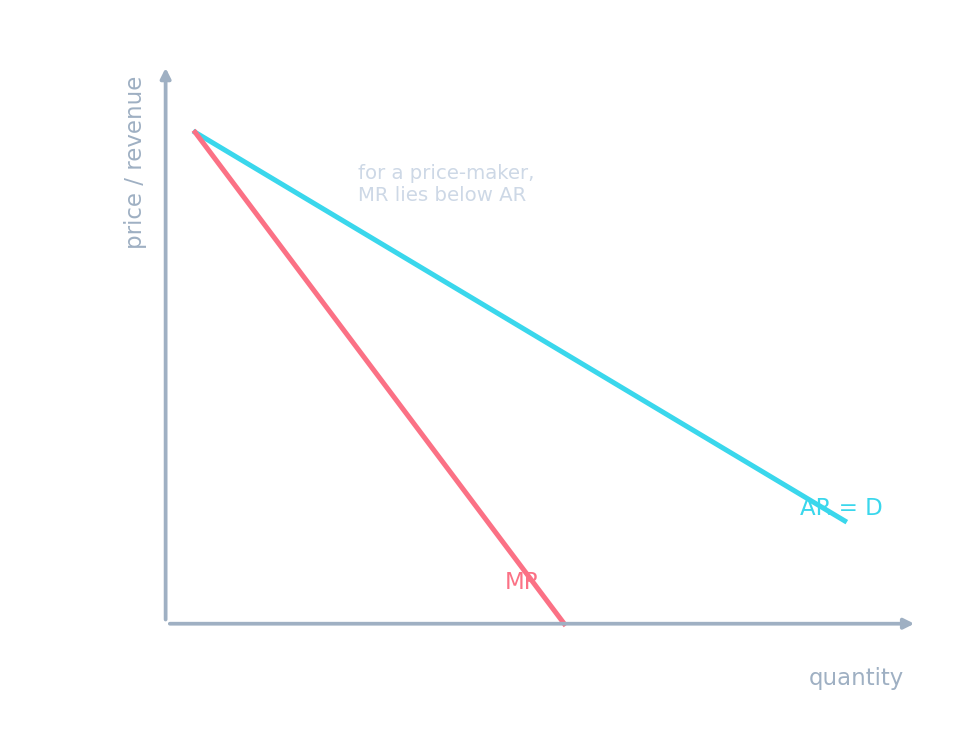
- Now no price cut on earlier units is needed, so the demand curve becomes the marginal-revenue curve.
- The firm keeps selling until $P = MC$ — the allocatively efficient 配置有效率 quantity, with no deadweight loss.
完全价格歧视
- 在完全价格歧视(perfect price discrimination,又称一级(first-degree))下,企业向每个买家收取他们各自的最高支付意愿。
- 这时不必给较早的单位降价,所以需求曲线变成了边际收入曲线。
- 企业一直卖到 $P = MC$——即配置有效率(allocatively efficient)的数量,没有无谓损失。
Demand is P = 100 − Q and MC = 20. A perfect price discriminator sells until P = MC. What quantity does it produce? · 需求是 P = 100 − Q,MC = 20。完全价格歧视者一直卖到 P = MC。它生产多少数量?
Set 100 − Q = 20 → Q = 80 — the efficient quantity, double the single-price monopoly's 40. · 令 100 − Q = 20 → Q = 80——有效率的数量,是单一定价垄断者 40 的两倍。
Because it produces where P = MC, perfect price discrimination has no ______ loss. · 因为它在 P = MC 处生产,完全价格歧视没有______损失。
It reaches the allocatively efficient quantity — the same as perfect competition. · 它达到配置有效率的数量——与完全竞争相同。
Who gets the surplus
- The efficiency is real, but the welfare split is brutal.
- All consumer surplus 消费者剩余 is captured by the firm.
- Producer surplus 生产者剩余 swells to include the entire gains-from-trade triangle.
谁得到剩余
- 效率是真实的,但福利的分配却很残酷。
- 全部消费者剩余(consumer surplus)被企业攫取。
- 生产者剩余(producer surplus)膨胀到包含整个贸易收益三角形。
Under perfect price discrimination, consumer surplus is: · 在完全价格歧视下,消费者剩余:
The firm charges each buyer their maximum willingness to pay, so no consumer surplus is left. · 企业向每个买家收取其最高支付意愿,所以没有消费者剩余留下。
Price discrimination charges different buyers different prices; it needs market power, sortable willingness to pay, and no resale. Perfect price discrimination reaches the efficient $P = MC$ quantity with no deadweight loss — but the firm captures all the consumer surplus.
价格歧视向不同买家收不同价格;它需要市场势力、可区分的支付意愿,以及无法转售。完全价格歧视达到有效率的 $P = MC$ 数量,没有无谓损失——但企业攫取了全部消费者剩余。