Types of Profit · 利润的类型
| English | 中文 | Pinyin · 拼音 |
|---|---|---|
| implicit costs/ɪmˈplɪsɪt kɒsts/ | 隐性成本 | yǐn xìng chéng běn |
| explicit costs/ekˈsplɪsɪt kɒsts/ | 显性成本 | xiǎn xìng chéng běn |
| opportunity cost/ɒpəˈtjuːnɪti kɒst/ | 机会成本 | jī huì chéng běn |
| accounting profit/əˈkaʊntɪŋ ˈprɒfɪt/ | 会计利润 | kuài jì lì rùn |
| economic profit/ˌiːkəˈnɒmɪk ˈprɒfɪt/ | 经济利润 | jīng jì lì rùn |
| normal profit/ˈnɔːml ˈprɒfɪt/ | 正常利润 | zhèng cháng lì rùn |
Two ways to measure profit
- An accountant and an economist look at the same cafe and disagree about its profit.
- Neither is wrong — they simply count different costs.
- The gap between them is one of the most useful ideas in economics.
- It decides whether a business should keep going, or do something else entirely.
衡量利润的两种方式
- 会计师和经济学家看着同一家咖啡馆,却对它的利润各执一词。
- 两人都没错——他们只是计入了不同的成本。
- 两者之间的差距,是经济学里最有用的概念之一。
- 它决定一门生意该继续下去,还是干脆改做别的。
Explicit and implicit costs
- Explicit costs 显性成本 are real money paid out — wages, rent, materials. They show up on a bill.
- Implicit costs 隐性成本 are the value of resources the owner already owns and uses — no money changes hands.
- The key implicit cost is the opportunity cost 机会成本 of the owner's own time and money.
显性成本与隐性成本
- 显性成本(explicit costs)是真金白银付出去的钱——工资、租金、材料。它们会出现在账单上。
- 隐性成本(implicit costs)是所有者已经拥有并使用的资源的价值——没有金钱易手。
- 关键的隐性成本是所有者自己时间和金钱的机会成本(opportunity cost)。
Explicit or implicit? · 显性还是隐性?
Explicit costs are money actually paid out; implicit costs are the opportunity cost of resources the owner already owns. · 显性成本是真正付出去的钱;隐性成本是所有者已拥有资源的机会成本。
Accounting vs economic profit
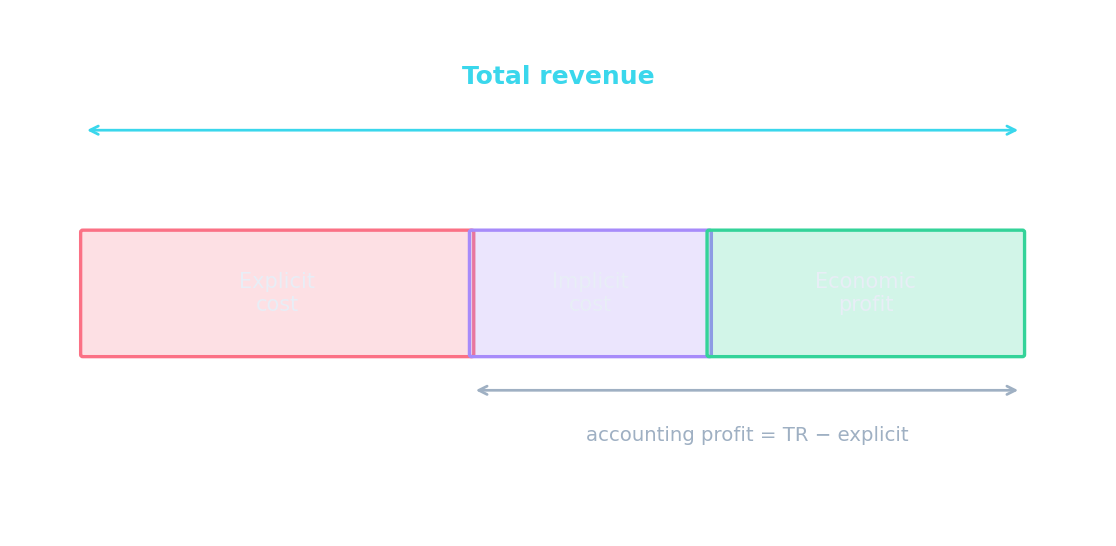
- Accounting profit 会计利润 = total revenue − explicit costs only.
- Economic profit 经济利润 = total revenue − (explicit and implicit costs).
- So economic profit is always smaller than accounting profit.
- Normal profit 正常利润 is when economic profit is exactly zero — the owner covers every cost, including opportunity cost.
会计利润与经济利润
- 会计利润(accounting profit)= 总收入 − 仅显性成本。
- 经济利润(economic profit)= 总收入 − (显性加隐性成本)。
- 所以经济利润总是比会计利润更小。
- 正常利润(normal profit)是经济利润恰好为零时——所有者覆盖了每一项成本,包括机会成本。
Accounting profit equals: · 会计利润等于:
Accountants subtract only the explicit (paid-out) costs. · 会计师只减去显性(付出去的)成本。
Economic profit is always smaller than (or equal to) accounting profit. · 经济利润总是小于(或等于)会计利润。
Economic profit subtracts implicit costs as well, so it cannot be larger. · 经济利润还减去隐性成本,所以不会更大。
Maria's revenue is 200,000; explicit costs are 130,000; the salary she gave up (implicit cost) is 50,000. What is her economic profit? · Maria 的收入是 200,000;显性成本是 130,000;她放弃的工资(隐性成本)是 50,000。她的经济利润是多少?
Economic profit = 200,000 − 130,000 − 50,000 = 20,000. · 经济利润 = 200,000 − 130,000 − 50,000 = 20,000。
When economic profit is exactly zero, the firm earns ______ profit. · 当经济利润恰好为零时,企业赚得______利润。
Normal profit means every cost — including opportunity cost — is just covered. · 正常利润表示每项成本——包括机会成本——都刚好被覆盖。
The signal to enter or exit
- Positive economic profit → the firm beats its next-best option, so new firms enter.
- Negative economic profit (a loss) → the owner could do better elsewhere, so firms exit.
- Zero economic profit (normal profit) → no reason to enter or leave.
进入或退出的信号
- 经济利润为正 → 企业胜过它的次优选择,于是新企业进入。
- 经济利润为负(亏损)→ 所有者本可在别处做得更好,于是企业退出。
- 经济利润为零(正常利润)→ 没有理由进入或离开。
Firms in a market are earning positive economic profit. Over time: · 某市场中的企业正赚取正的经济利润。随着时间推移:
Positive economic profit beats the next-best option, so new firms are attracted to enter. · 正的经济利润胜过次优选择,于是吸引新企业进入。
Match each economic-profit signal to what firms do. · 把每种经济利润信号与企业的行为配对。
Economic profit is the entry/exit signal because it already includes opportunity cost. · 经济利润是进出信号,因为它已经包含机会成本。
Accounting profit subtracts only explicit costs; economic profit subtracts implicit costs too, so it is smaller. Normal profit = zero economic profit. Economic profit is the right signal: positive attracts entry, negative forces exit.
会计利润只减去显性成本;经济利润连隐性成本也减去,所以更小。正常利润 = 经济利润为零。经济利润是正确的信号:为正吸引进入,为负迫使退出。