Other Elasticities · 其他弹性
| English | 中文 | Pinyin · 拼音 |
|---|---|---|
| cross-price elasticity of demand/krɒs praɪs ɪlæˈstɪsɪti ɒv dɪˈmænd/ | 交叉价格弹性 | jiāo chā jià gé tán xìng |
| substitutes/ˈsʌbstɪtjuːts/ | 替代品 | tì dài pǐn |
| complements/ˈkɒmplɪmənts/ | 互补品 | hù bǔ pǐn |
| income elasticity of demand/ˈɪŋkʌm ɪlæˈstɪsɪti ɒv dɪˈmænd/ | 收入弹性 | shōu rù tán xìng |
| normal good/ˈnɔːml ɡʊd/ | 正常商品 | zhèng cháng shāng pǐn |
| inferior good/ɪnˈfɪərɪə ɡʊd/ | 低档商品 | dī dàng shāng pǐn |
What tea tells you about coffee
- When the price of tea jumps, something happens to coffee — its demand rises.
- When incomes rise, people buy more of some goods and less of others.
- Demand does not only react to a good's own price.
- Two more elasticities capture these other reactions.
茶能告诉你关于咖啡的什么
- 当茶的价格跳涨,咖啡也会跟着变——它的需求上升。
- 当收入上升,人们会多买某些商品,却少买另一些。
- 需求不只对某商品自身的价格做出反应。
- 另外两种弹性,刻画了这些"别的"反应。
Cross-price elasticity (XED)
- Cross-price elasticity of demand 交叉价格弹性 measures how demand for good X reacts to the price of good Y.
- Formula: $\text{XED} = \dfrac{\%\,\Delta\,Q_X}{\%\,\Delta\,P_Y}$.
- Positive XED → the goods are substitutes 替代品 (tea dearer → more coffee bought).
- Negative XED → the goods are complements 互补品 (printers dearer → less ink bought).
交叉价格弹性(XED)
- 交叉价格弹性(cross-price elasticity of demand)衡量对商品 X 的需求如何对商品 Y 的价格做出反应。
- 公式:$\text{XED} = \dfrac{\%\,\Delta\,Q_X}{\%\,\Delta\,P_Y}$。
- XED 为正 → 两者是替代品(substitutes)(茶更贵 → 买更多咖啡)。
- XED 为负 → 两者是互补品(complements)(打印机更贵 → 买更少墨水)。
Two goods have a positive · positive(实证性) cross-price elasticity. They are: · 两种商品的交叉价格弹性为正。它们是:
Positive XED: a dearer Y sends buyers to X — the goods substitute for each other. · 正的 XED:Y 更贵时买家转向 X——两者互相替代。
Printers and ink are complements, so their cross-price elasticity is negative. · 打印机和墨水是互补品,所以它们的交叉价格弹性是负的。
A dearer printer lowers ink demand — a negative XED marks complements. · 更贵的打印机降低墨水需求——负的 XED 标志互补品。
Income elasticity (YED)
- Income elasticity of demand 收入弹性 measures how demand reacts to a change in income.
- Formula: $\text{YED} = \dfrac{\%\,\Delta\,Q}{\%\,\Delta\,\text{income}}$.
- Positive YED → a normal good 正常商品 (buy more as income rises).
- Negative YED → an inferior good 低档商品 (buy less as income rises).
收入弹性(YED)
- 收入弹性(income elasticity of demand)衡量需求如何对收入变化做出反应。
- 公式:$\text{YED} = \dfrac{\%\,\Delta\,Q}{\%\,\Delta\,\text{income}}$。
- YED 为正 → 正常商品(normal good)(收入上升就多买)。
- YED 为负 → 低档商品(inferior good)(收入上升反而少买)。
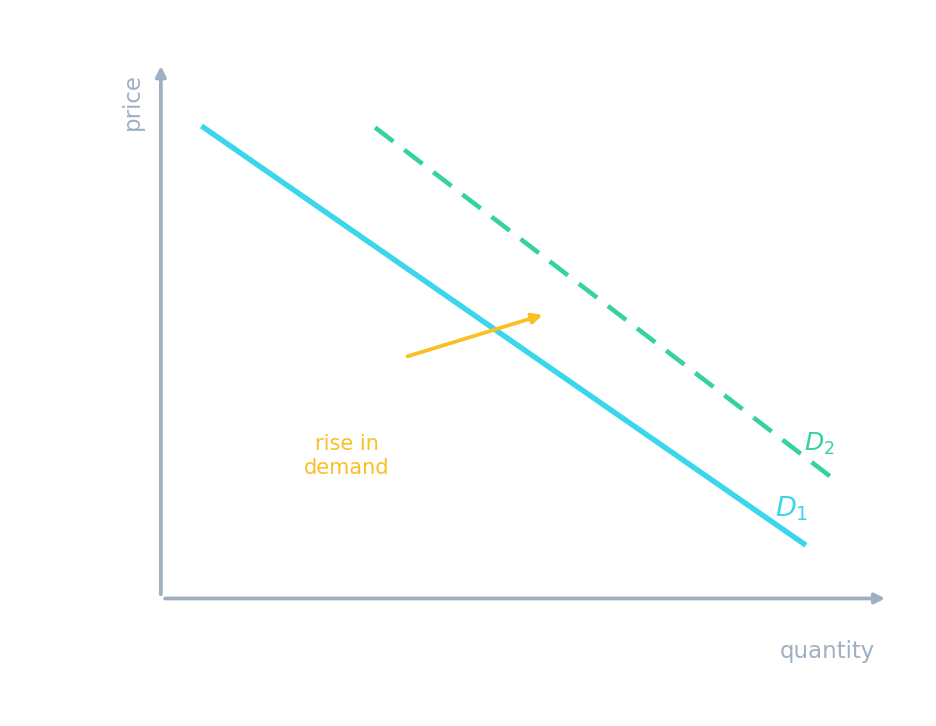
Read the sign · 读懂符号
The sign of cross-price elasticity tells you substitutes (+) from complements (−); the sign of income elasticity tells you normal (+) from inferior (−) goods. · 交叉价格弹性的符号区分替代品(+)与互补品(−);收入弹性的符号区分正常商品(+)与低档商品(−)。
A good with a positive · positive(实证性) income elasticity of demand is a: · 收入弹性为正的商品是:
Positive YED: buyers want more as income rises — a normal good. · 正的 YED:收入上升时买家想要更多——正常商品。
A good you buy less of as your income rises is called an ______ good. · 收入上升时你反而少买的商品,叫做______商品。
An inferior good has a negative income elasticity of demand. · 低档商品的收入弹性为负。
Read the sign, not just the size
- Worked idea. Income rises 10% and quantity of bus tickets demanded falls 5%.
- Then $\text{YED} = \dfrac{-5\%}{10\%} = -0.5$.
- The sign is negative, so bus travel is an inferior good here — richer people switch to taxis or cars.
- With these elasticities, the sign classifies the relationship; the size shows how strong it is.
先看符号,再看大小
- 例题。 收入上升 10%,公交车票的需求量下降 5%。
- 那么 $\text{YED} = \dfrac{-5\%}{10\%} = -0.5$。
- 符号是负的,所以这里公交出行是低档商品——更有钱的人转向出租车或私家车。
- 有了这些弹性,符号给关系分类,大小显示它有多强。
Income rises 10% and quantity of bus tickets demanded falls 5%. What is the income elasticity of demand (keep the sign)? · 收入上升 10%,公交车票的需求量下降 5%。收入弹性是多少(保留符号)?
$\text{YED} = -5\% \div 10\% = -0.5$; the negative sign means bus travel is an inferior good here. · $\text{YED} = -5\% \div 10\% = -0.5$;负号表示这里公交出行是低档商品。
Match each elasticity sign to what it tells you. · 把每个弹性符号与它告诉你的信息配对。
The sign does the classifying: substitutes/complements for XED, normal/inferior for YED. · 符号负责分类:XED 分替代品/互补品,YED 分正常/低档商品。
XED = %ΔQ of X ÷ %ΔP of Y: positive → substitutes, negative → complements. YED = %ΔQ ÷ %Δincome: positive → normal good, negative → inferior good. Always read the sign first.
XED = X 的 %ΔQ ÷ Y 的 %ΔP:正 → 替代品,负 → 互补品。YED = %ΔQ ÷ 收入的 %Δ:正 → 正常商品,负 → 低档商品。永远先读符号。