Price Elasticity of Demand · 需求价格弹性
| English | 中文 | Pinyin · 拼音 |
|---|---|---|
| price elasticity of demand/praɪs ɪlæˈstɪsɪti ɒv dɪˈmænd/ | 需求价格弹性 | xū qiú jià gé tán xìng |
| absolute value/ˈæbsəluːt ˈvæljuː/ | 绝对值 | jué duì zhí |
| midpoint method/ˈmɪdpɔɪnt ˈmeθəd/ | 中点法 | zhōng diǎn fǎ |
| elastic/ɪˈlæstɪk/ | 富有弹性 | fù yǒu tán xìng |
| inelastic/ɪnɪˈlæstɪk/ | 缺乏弹性 | quē fá tán xìng |
| unit elastic/ˈjuːnɪt ɪˈlæstɪk/ | 单位弹性 | dān wèi tán xìng |
| total revenue/ˈtəʊtl ˈrevənjuː/ | 总收入 | zǒng shōu rù |
Should the shop cut its price?
- Cut the price and you sell more — but each sale earns less.
- Sometimes the extra sales win; sometimes the lower price wins.
- Which one happens depends on how sensitive buyers are to price.
- That sensitivity has a name: price elasticity of demand 需求价格弹性 (PED).
这家店该不该降价?
- 降价你能卖出更多——但每一单赚得更少。
- 有时多卖的量占上风;有时更低的价格占上风。
- 到底哪一个,取决于买家对价格有多敏感。
- 这种敏感度有个名字:需求价格弹性(price elasticity of demand,PED)。
Measuring PED
- PED answers: "if price changes by 1%, by what % does quantity demanded change?"
- Formula: $\text{PED} = \dfrac{\%\,\Delta\,\text{quantity demanded}}{\%\,\Delta\,\text{price}}$.
- Because price and quantity move in opposite directions, PED is negative — so we read its absolute value 绝对值.
- To get one clean answer, AP uses the midpoint method 中点法: divide each change by the average of the start and end values.
衡量 PED
- PED 回答:"如果价格变动 1%,需求量变动百分之几?"
- 公式:$\text{PED} = \dfrac{\%\,\Delta\,\text{quantity demanded}}{\%\,\Delta\,\text{price}}$。
- 因为价格与数量方向相反,PED 是负的——所以我们读它的绝对值(absolute value)。
- 为了得到一个干净的答案,AP 用中点法(midpoint method):把每个变化除以起点和终点的平均值。
Price elasticity of demand is calculated as: · 需求价格弹性的计算方式是:
PED divides the percentage change in quantity by the percentage change in price. · PED 用数量的百分比变化除以价格的百分比变化。
Put the midpoint-method steps to find PED in order. · 把用中点法求 PED 的步骤按顺序排列。
The midpoint method divides each change by the average of the two values, then you take |PED|. · 中点法把每个变化除以两个值的平均,然后取 |PED|。
Elastic, inelastic, or unit elastic
- Elastic 富有弹性: $|\text{PED}| > 1$ — quantity responds strongly (buyers are sensitive).
- Inelastic 缺乏弹性: $|\text{PED}| < 1$ — quantity barely responds.
- Unit elastic 单位弹性: $|\text{PED}| = 1$ — the two percentages are equal.
富有弹性、缺乏弹性,还是单位弹性
- 富有弹性(elastic):$|\text{PED}| > 1$ —— 数量反应强烈(买家敏感)。
- 缺乏弹性(inelastic):$|\text{PED}| < 1$ —— 数量几乎不动。
- 单位弹性(unit elastic):$|\text{PED}| = 1$ —— 两个百分比相等。
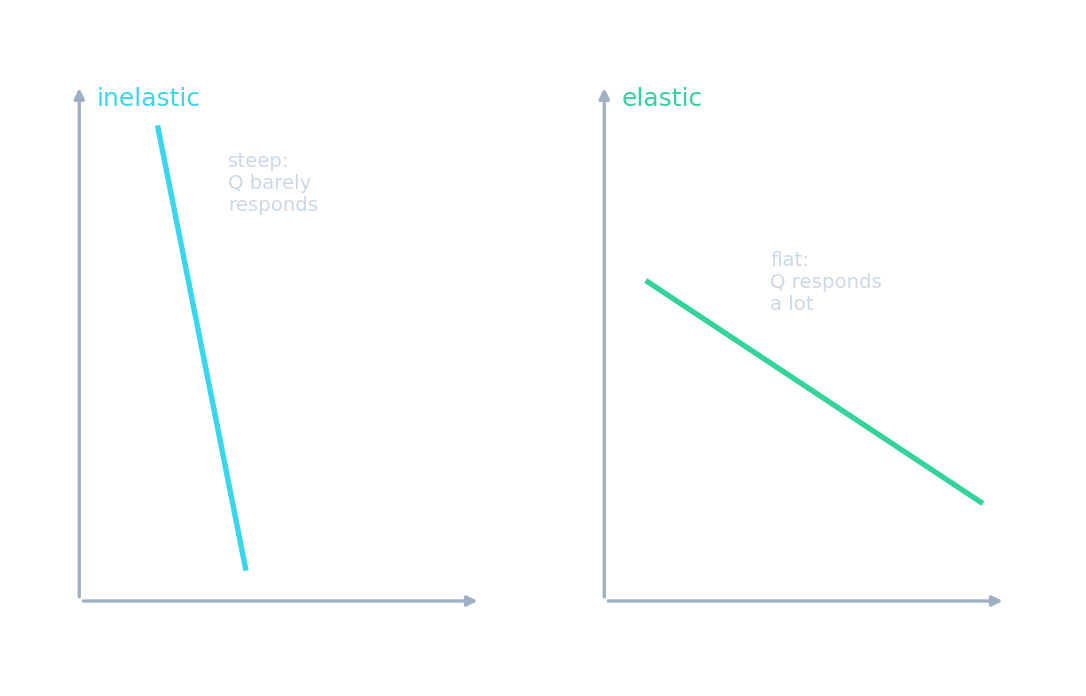
Steep vs flat demand · 陡峭与平坦的需求
A steep · 陡峭 demand curve is inelastic — quantity barely responds to price. A flat one is elastic. Drag to feel the difference and see it in total revenue. · 陡峭的需求曲线缺乏弹性——数量对价格几乎无反应。平坦的则富有弹性。拖动感受差异,并观察它对总收入的影响。
Price rises from 4 to 6; quantity demanded falls from 120 to 80. Using the midpoint method, what is |PED|? · 价格从 4 升到 6;需求量从 120 降到 80。用中点法,|PED| 是多少?
%ΔQ = -40/100 = -0.40 and %ΔP = 2/5 = 0.40, so PED = -1 and |PED| = 1 (unit elastic). · %ΔQ = -40/100 = -0.40,%ΔP = 2/5 = 0.40,所以 PED = -1,|PED| = 1(单位弹性)。
When |PED| equals exactly 1, demand is said to be ______ elastic. · 当 |PED| 恰好等于 1 时,需求被称为______弹性。
Unit elastic means the two percentage changes are equal; total revenue is at its maximum. · 单位弹性表示两个百分比变化相等;此时总收入最大。
PED and total revenue
- Total revenue 总收入 is $\text{TR} = P \times Q$.
- The total revenue test: if demand is elastic, price and TR move in opposite directions (cut price → TR rises).
- If demand is inelastic, price and TR move in the same direction (raise price → TR rises).
- If demand is unit elastic, total revenue is at its maximum.
PED 与总收入
- 总收入(total revenue)是 $\text{TR} = P \times Q$。
- 总收入检验:如果需求富有弹性,价格与 TR 方向相反(降价 → TR 上升)。
- 如果需求缺乏弹性,价格与 TR 方向相同(涨价 → TR 上升)。
- 如果需求是单位弹性,总收入达到最大。
Demand for a good is inelastic. To raise total revenue, the firm should: · 某商品的需求缺乏弹性。要提高总收入,企业应该:
With inelastic demand, price and total revenue move together — raising price raises TR. · 需求缺乏弹性时,价格与总收入同向变动——涨价提高 TR。
What makes demand elastic
- More substitutes available → more elastic (easy to switch away).
- A larger share of income spent on the good → more elastic.
- More time to adjust → more elastic in the long run.
什么让需求更有弹性
- 替代品更多 → 更有弹性(容易转向别处)。
- 花在该商品上的收入占比更大 → 更有弹性。
- 时间更充裕去调整 → 长期更有弹性。
Select all · 所有 that make demand more elastic. · 选出所有让需求更有弹性的因素。
Substitutes, a big income share and more time raise elasticity; a necessity with no substitute is inelastic. · 替代品、大的收入占比和更多时间提高弹性;没有替代品的必需品缺乏弹性。
PED = %ΔQ ÷ %ΔP (read as an absolute value, via the midpoint method). $|\text{PED}|>1$ is elastic, $<1$ inelastic, $=1$ unit elastic. The total revenue test: cut price when elastic, raise it when inelastic. More substitutes, a bigger income share, and more time all raise elasticity.
PED = %ΔQ ÷ %ΔP(取绝对值,用中点法)。$|\text{PED}|>1$ 为富有弹性,$<1$ 为缺乏弹性,$=1$ 为单位弹性。总收入检验:富有弹性时降价,缺乏弹性时涨价。替代品更多、收入占比更大、时间更充裕,都会提高弹性。