Phylogeny · 系统发育
| English | 中文 | Pinyin · 拼音 |
|---|---|---|
| phylogeny/faɪˈlɒdʒeni/ | 系统发育 | xì tǒng fā yù |
| phylogenetic tree/ˌfaɪləʊdʒˈnetɪk triː/ | 系统发育树 | xì tǒng fā yù shù |
| taxonomy/tækˈsɒnəmi/ | 分类学 | fēn lèi xué |
Mapping life's family tree
- If all life is related, we can draw the relationships as a tree.
- Close relatives sit on nearby branches; distant ones split off long ago.
- Scientists build these trees from DNA and anatomy.
- The study of these evolutionary relationships is called phylogeny.
描绘生命的家谱
- 如果所有生命都相关,我们就能把这些关系画成一棵树。
- 近亲坐在相邻的分支上;远亲很久以前就分开了。
- 科学家从 DNA 和解剖学构建这些树。
- 对这些进化关系的研究叫做系统发育。
The phylogenetic tree
- A phylogenetic tree 系统发育树 shows how species are related.
- The tips are living species; the branch points are common ancestors.
- The study of building and reading these trees is phylogeny 系统发育.
- Two species that branch off recently are more closely related.
系统发育树
- 一棵系统发育树(phylogenetic tree)展示物种如何相关。
- 树梢是现存物种;分叉点是共同祖先。
- 构建和阅读这些树的研究是系统发育(phylogeny)。
- 两个最近才分叉的物种,亲缘关系更近。
A phylogenetic tree shows… · 一棵系统发育树展示……
A phylogenetic tree maps how species are related through common ancestors — the study is phylogeny. · 一棵系统发育树描绘物种如何通过共同祖先相关——这门研究是系统发育。
Reading the tree
- Each branch point marks a shared ancestor.
- To see how related two species are, find where their branches meet.
- A more recent meeting point means a closer relationship.
- Surprises happen — birds branch from within the reptiles.
阅读这棵树
- 每个分叉点标出一个共享的祖先。
- 要看两个物种有多相关,找它们的分支相遇的地方。
- 一个更近的相遇点意味着更近的关系。
- 会有惊喜——鸟从爬行动物之内分叉出来。
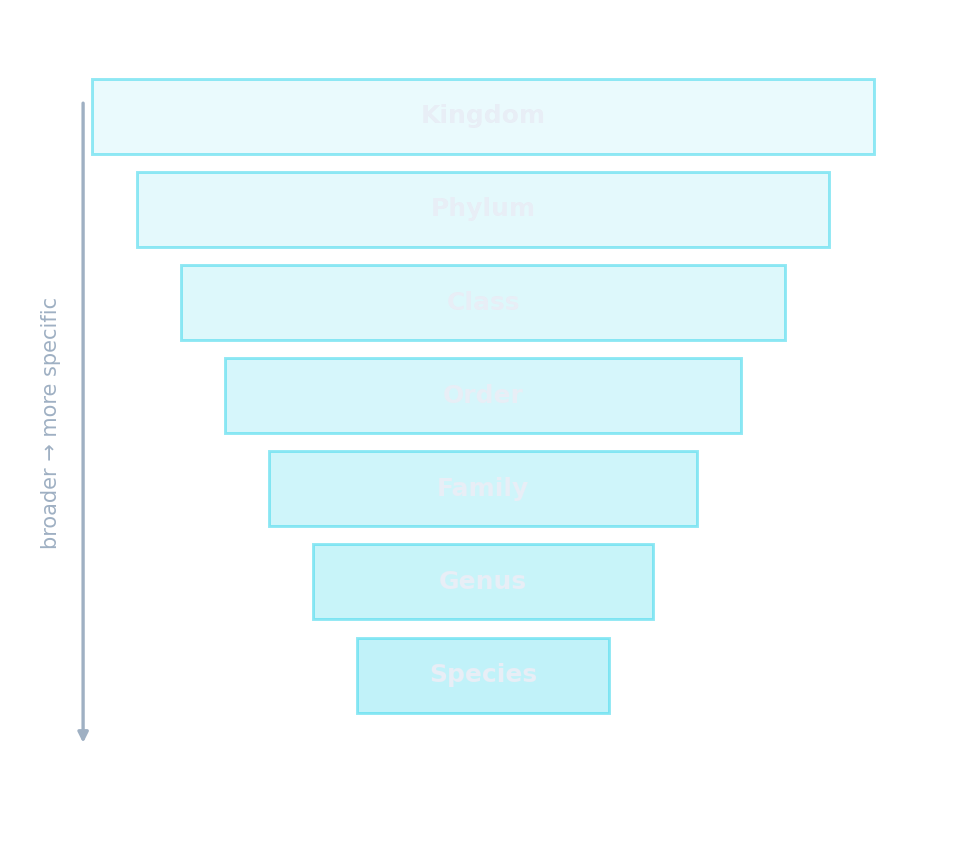
From domain down to species · 从域到种
Step down the classification ranks - each level is narrower and groups more closely related organisms. · 一步步走下分类的各个等级——每一层都更窄,把亲缘关系更近的生物归在一起。
On a phylogenetic tree, a branch point represents… · 在一棵系统发育树上,一个分叉点代表……
Each branch point is a common ancestor from which the branches above it descend. · 每个分叉点是一个共同祖先,它上面的分支都由它而来。
Classifying into ranks
- Taxonomy 分类学 sorts life into a set of nested ranks.
- From broad to narrow: domain, kingdom, phylum, class, order, family, genus, species.
- Each level down groups more closely related organisms.
- The narrowest rank, species, is a single kind of organism.
分类到各等级
- 分类学(taxonomy)把生命分到一套嵌套的等级里。
- 从宽到窄:域、界、门、纲、目、科、属、种。
- 往下每一层都把亲缘关系更近的生物归在一起。
- 最窄的等级,种,是一种生物。
The system of naming and classifying organisms into ranks is called . · 把生物命名并分类到各个等级的系统叫做。
Taxonomy classifies life into nested ranks, from domain down to species. · 分类学把生命分类到嵌套的等级,从域到种。
Which is the narrowest classification rank listed here? · 这里列出的哪个是最窄的分类等级?
Species · 种 is the narrowest rank — one kind of organism; domain is the broadest. · 种是最窄的等级——一种生物;域是最宽的。
Select all · 所有 true statements about phylogeny. · 选出关于系统发育的所有正确说法。
A tree shows relationships, not which species is "best". The other three are correct. · 树展示关系,而不是哪个物种"最好"。其余三条正确。
Read relatedness from the branch points, not from how close the tips sit on the page. Two species drawn side by side may be distant relatives; what matters is where their branches join, not where they end up on the diagram.
从分叉点读亲缘关系,而不是从树梢在纸上挨得多近。两个并排画着的物种可能是远亲;重要的是它们的分支在哪里相接,而不是它们在图上落在哪里。
A surprising cousin:
- You might guess a crocodile is most closely related to a lizard.
- But on the tree, crocodiles share a more recent ancestor with birds.
- So a crocodile is more closely related to a sparrow than to a lizard — the branch points reveal it.
一个令人惊讶的表亲:
- 你可能猜鳄鱼与蜥蜴的亲缘关系最近。
- 但在树上,鳄鱼与鸟共享一个更近的祖先。
- 所以鳄鱼与麻雀的亲缘关系比与蜥蜴的更近——分叉点揭示了它。
Phylogeny studies how species are related, drawn as a phylogenetic tree whose branch points are common ancestors. Taxonomy classifies life into nested ranks from domain down to species. Read relatedness from where branches join, and build the trees from DNA and anatomical evidence.
系统发育研究物种如何相关,画成一棵系统发育树,它的分叉点是共同祖先。分类学把生命分类到从域到种的嵌套等级。从分支相接的地方读亲缘关系,并从 DNA 和解剖学证据构建这些树。