Nucleic Acids · 核酸
| English | 中文 | Pinyin · 拼音 |
|---|---|---|
| nucleic acid/njuːˈklɪɪk ˈæsɪd/ | 核酸 | hé suān |
| nucleotides/ˈnjuːklɪɒtaɪdz/ | 核苷酸 | hé gān suān |
| nitrogen base/ˈnaɪtrədʒn beɪs/ | 碱基 | jiǎn jī |
| double helix/ˈdʌbl ˈhiːlɪks/ | 双螺旋 | shuāng luó xuán |
| complementary base pairing/ˌkɒmplɪˈmentəri beɪs ˈpeərɪŋ/ | 互补碱基配对 | hù bǔ jiǎn jī pèi duì |
The molecule of information
- One family of molecules stores the instructions for building a whole organism.
- These are the nucleic acids: DNA and RNA.
- They do not do chemistry like enzymes — they store and carry a code.
- That code is written in a four-letter alphabet.
信息的分子
- 有一个分子家族储存着构建整个生物体的指令。
- 它们就是核酸:DNA 和 RNA。
- 它们不像酶那样做化学反应——它们储存并携带一段密码。
- 那段密码是用一个四字母的字母表写成的。
Nucleotides: the building blocks
- A nucleic acid 核酸 is a polymer of small units called nucleotides 核苷酸.
- Each nucleotide has three parts: a phosphate, a sugar, and a nitrogen base 碱基.
- There are four bases in DNA: A, T, C, and G.
- The order of these bases is the genetic message.
核苷酸:构建单元
- 核酸(nucleic acid)是由叫做核苷酸(nucleotide)的小单元组成的聚合物。
- 每个核苷酸有三部分:一个磷酸、一个糖和一个碱基(base)。
- DNA 里有四种碱基:A、T、C 和 G。
- 这些碱基的顺序就是遗传信息。
A nucleotide is made of a phosphate, a sugar, and a… · 一个核苷酸由一个磷酸、一个糖和一个……组成。
Each · 每个 nucleotide = phosphate + sugar + a nitrogen base (A, T, C, G, or U). · 每个核苷酸 = 磷酸 + 糖 + 一个含氮碱基(A、T、C、G 或 U)。
DNA: the double helix
- DNA is two strands twisted into a double helix 双螺旋.
- The strands are held together by pairs of bases across the middle.
- Complementary base pairing 互补碱基配对: A always pairs with T, and C with G.
- So one strand is a template that exactly predicts the other.
DNA:双螺旋
- DNA 是两条链扭成的双螺旋(double helix)。
- 两条链靠中间成对的碱基连在一起。
- 互补碱基配对(complementary base pairing):A 总是与 T 配对,C 与 G 配对。
- 所以一条链是一个模板,能精确地预测另一条。
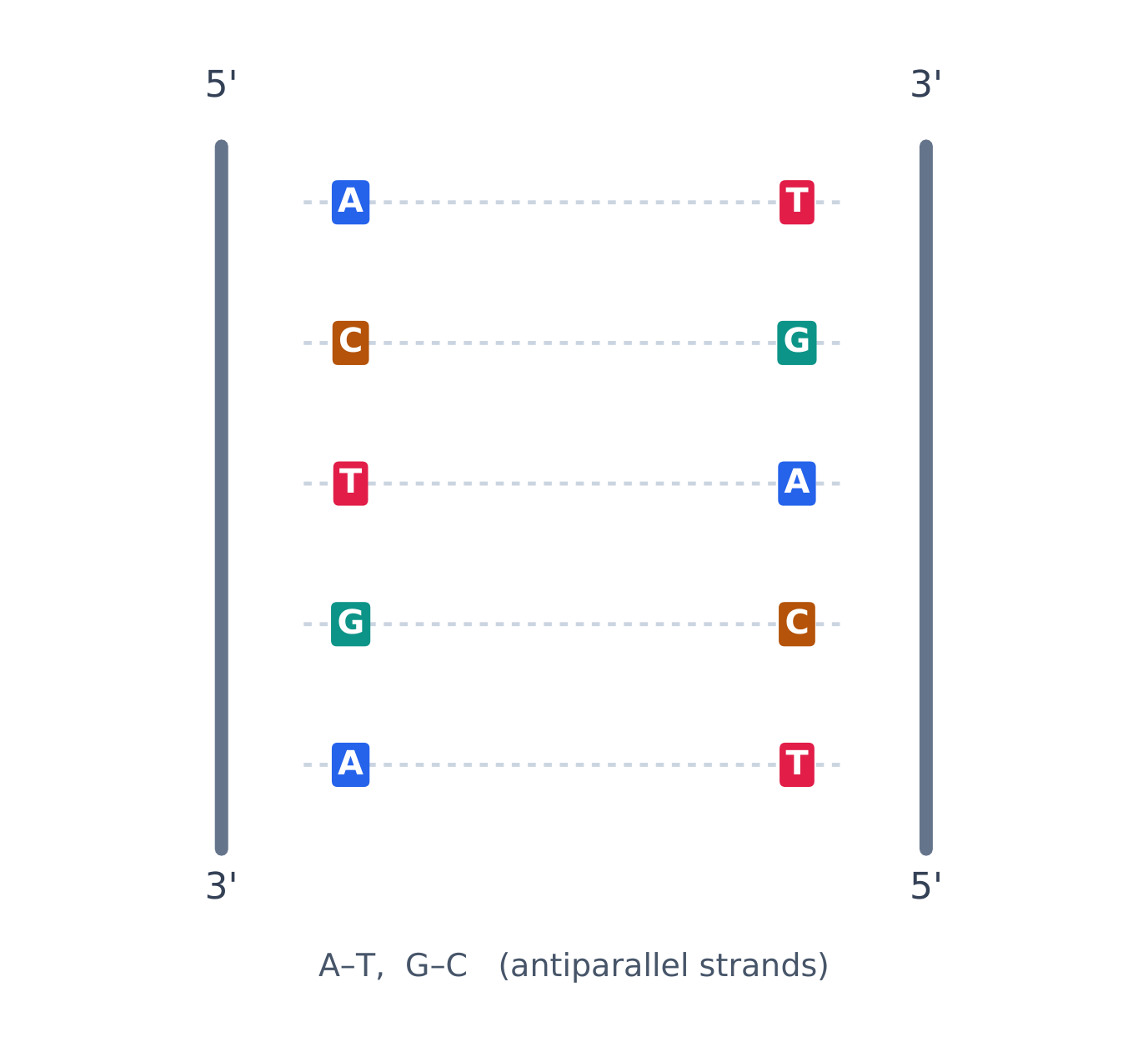
In DNA, which base always pairs with adenine (A)? · 在 DNA 中,哪个碱基总是与腺嘌呤(A)配对?
A pairs with T, and C pairs with G — this is complementary base pairing. · A 与 T 配对,C 与 G 配对——这就是互补碱基配对。
The twisted-ladder shape of DNA is called a double ____. · DNA 那扭曲的梯子形状叫做双 ____。
DNA is a double helix — two strands wound around each other like a spiral staircase. · DNA 是一个双螺旋——两条链像螺旋楼梯一样彼此缠绕。
RNA: the working copy
- RNA is usually a single strand, not a double helix.
- It uses the base uracil (U) in place of thymine (T).
- RNA carries copies of the DNA message out to where proteins are built.
- DNA is the master library; RNA is the photocopy you carry around.
RNA:工作副本
- RNA 通常是单链,不是双螺旋。
- 它用碱基尿嘧啶(U)代替胸腺嘧啶(T)。
- RNA 把 DNA 信息的副本带到构建蛋白质的地方。
- DNA 是主图书馆;RNA 是你随身携带的复印件。
DNA or RNA? · DNA 还是 RNA?
Sort each feature by whether it belongs to DNA, RNA, or both nucleic acids. · 按照每个特征属于 DNA、RNA 还是两种核酸都有,给它们分类。
RNA uses the base uracil (U) where DNA uses thymine (T). · RNA 在 DNA 用胸腺嘧啶(T)的地方用碱基尿嘧啶(U)。
RNA replaces thymine with uracil and is usually a single strand. · RNA 用尿嘧啶替换胸腺嘧啶,而且通常是单链。
Select all · 所有 true statements about nucleic acids. · 选出关于核酸的所有正确说法。
Nucleic acids are nucleotide chains, not lipids. The other three are correct. · 核酸是核苷酸的链,不是脂质。其余三条正确。
Do not confuse a nucleotide with a nucleic acid. A nucleotide is one building block (phosphate + sugar + base); a nucleic acid is the whole chain of thousands of them, like DNA.
不要把核苷酸和核酸搞混。核苷酸是一个构建单元(磷酸 + 糖 + 碱基);核酸是几千个它们组成的整条链,比如 DNA。
Reading a template strand:
- If one DNA strand reads $\text{A–T–G–C}$…
- …its partner must read $\text{T–A–C–G}$ — each base pairs with its complement.
- This pairing is how DNA is copied exactly before a cell divides.
读一条模板链:
- 如果一条 DNA 链读作 $\text{A–T–G–C}$……
- ……它的伙伴一定读作 $\text{T–A–C–G}$——每个碱基与它的互补配对。
- 这种配对就是细胞分裂前 DNA 被精确复制的方式。
Nucleic acids are chains of nucleotides (phosphate + sugar + base). DNA is a double helix whose bases follow complementary base pairing (A–T, C–G), storing the genetic code. RNA is a single strand that uses uracil and carries copies of that code.
核酸是核苷酸(磷酸 + 糖 + 碱基)的链。DNA 是一个双螺旋,它的碱基遵循互补碱基配对(A–T、C–G),储存遗传密码。RNA 是单链,用尿嘧啶,并携带那段密码的副本。