Energy levels and line spectra · 能级与线状光谱
| English | 中文 | Pinyin · 拼音 |
|---|---|---|
| discrete/dɪˈskriːt/ | 分立 | fēn lì |
| energy levels/ˈenədʒi ˈlevlz/ | 能级 | néng jí |
| ground state/ɡraʊnd steɪt/ | 基态 | jī tài |
| excited states/ekˈsaɪtɪd steɪts/ | 激发态 | jī fā tài |
| emission spectrum/ɪˈmɪʃn ˈspektrəm/ | 发射光谱 | fā shè guāng pǔ |
| transition/trænˈsɪʃn/ | 跃迁 | yuè qiān |
| absorption spectrum/əbˈsɔːpʃn ˈspektrəm/ | 吸收光谱 | xī shōu guāng pǔ |
Every element has a barcode
- A sodium street lamp is orange. A neon sign is red. A mercury lamp is bluish-white. None of them can be persuaded to be any other colour.
- Split that light with a prism and you do not get a rainbow. You get a few sharp lines, always at the same wavelengths for that element.
- Those lines are how we know what the Sun and every distant star are made of, without going there.
- This lesson is why the lines exist: discrete energy levels 能级 inside the atom, and $hf = E_2 - E_1$.
每种元素都有自己的条形码
- 钠灯是橙色的。霓虹灯是红色的。汞灯是发蓝的白色。谁也劝不动它们变成别的颜色。
- 用棱镜把那些光分开,你得到的不是彩虹,而是几条锐利的线,对那种元素来说总在同样的波长上。
- 正是这些线让我们不必亲自去,就知道太阳和每一颗遥远恒星是由什么组成的。
- 这一课讲这些线为什么存在:原子内部分立的能级(discrete energy levels),以及 $hf = E_2 - E_1$。
Discrete energy levels
- In an isolated atom an electron can sit only at certain discrete 分立 energies, never in between. The lowest is the ground state 基态; the rest are excited states 激发态.
- By convention the energies are written negative, with $E = 0$ for an electron just free of the atom. For hydrogen the ground state is $E_1 = -13.6\ \text{eV}$, and the higher levels creep up towards zero.
- The negative sign means bound. The number is how much energy you would have to supply to remove the electron altogether.
- The levels get closer together as they rise, which is why the spectral lines crowd towards the short-wavelength end.
Rungs that get closer as they climb
分立的能级
- 在孤立原子中,电子只能处在某些分立的(discrete)能量上,中间的值一概不行。最低的是基态(ground state),其余是激发态(excited states)。
- 按照约定,能量写成负的,而电子刚好脱离原子时 $E = 0$。氢的基态是 $E_1 = -13.6\ \text{eV}$,更高的能级逐渐爬向零。
- 负号表示被束缚。那个数值就是把电子完全移走所需供给的能量。
- 能级越高间隔越密,这就是谱线在短波端挤在一起的原因。
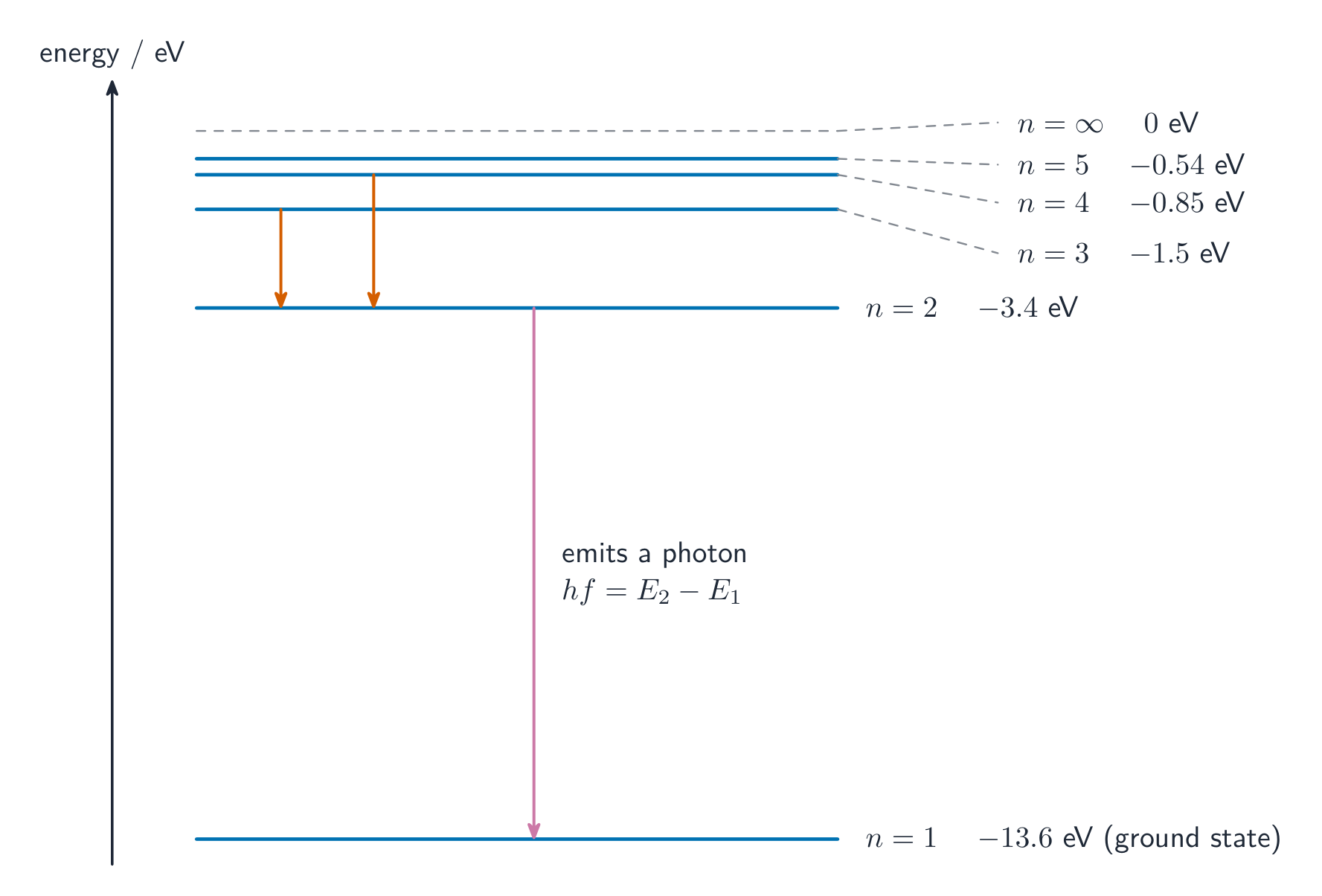
越往上越密的梯级
Electrons in an atom can only occupy certain ____ energy levels. · 原子中的电子只能占据某些 ____ 的能级。
The levels are discrete (quantised) — an electron cannot have an energy in between them. · 能级是分立的(量子化的)——电子不能有处于它们之间的能量。
Atomic energy levels are written as negative, with 0 for a just-free electron. · 原子能级写成负值,0 表示一个刚好自由的电子。
The most tightly bound (ground) state is the most negative; energy rises toward 0 as the electron is freed. · 束缚得最紧的(基)态最负;随着电子被释放,能量向 0 升高。
Emission: one drop, one photon
- When an electron falls from a higher level $E_2$ to a lower level $E_1$, it emits one photon:
- Both energies are negative and their difference is positive, so subtract carefully: $-3.40 - (-13.6) = 10.2\ \text{eV}$.
- Because the levels are discrete, only certain photon energies come out. The emission spectrum 发射光谱 is a set of sharp bright lines on a dark background, one line per transition 跃迁.
A handful of lines, always the same ones
发射:一次下落,一个光子
- 当电子从较高能级 $E_2$ 落到较低能级 $E_1$,它发射一个光子:
- 两个能量都是负的而它们的差是正的,所以相减要小心:$-3.40 - (-13.6) = 10.2\ \text{eV}$。
- 由于能级是分立的,出来的只有某些特定的光子能量。发射光谱(emission spectrum)是暗背景上一组锐利的亮线,每条线对应一次跃迁(transition)。
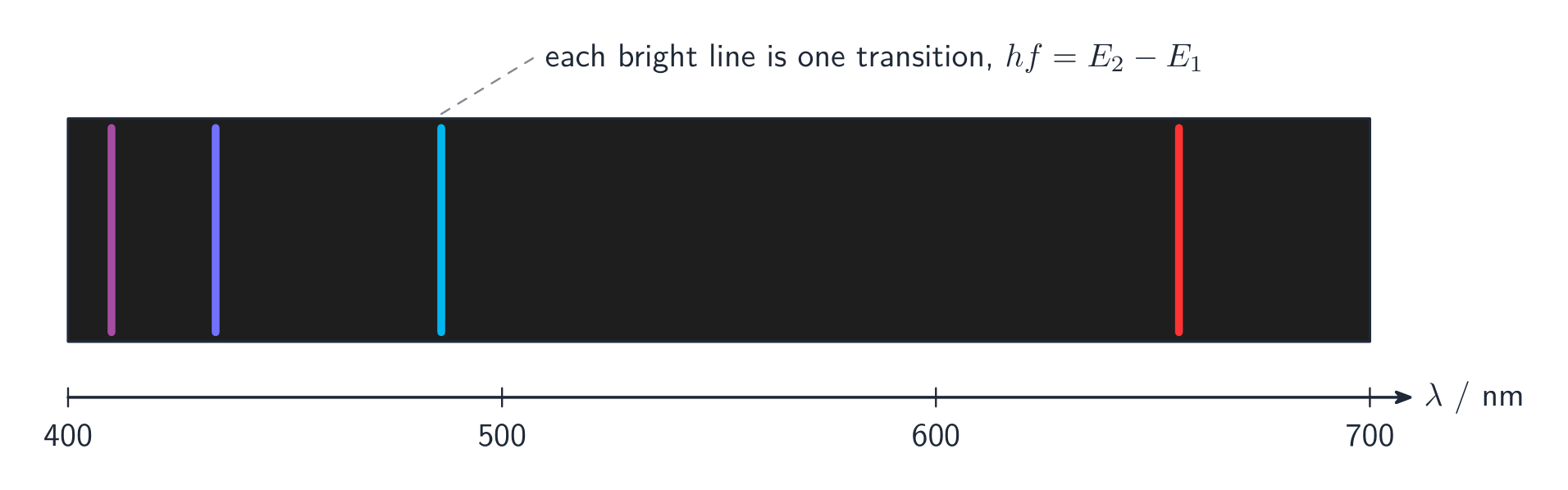
就那么几条线,而且总是同样的几条
Make an element's spectral lines · 制造一个元素的谱线
An electron dropping between fixed energy levels emits a photon of exactly the gap's energy — a fixed wavelength and colour. Each jump is one line of the element's barcode. · 一个电子在固定能级之间下落,发出能量恰好等于能级差的光子——一个固定的波长和颜色。每次跳跃都是元素条形码的一条线。
When an electron drops from level $E_2$ to · 到 $E_1$, the emitted photon has energy: · 当一个电子从能级 $E_2$ 跌到 $E_1$ 时,发射的光子能量是:
$hf = E_2 - E_1$ — a positive amount, since $E_2$ is the higher (less negative) level. · $hf = E_2 - E_1$——一个正值,因为 $E_2$ 是更高(负得更少)的能级。
Explaining a line spectrum, the standard four-marker
- One. The electrons in an isolated atom can occupy only discrete energy levels.
- Two. An electron in an excited state falls to a lower level, and the energy it loses is emitted as one photon.
- Three. The photon energy equals the difference between the two levels, $hf = E_2 - E_1$, so only certain frequencies are emitted.
- Four. Each possible transition gives one line, and the same set of levels always gives the same lines, which is why a spectrum identifies the element.
- All four are separate marks. Answers that stop after "the levels are discrete" collect one of them.
解释线状光谱:标准四分题
- 一。孤立原子中的电子只能占据分立的能级。
- 二。处于激发态的电子落到较低能级,它损失的能量以一个光子的形式发射出去。
- 三。光子能量等于两个能级之差,$hf = E_2 - E_1$,所以只发射某些特定频率。
- 四。每一种可能的跃迁给出一条线,而同一组能级永远给出同样的线,这就是光谱能鉴别元素的原因。
- 这四点是分开给分的。说到"能级是分立的"就停下的答案,只拿到其中一分。
An emission spectrum looks like: · 发射光谱看起来像:
Discrete transitions give discrete wavelengths — bright lines. (Dark lines on bright is an absorption spectrum.) · 分立的跃迁给出分立的波长——亮线。(亮背景上的暗线是吸收光谱。)
Put the four-mark explanation of a line emission spectrum in order. · 把线状发射光谱的四分解释按顺序排列。
All four ideas are separately marked. Stopping at "the levels are discrete" collects one mark of four. · 这四个要点是分开给分的。说到"能级是分立的"就停下,四分里只得一分。
Worked example: hydrogen's ultraviolet lines
- The lowest four levels of hydrogen are $-13.6$, $-3.40$, $-1.51$ and $-0.85\ \text{eV}$. Find the wavelengths of the three lines from transitions to the ground state, and how many lines the four levels give altogether.
- $2 \to 1$: $\Delta E = 10.2\ \text{eV}$, so $\lambda = 1240/10.2 = 122\ \text{nm}$.
- $3 \to 1$: $12.09\ \text{eV}$, $\lambda = 103\ \text{nm}$. $4 \to 1$: $12.75\ \text{eV}$, $\lambda = 97.3\ \text{nm}$. All three are ultraviolet, and the largest jump gives the shortest wavelength.
- Altogether: $4\to3$, $4\to2$, $4\to1$, $3\to2$, $3\to1$, $2\to1$, so six lines. Count every downward pair, not just the drops to the ground state.
- The visible red line of hydrogen is $3\to2$: $1.89\ \text{eV}$, $656\ \text{nm}$.
例题:氢的紫外谱线
- 氢最低的四个能级是 $-13.6$、$-3.40$、$-1.51$ 和 $-0.85\ \text{eV}$。求跃迁到基态的三条谱线的波长,以及这四个能级一共给出多少条线。
- $2 \to 1$:$\Delta E = 10.2\ \text{eV}$,所以 $\lambda = 1240/10.2 = 122\ \text{nm}$。
- $3 \to 1$:$12.09\ \text{eV}$,$\lambda = 103\ \text{nm}$。$4 \to 1$:$12.75\ \text{eV}$,$\lambda = 97.3\ \text{nm}$。三条都在紫外区,而跳得最大的给出最短的波长。
- 一共:$4\to3$、$4\to2$、$4\to1$、$3\to2$、$3\to1$、$2\to1$,所以是六条线。要数出每一对向下的组合,不只是落到基态的那些。
- 氢的可见红线是 $3\to2$:$1.89\ \text{eV}$,$656\ \text{nm}$。
An electron drops from $-1.5\ \text{eV}$ to · 到 $-3.4\ \text{eV}$. What is the energy of the emitted photon? · 一个电子从 $-1.5\ \text{eV}$ 跌到 $-3.4\ \text{eV}$。发射的光子能量是多少?
$hf = E_2 - E_1 = (-1.5) - (-3.4) = 1.9\ \text{eV}$. · $hf = E_2 - E_1 = (-1.5) - (-3.4) = 1.9\ \text{eV}$。
How many different spectral lines can four energy levels produce? · 四个能级一共能产生多少条不同的谱线?
Every downward pair counts: 4-3, 4-2, 4-1, 3-2, 3-1, 2-1. In general n levels give n(n-1)/2 lines, not n-1. · 每一对向下的组合都算:4-3、4-2、4-1、3-2、3-1、2-1。一般地,n 个能级给出 n(n-1)/2 条线,不是 n-1 条。
From levels to lines
- The rule for matching a diagram to a spectrum is short: the largest energy gap gives the highest frequency and the shortest wavelength.
- So the widest arrow on the level diagram is the line furthest to the left on a wavelength scale.
- Two atoms with completely different levels but the same gap emit the same line. The gap fixes the colour, never either level on its own.
Widest arrow, leftmost line
从能级到谱线
- 把能级图与光谱对应起来的规则很短:最大的能级间隔给出最高的频率和最短的波长。
- 所以能级图上最宽的那支箭,对应波长标尺上最左边的那条线。
- 两个能级完全不同、但间隔相同的原子,发出同一条线。定颜色的是间隔,从来不是单独的哪一个能级。
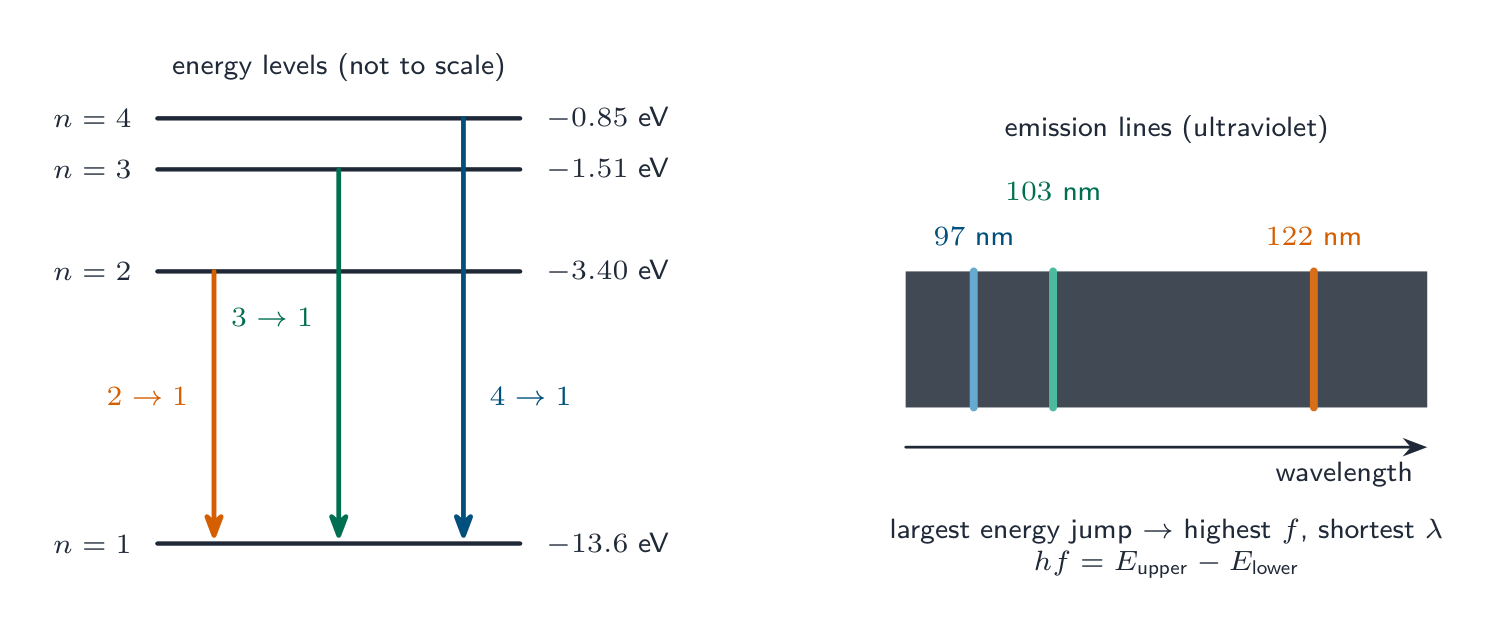
最宽的箭,最左的线
Match each transition to the line it produces. · 把每次跃迁与它产生的谱线配对。
Frequency and wavelength move in opposite directions, which is where most of the confusion in this question type comes from. · 频率和波长的方向相反,这类题的混乱大多来自这里。
On an energy-level diagram, the largest downward jump produces the line of ____ wavelength. · 在能级图上,最大的向下跃迁产生波长____的谱线。
Largest gap, largest photon energy, highest frequency, shortest wavelength. On a wavelength scale that line sits furthest to the left. · 间隔最大,光子能量最大,频率最高,波长最短。在波长标尺上那条线在最左边。
Absorption: the same lines, dark
- Pass white light through a cool gas and photons whose energy exactly matches an upward transition are absorbed, lifting electrons to higher levels.
- The result is dark lines on a bright continuous background, the absorption spectrum 吸收光谱, at exactly the same wavelengths as that gas emits.
- The subtle part, and the marked part: the excited electron soon falls back and re-emits a photon of the same energy, but in a random direction, so almost none of it continues along the original beam.
- Everything else in the white light matches no gap and passes straight through. The Sun's dark lines are made by the cooler gases in its outer layers.
A rainbow with pieces missing
吸收:同样的线,变成暗的
- 让白光穿过低温气体,能量恰好等于某个向上跃迁的光子会被吸收,把电子提到更高的能级。
- 结果是明亮连续背景上的暗线,即吸收光谱(absorption spectrum),位置与该气体发射的波长完全相同。
- 微妙之处,也是得分之处:被激发的电子很快落回,并重新发射一个能量相同的光子,但方向是随机的,所以几乎没有光继续沿原来的光束前进。
- 白光中其余的部分不匹配任何间隔,径直穿过。太阳光谱中的暗线是它外层较冷的气体造成的。
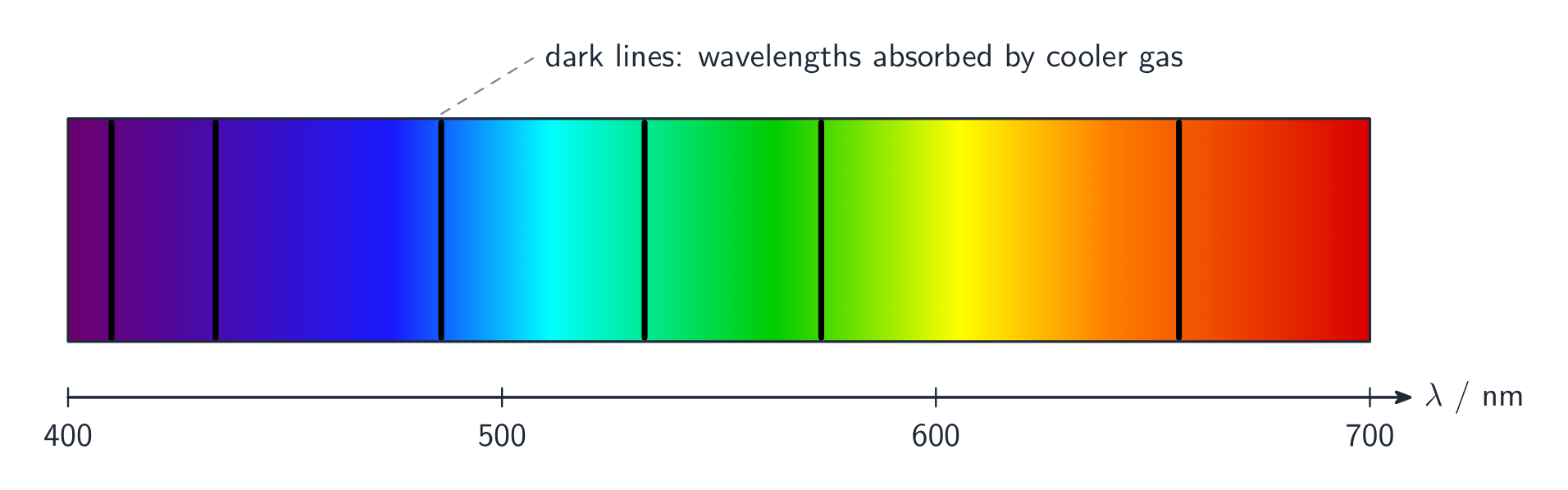
缺了几块的彩虹
A gas absorbs light at the same wavelengths at which it emits. · 一种气体在它发射的相同波长处吸收光。
The same energy gaps work both ways — so absorption lines sit exactly where the emission lines are. · 相同的能量间隔两个方向都成立——所以吸收线正好位于发射线所在的地方。
Why does a cool gas produce dark lines in a continuous spectrum? Select all · 所有 that apply. · 低温气体为什么会在连续光谱中产生暗线?选出所有适用的。
The random direction is the marked point. Absorption alone would not darken the line, because the energy could have carried on forwards. · 随机方向才是得分点。只有吸收并不能使谱线变暗,因为能量本可以继续向前传。
Worked example: from a wavelength to a gap
- A laser emits red light of wavelength $650\ \text{nm}$ when electrons drop between two levels. Find the energy gap.
- $\Delta E = \dfrac{hc}{\lambda} = \dfrac{1240}{650} = 1.91\ \text{eV} = 3.1\times10^{-19}\ \text{J}$.
- Use $hc = 1240\ \text{eV nm}$ when the answer is wanted in eV, and $hc = 1.99\times10^{-25}\ \text{J m}$ when it is wanted in joules. Mixing them is the standard slip.
- Note what the question can and cannot tell you: the gap, not either level. Two different atoms with the same gap give the same line.
例题:从波长求能级间隔
- 某激光器在电子在两个能级间下落时发出波长 $650\ \text{nm}$ 的红光。求这个能级间隔。
- $\Delta E = \dfrac{hc}{\lambda} = \dfrac{1240}{650} = 1.91\ \text{eV} = 3.1\times10^{-19}\ \text{J}$。
- 答案要 eV 时用 $hc = 1240\ \text{eV nm}$,要焦耳时用 $hc = 1.99\times10^{-25}\ \text{J m}$。把两者混用是标准失误。
- 注意这道题能告诉你什么、不能告诉你什么:是间隔,而不是任何一个能级。间隔相同的两种不同原子给出同一条线。
A laser emits light of wavelength 650 nm. What is the energy gap between the two levels, in eV? · 某激光器发出波长 650 nm 的光。两个能级之间的间隔是多少 eV?
1240/650 = 1.91 eV. The measurement fixes the GAP, not either level: two different atoms with the same gap emit the same line. · 1240/650 = 1.91 eV。测量确定的是间隔,不是任何一个能级:间隔相同的两种不同原子发出同一条线。
Marks that slip away
- Energy levels are negative. Subtracting them the wrong way round gives a negative photon energy and a negative wavelength.
- $n$ levels give $\tfrac{1}{2}n(n-1)$ lines, not $n - 1$. Count every pair.
- The largest gap gives the shortest wavelength. The two words move in opposite directions.
- For absorption, say the re-emission goes in a random direction. "The photon is absorbed" alone does not explain a dark line, since the energy could have carried on forwards.
- Convert eV to joules before mixing with SI quantities, or stay in eV and use $1240\ \text{eV nm}$ throughout.
容易丢掉的分
- 能级是负的。相减的方向弄反会得到负的光子能量和负的波长。
- $n$ 个能级给出 $\tfrac{1}{2}n(n-1)$ 条线,不是 $n - 1$ 条。要把每一对都数上。
- 最大的间隔给出最短的波长。这两个词的方向是相反的。
- 讲吸收时要说重新发射是朝随机方向的。只说"光子被吸收"解释不了暗线,因为能量本可以继续向前传。
- 与 SI 量混算之前把 eV 换成焦耳,或者全程留在 eV 并用 $1240\ \text{eV nm}$。
You've got it
- electrons in an isolated atom occupy discrete, negative energy levels, the lowest being the ground state
- a drop from $E_2$ to $E_1$ emits one photon with $hf = E_2 - E_1$, giving sharp bright lines unique to the element
- an absorption spectrum is dark lines on a bright background at the same wavelengths, because the re-emitted photons go off in random directions
- the largest energy gap gives the highest frequency and shortest wavelength, and $n$ levels give $\tfrac{1}{2}n(n-1)$ possible lines
你掌握了
- 孤立原子中的电子占据分立的、为负的能级,最低的是基态
- 从 $E_2$ 落到 $E_1$ 发射一个光子,$hf = E_2 - E_1$,给出该元素独有的锐利亮线
- 吸收光谱是明亮背景上、位于相同波长处的暗线,因为重新发射的光子飞向随机方向
- 最大的能级间隔给出最高频率和最短波长,而 $n$ 个能级给出 $\tfrac{1}{2}n(n-1)$ 条可能的谱线