Simple harmonic motion · 简谐运动
| English | 中文 | Pinyin · 拼音 |
|---|---|---|
| simple harmonic motion/ˈsɪmpl hɑːˈmɒnɪk ˈməʊʃn/ | 简谐运动 | jiǎn xié yùn dòng |
| displacement/dɪˈspleɪsmənt/ | 位移 | wèiyí |
| equilibrium/ˌiːkwɪˈlɪbrɪəm/ | 平衡 | píng héng |
| amplitude/ˈæmplɪtjuːd/ | 振幅 | zhèn fú |
| period/ˈpɪərɪəd/ | 周期 | zhōu qī |
| frequency/ˈfriːkwənsi/ | 频率 | pín lǜ |
| angular frequency/ˈæŋɡjʊlə ˈfriːkwənsi/ | 角频率 | jiǎo pín lǜ |
The lamp that taught the world to keep time
- In 1583 a student in Pisa cathedral, bored during a sermon, timed a swinging lamp against his own pulse. Whether the lamp swung wide or narrow, each swing took the same time.
- That is not obvious and it is not true of most motions. It is true whenever the restoring force grows in proportion to how far the thing has been displaced, and that one condition defines the whole topic.
- Galileo's observation became the pendulum clock, and every clock for the next 300 years.
- This lesson is simple harmonic motion 简谐运动: its defining equation, the words that describe it, and how to read $\omega$ off a graph.
教会世界计时的那盏吊灯
- 1583 年,比萨大教堂里一名在布道中听得无聊的学生,用自己的脉搏给一盏摇摆的吊灯计时。不论灯摆得宽还是窄,每一次摆动用的时间都一样。
- 这并不显然,对大多数运动也不成立。只要回复力随物体被拉开的距离成正比地增长,它就成立,而这一个条件定义了整个单元。
- 伽利略的这个观察变成了摆钟,以及此后三百年里的每一台钟。
- 这一课讲简谐运动(simple harmonic motion):它的定义式、描述它的术语,以及怎样从图上读出 $\omega$。
The definition
- A body moves with simple harmonic motion when its acceleration is proportional to its displacement 位移 from a fixed point, and always directed towards that point.
- Both halves are needed for both marks. "Proportional to displacement" alone describes a force pushing it further away just as well.
- In symbols, with the minus sign carrying "towards the equilibrium position":
Displaced right, accelerating left; displaced left, accelerating right
定义
- 当一个物体的加速度与它相对某定点的位移(displacement)成正比,并且始终指向那个点时,它作简谐运动。
- 两分需要两半都有。单说"与位移成正比",同样可以描述一个把它推得更远的力。
- 用符号写,负号承载着"指向平衡位置"的含义:
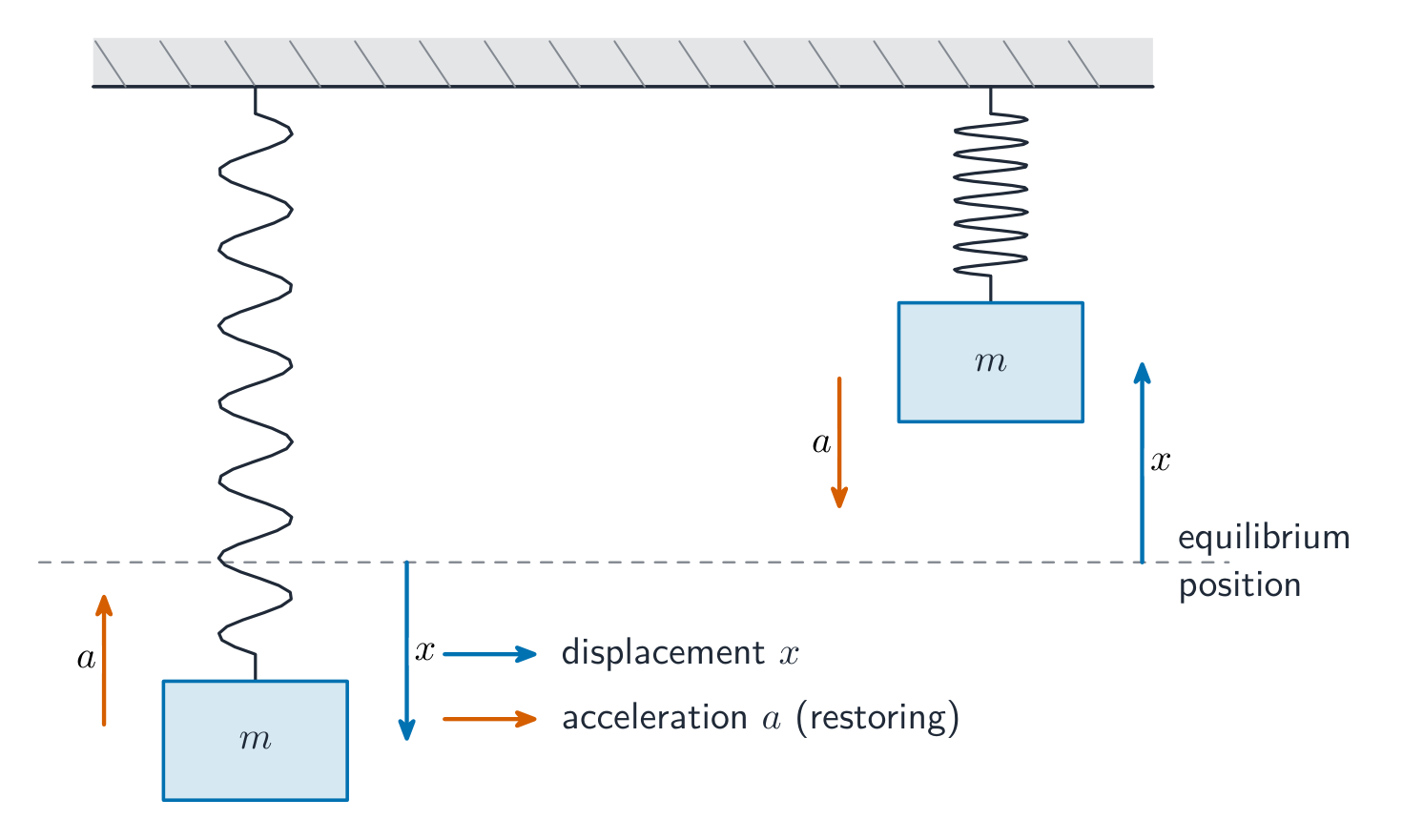
向右位移,向左加速;向左位移,向右加速
In simple harmonic motion, the acceleration is: · 在简谐运动中,加速度是:
That is exactly $a = -\omega^{2}x$ — bigger displacement, bigger pull back; always toward the middle. · 这正是 $a = -\omega^{2}x$——位移越大,拉回越大;总是指向中间。
A full definition of simple harmonic motion needs which statements? Select all · 所有 that apply. · 简谐运动的完整定义需要哪些陈述?选出所有适用的。
Those two statements are the definition and carry both marks. The constant period is a consequence of them, and the speed is certainly not constant. · 这两句就是定义,承载两分。恒定周期是它们的结果,而速率显然不恒定。
The vocabulary
- Displacement $x$: distance from the equilibrium 平衡 position, with a direction. Amplitude 振幅 $x_0$: the maximum displacement.
- Period 周期 $T$: the time for one complete oscillation. Frequency 频率 $f = 1/T$: oscillations per second, in hertz.
- Angular frequency 角频率 $\omega$: connects the two, $\omega = \dfrac{2\pi}{T} = 2\pi f$. Given any one of $\omega$, $f$ and $T$ you can find the others, and most questions start by doing exactly that.
术语
- 位移 $x$:相对平衡(equilibrium)位置的距离,带方向。振幅(amplitude)$x_0$:最大位移。
- 周期(period)$T$:完成一次完整振动所需的时间。频率(frequency)$f = 1/T$:每秒的振动次数,单位赫兹。
- 角频率(angular frequency)$\omega$:把两者联系起来,$\omega = \dfrac{2\pi}{T} = 2\pi f$。已知 $\omega$、$f$、$T$ 中任何一个就能求出其余,而多数题目开头做的正是这件事。
Swing a pendulum · 摆动单摆
Set it swinging, then change the start angle — the time for one swing stays the same (that is what makes it a good clock). Now make the string longer, or move to the Moon, and watch the period change. · 设置其摆动,然后改变起始角度——一次摆动的时间保持不变(这正是它成为良好时钟的原因)。现在加长绳子,或移至月球,观察周期的变化。
An oscillation has a period of $2.0\ \text{s}$. What is its angular frequency $\omega$? · 一个振动的周期是 $2.0\ \text{s}$。它的角频率 $\omega$ 是多少?
$\omega = \dfrac{2\pi}{T} = \dfrac{2\pi}{2.0} = \pi \approx 3.14\ \dfrac{\text{rad}}{\text{s}}$. · $\omega = \dfrac{2\pi}{T} = \dfrac{2\pi}{2.0} = \pi \approx 3.14\ \dfrac{\text{rad}}{\text{s}}$。
Displacement with time
- Starting from the equilibrium position at $t = 0$: $x = x_0 \sin(\omega t)$. Starting from an extreme: $x = x_0 \cos(\omega t)$.
- Which you use depends only on where the motion starts. Read the question's opening condition before choosing.
- The graph is a sine curve of amplitude $x_0$ and period $T$, and the motion repeats exactly.
One period, one full cycle, and then the same again
位移随时间的变化
- 若 $t = 0$ 时从平衡位置出发:$x = x_0 \sin(\omega t)$。若从一端出发:$x = x_0 \cos(\omega t)$。
- 用哪一个只取决于运动从哪里开始。选之前先读题目开头的条件。
- 图像是振幅 $x_0$、周期 $T$ 的正弦曲线,而运动精确地重复。
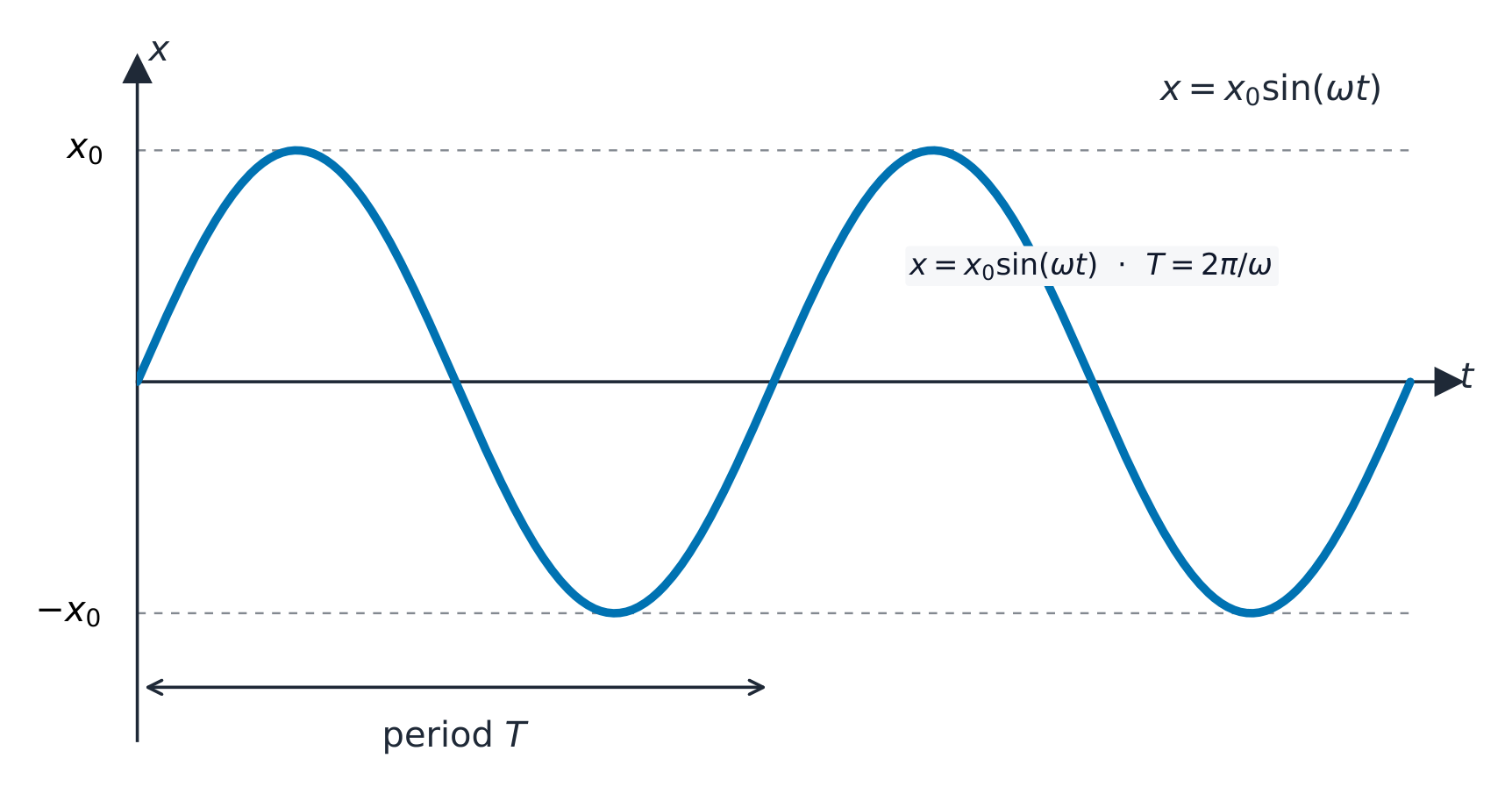
一个周期,一个完整循环,然后重来
Speed anywhere in the motion
- The speed at displacement $x$, without needing the time:
- At the centre, $x = 0$, this gives the maximum speed $v_{\text{max}} = \omega x_0$. At the extremes, $x = \pm x_0$, it gives zero.
- That is the pattern to hold on to: fastest in the middle, momentarily at rest at each end, and the acceleration is the other way round, zero in the middle and greatest at the ends.
运动中任意位置的速率
- 位移为 $x$ 处的速率,不需要时间:
- 在中心 $x = 0$ 处,这给出最大速率 $v_{\text{max}} = \omega x_0$。在两端 $x = \pm x_0$ 处,它给出零。
- 要记住这个规律:中间最快,两端各有一瞬静止;而加速度恰好相反,中间为零、两端最大。
In SHM the speed is greatest at the ____ position. · 在简谐运动中,速率在 ____ 位置最大。
At the middle all the energy is kinetic, so the speed is maximum ($v = \omega x_0$). · 在中间所有能量都是动能,所以速率最大($v = \omega x_0$)。
At the extremes of the motion ($x = \pm x_0$), the speed is zero. · 在运动的两端($x = \pm x_0$),速率为零。
The oscillator stops for an instant at each end before reversing — speed zero, acceleration maximum. · 振子在每一端瞬间停下再反向——速率为零,加速度最大。
An oscillator has amplitude $0.10\ \text{m}$ and $\omega = 10\ \dfrac{\text{rad}}{\text{s}}$. What is its maximum speed? · 一个振子的振幅是 $0.10\ \text{m}$,$\omega = 10\ \dfrac{\text{rad}}{\text{s}}$。它的最大速率是多少?
Maximum speed $= \omega x_0 = 10 \times 0.10 = 1.0\ \dfrac{\text{m}}{\text{s}}$. · 最大速率 $= \omega x_0 = 10 \times 0.10 = 1.0\ \dfrac{\text{m}}{\text{s}}$。
Match each quantity to where in the oscillation it is greatest. · 把每个量与它在振动中何处最大配对。
Speed and acceleration peak at opposite places, and they are never both maximum at the same instant. · 速率和加速度在相反的位置取最大,而且它们绝不会在同一瞬间同时最大。
Worked example: from period to maximum speed
- A mass oscillates with a period of $2.0\ \text{s}$ and an amplitude of $0.10\ \text{m}$. Find its maximum speed and its maximum acceleration.
- First $\omega$: $\omega = \dfrac{2\pi}{T} = \dfrac{2\pi}{2.0} = 3.14\ \text{rad/s}$. Almost every SHM question begins here.
- Maximum speed, at the centre: $v_{\text{max}} = \omega x_0 = 3.14 \times 0.10 = 0.31\ \text{m/s}$.
- Maximum acceleration, at the extremes: $a_{\text{max}} = \omega^2 x_0 = 3.14^2 \times 0.10 = 0.99\ \text{m/s}^2$.
- Note where each maximum occurs. A question asking "at what displacement" wants the centre for speed and the extremes for acceleration.
例题:从周期到最大速率
- 一个物体以 $2.0\ \text{s}$ 的周期、$0.10\ \text{m}$ 的振幅振动。求它的最大速率和最大加速度。
- 先求 $\omega$:$\omega = \dfrac{2\pi}{T} = \dfrac{2\pi}{2.0} = 3.14\ \text{rad/s}$。几乎每道简谐运动题都从这里开始。
- 最大速率,在中心:$v_{\text{max}} = \omega x_0 = 3.14 \times 0.10 = 0.31\ \text{m/s}$。
- 最大加速度,在两端:$a_{\text{max}} = \omega^2 x_0 = 3.14^2 \times 0.10 = 0.99\ \text{m/s}^2$。
- 注意每个最大值出现在哪里。问"在什么位移处"的题,速率要答中心,加速度要答两端。
An oscillation has period 2.0 s and amplitude 0.10 m. What is its maximum speed in m/s? · 一个振动的周期是 2.0 s,振幅是 0.10 m。它的最大速率是多少 m/s?
omega = 2 pi / T = 3.14 rad/s, and v_max = omega x0 = 0.31 m/s, which occurs at the centre. The maximum acceleration, at the ends, is omega squared times x0 = 0.99 m/s^2. · omega = 2 pi / T = 3.14 rad/s,v_max = omega x0 = 0.31 m/s,出现在中心。最大加速度在两端,为 omega 平方乘 x0 = 0.99 m/s^2。
Reading the acceleration-displacement graph
- Because $a = -\omega^2 x$, a graph of acceleration against displacement is a straight line through the origin with a negative gradient.
- The gradient is $-\omega^2$, so $\omega = \sqrt{|\text{gradient}|}$ and then $T = 2\pi/\omega$.
- This is the standard way an exam gives you $\omega$ without stating it. A straight line through the origin with negative gradient is also the standard way of asking you to show that a motion is simple harmonic.
Straight, through the origin, negative: all three matter
读加速度—位移图
- 因为 $a = -\omega^2 x$,加速度对位移的图像是一条过原点的直线,斜率为负。
- 斜率是 $-\omega^2$,所以 $\omega = \sqrt{|\text{gradient}|}$,再求 $T = 2\pi/\omega$。
- 这是考试在不明说的情况下给你 $\omega$ 的标准做法。一条过原点、斜率为负的直线,也是要求你证明某运动是简谐运动的标准方式。
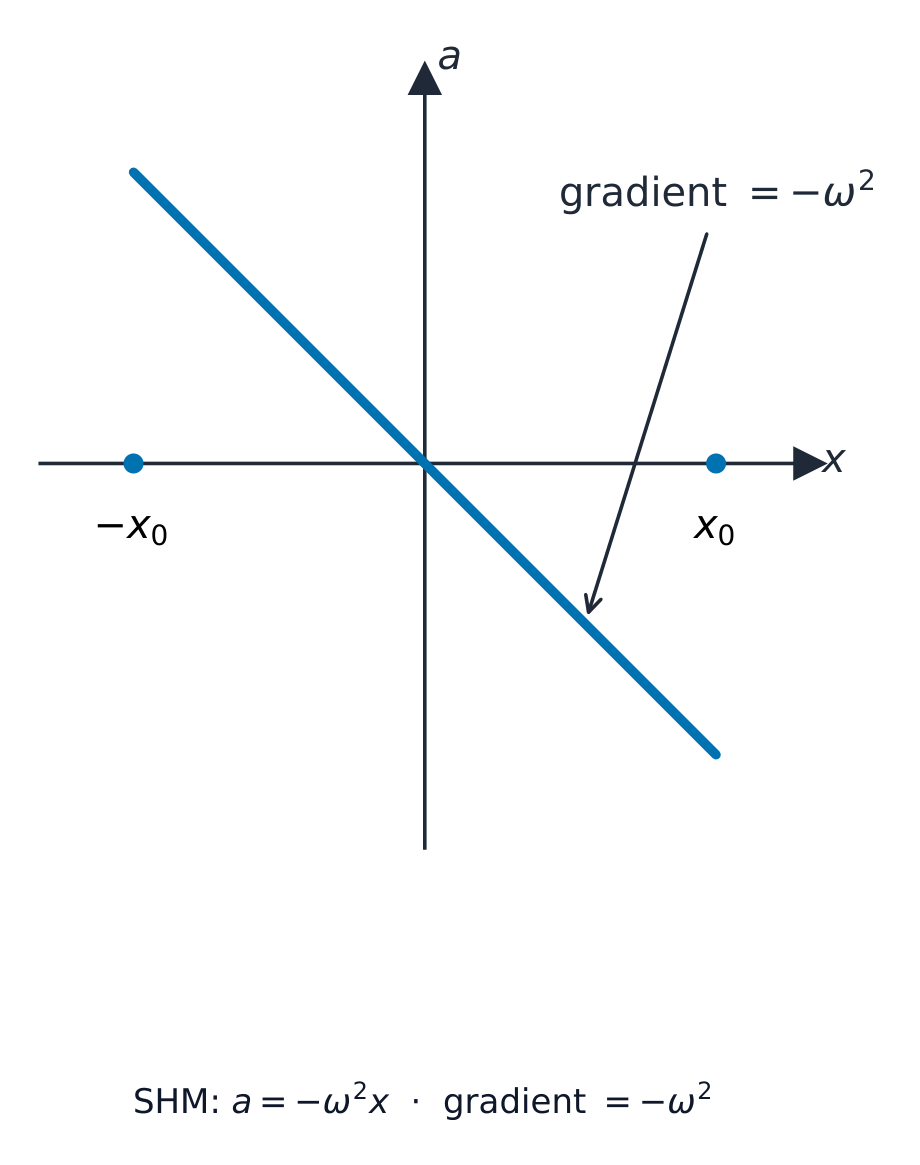
直线、过原点、斜率为负:三点都要紧
On an acceleration-against-displacement graph for SHM, the gradient equals: · 在简谐运动的加速度对位移图上,斜率等于:
$a = -\omega^{2}x$ is a straight line of gradient $-\omega^{2}$, so $\omega = \sqrt{|\text{gradient}|}$. · $a = -\omega^{2}x$ 是一条斜率为 $-\omega^{2}$ 的直线,所以 $\omega = \sqrt{|\text{gradient}|}$。
Worked example: is it simple harmonic?
- Measurements of a trolley's acceleration at various displacements give a straight line through the origin with gradient $-25\ \text{/s}^2$. Show that the motion is simple harmonic and find the period.
- The graph is a straight line, so $a \propto x$; it passes through the origin, so there is no constant term; and its gradient is negative, so the acceleration is directed towards the equilibrium position. Those three facts are the definition, so the motion is simple harmonic.
- The gradient is $-\omega^2 = -25$, so $\omega = 5.0\ \text{rad/s}$ and $T = \dfrac{2\pi}{5.0} = 1.3\ \text{s}$.
例题:它是简谐运动吗
- 测量一辆小车在不同位移处的加速度,得到一条过原点、斜率为 $-25\ \text{/s}^2$ 的直线。证明该运动是简谐运动并求周期。
- 图像是直线,所以 $a \propto x$;它过原点,所以没有常数项;它的斜率为负,所以加速度指向平衡位置。这三个事实就是定义,所以该运动是简谐运动。
- 斜率是 $-\omega^2 = -25$,所以 $\omega = 5.0\ \text{rad/s}$,$T = \dfrac{2\pi}{5.0} = 1.3\ \text{s}$。
An acceleration-displacement graph for an oscillator is a straight line through the origin of gradient -25 per second squared. What is the period, in seconds? · 某振子的加速度—位移图是一条过原点、斜率为每二次方秒 -25 的直线。周期是多少秒?
The gradient is minus omega squared, so omega = 5.0 rad/s and T = 2 pi / 5.0 = 1.3 s. Straight, through the origin and negative is also the proof that the motion is simple harmonic. · 斜率是负的 omega 平方,所以 omega = 5.0 rad/s,T = 2 pi / 5.0 = 1.3 s。直线、过原点、斜率为负,同时也是该运动为简谐运动的证明。
Marks that slip away
- The definition needs both halves: proportional to displacement and directed towards a fixed point. The minus sign is what carries the second.
- $\omega$ is in rad s$^{-1}$, not hertz. Convert with $\omega = 2\pi f$ before substituting.
- Speed is greatest at the centre; acceleration is greatest at the extremes. They are never both maximum at once.
- Choose sine or cosine from where the motion starts, not by habit.
容易丢掉的分
- 定义需要两半:与位移成正比并且指向一个定点。负号承载的正是第二半。
- $\omega$ 的单位是 rad s$^{-1}$,不是赫兹。代入前先用 $\omega = 2\pi f$ 换算。
- 速率在中心最大;加速度在两端最大。它们绝不会同时取最大。
- 按运动从哪里开始来选正弦还是余弦,不要凭习惯。
You've got it
- SHM: acceleration proportional to displacement and directed towards a fixed point, so $a = -\omega^2 x$
- $\omega = \dfrac{2\pi}{T} = 2\pi f$, and almost every question starts by finding $\omega$
- $x = x_0\sin\omega t$ from the centre or $x_0\cos\omega t$ from an extreme; $v = \pm\omega\sqrt{x_0^2 - x^2}$, so $v_{\text{max}} = \omega x_0$ at the centre and $a_{\text{max}} = \omega^2 x_0$ at the ends
- an acceleration-displacement graph that is straight, through the origin and negative proves SHM, and its gradient is $-\omega^2$
你掌握了
- 简谐运动:加速度与位移成正比且指向一个定点,所以 $a = -\omega^2 x$
- $\omega = \dfrac{2\pi}{T} = 2\pi f$,几乎每道题都从求 $\omega$ 开始
- 从中心出发用 $x = x_0\sin\omega t$,从一端出发用 $x_0\cos\omega t$;$v = \pm\omega\sqrt{x_0^2 - x^2}$,所以中心处 $v_{\text{max}} = \omega x_0$、两端 $a_{\text{max}} = \omega^2 x_0$
- 一条直的、过原点、斜率为负的加速度—位移图就证明了简谐运动,而它的斜率是 $-\omega^2$