Kinetic theory of gases · 气体分子动理论
| English | 中文 | Pinyin · 拼音 |
|---|---|---|
| kinetic theory/kɪˈnetɪk ˈθɪəri/ | 分子动理论 | fèn zǐ dòng lǐ lùn |
| random motion/ˈrændəm ˈməʊʃn/ | 无规则运动 | wú guī zé yùn dòng |
| elastic/ɪˈlæstɪk/ | 弹性 | tán xìng |
| momentum/məʊˈmentəm/ | 动量 | dòngliàng |
| mean-square speed/miːn skweə spiːd/ | 均方速率 | jūn fāng sù lǜ |
| root-mean-square/ruːt miːn skweə/ | 均方根 | jūn fāng gēn |
| average translational kinetic energy/ˈævrɪdʒ trænˈsleɪʃənl kɪˈnetɪk ˈenədʒi/ | 平动动能 | píng dòng dòng néng |
Pressure is a drum roll, not a push
- A balloon feels like it is being pushed steadily outwards. Nothing is pushing steadily. Molecules are striking the rubber at random, each blow lasting a fraction of a nanosecond.
- There are so many blows, so close together, that the average is perfectly smooth. Pressure is a drum roll heard from far enough away that the individual beats disappear.
- Taking that picture seriously, and applying nothing but Newton's laws to it, produces the gas laws from scratch and reveals what temperature actually is.
- This lesson is the assumptions of kinetic theory 分子动理论, the pressure derivation, r.m.s. speed and the meaning of temperature.
压强是一阵鼓点,不是一次推
- 气球感觉像是被稳稳地向外推着。并没有什么在稳稳地推。分子在随机地撞击橡皮,每一击只持续不到一纳秒。
- 撞击如此之多、如此密集,以致平均下来完美地平滑。压强是一阵从足够远处听到的鼓点,单个的敲击已经分辨不出。
- 认真对待这幅图像,并且只用牛顿定律作用于它,就能从零推出气体定律,并揭示温度究竟是什么。
- 这一课讲分子动理论(kinetic theory)的假设、压强的推导、均方根速率,以及温度的含义。
The assumptions
- A large number of identical molecules in continuous random motion 无规则运动.
- The molecules' own volume is negligible compared with the volume of the gas.
- There are no forces between molecules except during collisions, so they travel in straight lines between them.
- Collisions are perfectly elastic 弹性, losing no kinetic energy, and the time of a collision is negligible compared with the time between collisions. Newton's laws apply throughout.
- These fail at very high pressure, where molecular volume matters, and at very low temperature, where intermolecular forces matter.
假设
- 大量全同分子处于持续的无规则运动(random motion)中。
- 分子自身的体积与气体的体积相比可忽略。
- 除碰撞瞬间外分子之间没有作用力,所以它们在两次碰撞之间沿直线运动。
- 碰撞是完全弹性(elastic)的,不损失动能;而且一次碰撞的时间与两次碰撞的间隔相比可忽略。牛顿定律全程适用。
- 这些假设在极高压下失效——那时分子体积要紧;在极低温下也失效——那时分子间力要紧。
Select all · 所有 the assumptions of the kinetic theory of an ideal gas. · 选出所有理想气体分子动理论的假设。
Forces between molecules are ignored except during (elastic) collisions — they do not attract strongly at all times. · 除(弹性)碰撞期间外,分子之间的力被忽略——它们并非在任何时候都强烈吸引。
Deriving the pressure
- Take a cube of side $L$ holding $N$ molecules of mass $m$, and follow one moving along $x$ with velocity $u_1$.
- One collision with the right wall reverses its velocity, so its momentum 动量 changes by $-2mu_1$ and, by Newton's third law, the wall receives $+2mu_1$.
- Between hits on that wall it travels $2L$, so $\Delta t = 2L/u_1$, giving an average force $F_1 = \Delta p/\Delta t = mu_1^2/L$.
- Summing over all molecules and dividing by the wall area $L^2$ gives $p = Nm\langle u_x^2\rangle / V$. In three dimensions, symmetry means $\langle u_x^2\rangle = \tfrac13\langle c^2\rangle$, so:
One molecule, one wall, then multiply up
推导压强
- 取一个边长 $L$ 的立方体,内含 $N$ 个质量为 $m$ 的分子,跟踪其中一个沿 $x$ 方向以速度 $u_1$ 运动的分子。
- 与右壁的一次碰撞使它的速度反向,所以它的动量(momentum)改变 $-2mu_1$,而由牛顿第三定律,壁获得 $+2mu_1$。
- 两次撞击该壁之间它走过 $2L$,所以 $\Delta t = 2L/u_1$,平均力为 $F_1 = \Delta p/\Delta t = mu_1^2/L$。
- 对所有分子求和再除以壁面积 $L^2$,得 $p = Nm\langle u_x^2\rangle / V$。在三维中,由对称性 $\langle u_x^2\rangle = \tfrac13\langle c^2\rangle$,所以:
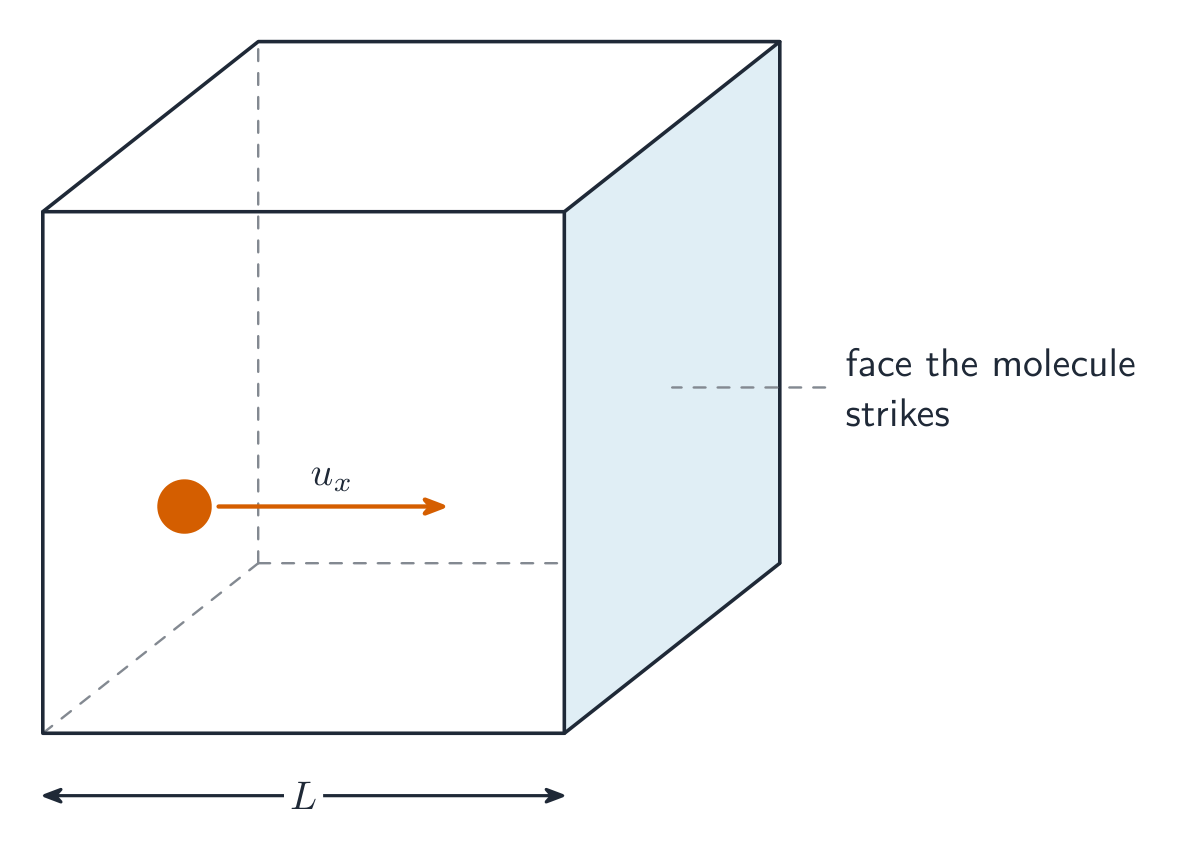
一个分子、一面墙,然后放大到全体
Boyle's law · 玻意耳定律
p ∝ 1/V
At constant temperature, pressure is inversely proportional to volume — squash the gas and the pressure rises. · 在恒定温度下,压力与体积成反比——压缩气体,压力上升。
A gas exerts pressure on its container because the molecules: · 气体对它的容器施加压强,因为分子:
Each collision pushes on the wall; the combined effect of countless collisions is the pressure. · 每次碰撞都推动器壁;无数次碰撞的合效果就是压强。
Worked example: explain the pressure in words
- Explain how molecular movement causes the pressure exerted by a gas. [3]
- The molecules move randomly and collide with the walls of the container.
- At each collision a molecule rebounds, so its momentum changes; by Newton's second law the wall exerts a force on it, and by the third law it exerts an equal and opposite force on the wall.
- There are very many collisions each second, so the individual impulses average to a steady total force, and pressure is that force divided by the area.
- Three sentences, three marks. The middle one must name both of Newton's laws to earn its mark.
例题:用文字解释压强
- 解释分子运动怎样产生气体施加的压强。[3]
- 分子作无规则运动并与容器壁碰撞。
- 每次碰撞时分子反弹,所以它的动量改变;由牛顿第二定律壁对它施力,由第三定律它对壁施加大小相等方向相反的力。
- 每秒有极多次碰撞,所以一次次的冲量平均成一个稳定的合力,而压强就是这个力除以面积。
- 三句话,三分。中间那句必须点出牛顿的两条定律才能拿到它那一分。
Put the three-mark explanation of gas pressure in order. · 把气体压强的三分解释按顺序排列。
Random motion, momentum change with both of Newton's laws, the averaging over many collisions, then force per area. · 无规则运动、带上牛顿两条定律的动量变化、在极多次碰撞上的平均,然后是单位面积上的力。
The density form
- $Nm$ is the total mass of the gas, so $Nm/V$ is its density $\rho$. The same result reads:
- Use this version whenever a question gives a density instead of $N$ and $m$, which it often does.
密度形式
- $Nm$ 是气体的总质量,所以 $Nm/V$ 是它的密度 $\rho$。同一结果读作:
- 当题目给出的是密度而不是 $N$ 和 $m$ 时——这很常见——就用这个版本。
Root-mean-square speed
- $\langle c^2 \rangle$ is the mean-square speed 均方速率: square each molecule's speed, then average. Its square root is the root-mean-square 均方根 speed:
- It is a single useful measure of molecular speed, slightly larger than the mean speed because squaring weights the fast molecules more heavily.
- The molecules do not all move at this speed. They have a wide spread, and raising the temperature shifts the whole spread to higher speeds.
A distribution, of which the r.m.s. speed is one summary
均方根速率
- $\langle c^2 \rangle$ 是均方速率(mean-square speed):把每个分子的速率平方,再求平均。它的平方根是均方根(root-mean-square)速率:
- 它是分子速率的一个有用的单一度量,略大于平均速率,因为平方给了快分子更大的权重。
- 分子并非都以这个速率运动。它们有很宽的分布,而提高温度会把整个分布移向更高的速率。
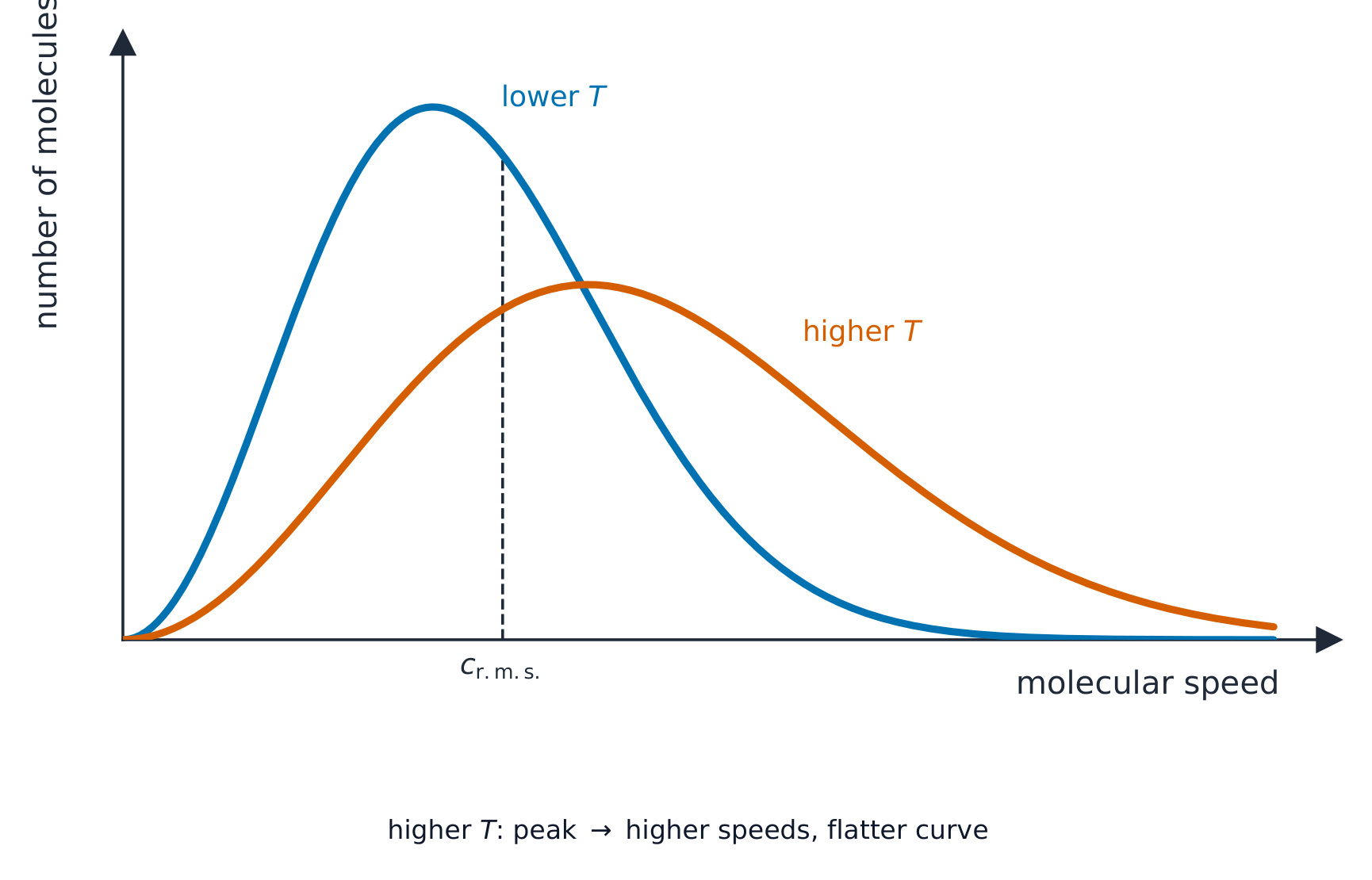
一个分布,而均方根速率是它的一个概括
The r.m.s. speed is the square root of the ____ speed. · 均方根速率是 ____ 速率的平方根。
Take the mean of the squared speeds, then square-root it: $c_{\text{r.m.s.}} = \sqrt{\langle c^{2}\rangle}$. · 先取速率平方的平均,再开平方根:$c_{\text{r.m.s.}} = \sqrt{\langle c^{2}\rangle}$。
How is the root-mean-square speed calculated from a set of molecular speeds? · 由一组分子速率怎样算出均方根速率?
Square, average, root, in that order. Squaring first weights the fast molecules more, which is why c_rms is slightly larger than the mean speed. · 平方、平均、开方,按这个顺序。先平方给了快分子更大权重,这就是 c_rms 略大于平均速率的原因。
Worked example: r.m.s. speed from a density
- An ideal gas at a pressure of $1.6 \times 10^5\ \text{Pa}$ has a density of $1.9\ \text{kg/m}^3$. Show that the r.m.s. speed of its molecules is about $500\ \text{m/s}$.
- From $p = \tfrac13\rho\langle c^2\rangle$: $\langle c^2 \rangle = \dfrac{3p}{\rho} = \dfrac{3 \times 1.6 \times 10^5}{1.9} = 2.53 \times 10^5\ \text{m}^2\text{/s}^2$.
- Then $c_{\text{r.m.s.}} = \sqrt{2.53 \times 10^5} = 503\ \text{m/s} \approx 500\ \text{m/s}$.
- In a "show that", carry an extra significant figure and quote it (503) before comparing with the value given. Rounding to 500 first proves nothing.
例题:由密度求均方根速率
- 某理想气体在 $1.6 \times 10^5\ \text{Pa}$ 的压强下密度为 $1.9\ \text{kg/m}^3$。证明其分子的均方根速率约为 $500\ \text{m/s}$。
- 由 $p = \tfrac13\rho\langle c^2\rangle$:$\langle c^2 \rangle = \dfrac{3p}{\rho} = \dfrac{3 \times 1.6 \times 10^5}{1.9} = 2.53 \times 10^5\ \text{m}^2\text{/s}^2$。
- 于是 $c_{\text{r.m.s.}} = \sqrt{2.53 \times 10^5} = 503\ \text{m/s} \approx 500\ \text{m/s}$。
- 在"证明约为"的题里,多带一位有效数字并把它写出来(503),再与给定值比较。先四舍五入到 500 什么也证明不了。
An ideal gas at 1.6 x 10^5 Pa has density 1.9 kg/m^3. What is the r.m.s. speed of its molecules, in m/s? · 某理想气体在 1.6 x 10^5 Pa 下密度为 1.9 kg/m^3。它分子的均方根速率是多少 m/s?
Use p = rho <c^2>/3, so <c^2> = 3p/rho = 2.53e5 and c_rms = 503 m/s. In a 'show that' question, quote the extra figure before rounding. · 用 p = rho <c^2>/3,所以 <c^2> = 3p/rho = 2.53e5,c_rms = 503 m/s。在"证明约为"的题里,先写出多余的那位再取整。
What temperature actually is
- Two expressions for the same $pV$: $pV = NkT$ from the equation of state, and $pV = \tfrac13 Nm\langle c^2\rangle$ from kinetic theory. Set them equal, cancel $N$ and multiply by $\tfrac32$:
- The left side is the average translational kinetic energy 平动动能 of one molecule. So temperature is a measure of average molecular kinetic energy, and nothing else.
- Two consequences the exam asks for. Double the absolute temperature and the average kinetic energy doubles, so $c_{\text{r.m.s.}}$ grows by $\sqrt{2}$. And at the same temperature, lighter molecules move faster, since $\tfrac12 m\langle c^2\rangle$ is the same for both.
温度究竟是什么
- 同一个 $pV$ 的两个表达式:由状态方程得 $pV = NkT$,由分子动理论得 $pV = \tfrac13 Nm\langle c^2\rangle$。令二者相等,约去 $N$,再乘以 $\tfrac32$:
- 左边是单个分子的平动动能(average translational kinetic energy)。所以温度就是平均分子动能的量度,别无其他。
- 考试要考的两个推论。绝对温度加倍,平均动能加倍,所以 $c_{\text{r.m.s.}}$ 增大 $\sqrt{2}$ 倍。而在同一温度下,更轻的分子运动更快,因为 $\tfrac12 m\langle c^2\rangle$ 对两者相同。
The average translational kinetic energy of a gas molecule depends only on: · 一个气体分子的平均平动动能只取决于:
$\langle E_k\rangle = \tfrac{3}{2}kT$ — only the thermodynamic temperature matters. · $\langle E_k\rangle = \tfrac{3}{2}kT$——只有热力学温度有关。
If the absolute temperature doubles, the r.m.s. speed grows by a factor of: · 如果绝对温度加倍,均方根速率变为原来的多少倍:
$\langle c^{2}\rangle \propto T$, so $c_{\text{r.m.s.}} \propto \sqrt{T}$ — doubling $T$ multiplies it by $\sqrt{2} \approx 1.41$. · $\langle c^{2}\rangle \propto T$,所以 $c_{\text{r.m.s.}} \propto \sqrt{T}$——$T$ 加倍使它乘以 $\sqrt{2} \approx 1.41$。
At the same temperature, lighter molecules move faster on average than heavier ones. · 在相同温度下,更轻的分子平均比更重的分子运动更快。
Same average KE $\tfrac{3}{2}kT$, but smaller mass means a larger $\langle c^{2}\rangle$ — so lighter molecules are faster. · 平均动能 $\tfrac{3}{2}kT$ 相同,但更小的质量意味着更大的 $\langle c^{2}\rangle$——所以更轻的分子更快。
Comparing pV = NkT with pV = Nm<c^2>/3 shows that the average translational kinetic energy of a molecule equals ____ kT. · 把 pV = NkT 与 pV = Nm<c^2>/3 比较,可知一个分子的平均平动动能等于 ____ kT。
So temperature is a direct measure of average molecular kinetic energy, and the internal energy of an ideal gas is (3/2)nRT. · 所以温度是平均分子动能的直接量度,而理想气体的内能是 (3/2)nRT。
Internal energy of an ideal gas
- An ideal gas has no forces between molecules, so there is no molecular potential energy: its internal energy is entirely kinetic.
- Multiplying the average kinetic energy by the number of molecules:
- So the internal energy of an ideal gas depends only on its temperature, not on its pressure or volume. That single fact does most of the work in the next lesson.
理想气体的内能
- 理想气体分子之间没有作用力,所以没有分子势能:它的内能全部是动能。
- 把平均动能乘以分子数:
- 所以理想气体的内能只取决于它的温度,与压强或体积无关。这一个事实承担了下一课的大部分工作。
The internal energy of an ideal gas equals: · 理想气体的内能等于:
Ideal-gas molecules have only kinetic energy, so $U = \tfrac{3}{2}NkT = \tfrac{3}{2}nRT$ — proportional to $T$. · 理想气体分子只有动能,所以 $U = \tfrac{3}{2}NkT = \tfrac{3}{2}nRT$——与 $T$ 成正比。
Marks that slip away
- The r.m.s. speed is the square root of the mean of the squares, not the mean speed. Order matters: square, average, then root.
- Average kinetic energy depends on temperature alone. Two different gases at the same temperature have the same average molecular kinetic energy.
- $T$ doubling makes $c_{\text{r.m.s.}}$ grow by $\sqrt{2}$, not by 2. The energy is proportional to $T$, so the speed goes as $\sqrt{T}$.
- An "explain the pressure" answer needs the momentum change, both of Newton's laws, and the very many collisions per second.
容易丢掉的分
- 均方根速率是平方的平均的平方根,不是平均速率。顺序要紧:先平方、再平均、最后开方。
- 平均动能只取决于温度。同一温度下的两种不同气体,平均分子动能相同。
- $T$ 加倍使 $c_{\text{r.m.s.}}$ 增大 $\sqrt{2}$ 倍,不是 2 倍。能量正比于 $T$,所以速率按 $\sqrt{T}$ 变化。
- "解释压强"的答案需要动量变化、牛顿的两条定律,以及每秒极多次碰撞。
You've got it
- assumptions: many identical molecules in random motion, negligible molecular volume, no forces except in collisions, elastic collisions of negligible duration, Newton's laws apply
- $pV = \tfrac13 Nm\langle c^2\rangle$, or $p = \tfrac13\rho\langle c^2\rangle$ when a density is given; pressure is momentum change at the walls, averaged over very many collisions
- $c_{\text{r.m.s.}} = \sqrt{\langle c^2\rangle}$, one summary of a wide spread of speeds
- comparing with $pV = NkT$ gives $\tfrac12 m\langle c^2\rangle = \tfrac32 kT$: temperature is average molecular kinetic energy, so $U = \tfrac32 nRT$ depends on temperature alone
你掌握了
- 假设:大量全同分子作无规则运动、分子体积可忽略、除碰撞外无作用力、碰撞是历时可忽略的弹性碰撞、牛顿定律适用
- $pV = \tfrac13 Nm\langle c^2\rangle$,给出密度时用 $p = \tfrac13\rho\langle c^2\rangle$;压强是壁处的动量变化在极多次碰撞上的平均
- $c_{\text{r.m.s.}} = \sqrt{\langle c^2\rangle}$,是很宽的速率分布的一个概括
- 与 $pV = NkT$ 比较得 $\tfrac12 m\langle c^2\rangle = \tfrac32 kT$:温度就是平均分子动能,所以 $U = \tfrac32 nRT$ 只取决于温度