The normal distribution · 正态分布
| English | 中文 | Pinyin · 拼音 |
|---|---|---|
| normal distribution/ˈnɔːml ˌdɪstrɪˈbjuːʃn/ | 正态分布 | zhèng tài fēn bù |
| continuous variable/kənˈtɪnjuːəs ˈveərɪəbl/ | 连续变量 | lián xù biàn liàng |
| standardize/ˈstændədaɪz/ | 标准化 | biāo zhǔn huà |
| approximate/əˈprɒksɪmət/ | 近似 | jìn sì |
| continuity correction/kɒntɪˈnjuːɪti kəˈrekʃn/ | 连续性校正 | lián xù xìng jiào zhèng |
The curve that rules the world
- Heights, IQ scores, measurement errors, exam results — all follow the same symmetric bell-shaped curve.
- The normal distribution 正态分布 is the most important distribution in statistics. Master it and you can model almost any continuous variable 连续变量.
统治世界的曲线
- 身高、智商分数、测量误差、考试成绩——全都遵循同一条对称的钟形曲线。
- 正态分布(normal distribution)是统计中最重要的分布。掌握它,你就能为几乎任何连续变量建模。
The normal distribution
- The normal distribution models a continuous variable with a symmetric bell shape: $X \sim N(\mu, \sigma^2)$.
- The mean $\mu$ determines the centre; the standard deviation $\sigma$ determines the spread.
The 68-95-99.7 rule. About 68% of values lie within 1 standard deviation of the mean, 95% within 2, and 99.7% within 3.
The normal curve is symmetric about the mean; about 68% of the area lies within one standard deviation.
正态分布
- 正态分布用一个对称的钟形为一个连续变量建模:$X \sim N(\mu, \sigma^2)$。
- 平均数 $\mu$ 决定中心;标准差 $\sigma$ 决定散布。
68-95-99.7 规则。 约 68% 的值位于平均数的 1 个标准差以内,95% 在 2 个以内,99.7% 在 3 个以内。

正态曲线关于平均数对称;约 68% 的面积位于一个标准差以内。
The normal curve · 正态曲线
P(Z < z)
The area · 面积 under the bell up to z is the probability · 概率 P(Z < z) — slide z to read it off. · 钟形曲线下直到 z 的面积是概率 P(Z < z)——滑动 z 来读出它。
The normal distribution curve is: · 正态分布曲线是:
It is the symmetric bell-shaped curve centred on the mean μ. · 它是以平均数 μ 为中心的对称钟形曲线。
Approximately what percentage of values lie within 1 standard deviation of the mean? · 大约百分之多少的值位于平均数的 1 个标准差以内?
The 68-95-99.7 rule: ~68% within 1σ, ~95% within 2σ, ~99.7% within 3σ. · 68-95-99.7 规则:~68% 在 1σ 以内,~95% 在 2σ 以内,~99.7% 在 3σ 以内。
Complete the standardising formula: Z = (X − μ) / ______. · 补全标准化公式:Z = (X − μ) / ______。
Z = (X − μ)/σ converts any normal variable to the standard normal N(0, 1). · Z = (X − μ)/σ 把任何正态变量转成标准正态 N(0, 1)。
Standardising
- To use the tables, standardize 标准化 to $Z \sim N(0, 1)$:
- Then $P(X < x) = P\!\left(Z < \dfrac{x - \mu}{\sigma}\right)$, read from the $\Phi$ table.
A Galton board: balls fall through rows of pegs and pile up into the bell-shaped normal distribution
标准化
- 要用表,标准化(standardize)到 $Z \sim N(0, 1)$:
- 然后 $P(X < x) = P\!\left(Z < \dfrac{x - \mu}{\sigma}\right)$,从 $\Phi$ 表读出。

一个高尔顿板:球落下穿过一排排的钉子,堆成钟形的正态分布
X ~ N(50, 4) means μ = 50, σ = 2. Standardize x = 56: what is Z = (x − μ)/σ? · X ~ N(50, 4) 意味着 μ = 50,σ = 2。标准化 x = 56:Z = (x − μ)/σ 是多少?
Z = (56 − 50)/2 = 6/2 = 3. · Z = (56 − 50)/2 = 6/2 = 3。
X ~ N(100, 25) means μ = 100, σ = 5. Standardize x = 90: Z = (90 − 100)/5. Find Z. · X ~ N(100, 25) 意味着 μ = 100,σ = 5。标准化 x = 90:Z = (90 − 100)/5。求 Z。
Z = (90 − 100)/5 = −10/5 = −2. · Z = (90 − 100)/5 = −10/5 = −2。
Worked example
- $X \sim N(50, 16)$ (so $\mu = 50$, $\sigma = 4$). Find $P(X < 58)$.
- $Z = \dfrac{58 - 50}{4} = 2$.
- $P(Z < 2) = \Phi(2) = 0.9772$.
Standardise before using tables. The $\Phi$ table only works for $Z \sim N(0, 1)$. You must convert $X$ to $Z$ first using $Z = \dfrac{X - \mu}{\sigma}$.
A Galton board produces the bell-shaped normal distribution
算例
- $X \sim N(50, 16)$(所以 $\mu = 50$,$\sigma = 4$)。求 $P(X < 58)$。
- $Z = \dfrac{58 - 50}{4} = 2$。
- $P(Z < 2) = \Phi(2) = 0.9772$。
用表前先标准化。 $\Phi$ 表只对 $Z \sim N(0, 1)$ 有效。你必须先用 $Z = \dfrac{X - \mu}{\sigma}$ 把 $X$ 转成 $Z$。

一个高尔顿板产生钟形的正态分布
If Z = 2, Φ(2) = 0.9772. What is P(Z < 2) (to 4 dp)? · 如果 Z = 2,Φ(2) = 0.9772。P(Z < 2) 是多少(到 4 位小数)?
P(Z < 2) = Φ(2) = 0.9772 from the standard normal table. · 从标准正态表,P(Z < 2) = Φ(2) = 0.9772。
Approximating 近似 the binomial
- For large $n$, the normal distribution approximates the binomial: $B(n, p) \approx N(np, np(1-p))$.
- Because you replace a discrete variable by a continuous one, apply a continuity correction 连续性校正 (adjust by 0.5).
For large n the binomial bars closely follow the smooth normal curve N(np, np(1−p))
The binomial distribution B(10, 0.3); its mean is np = 3
- The normal models a continuous random variable; use standardisation $Z=(X-\mu)/\sigma$, and as an approximation to the binomial.
近似二项分布
- 对大的 $n$,正态分布近似(approximates)二项分布:$B(n, p) \approx N(np, np(1-p))$。
- 因为你用一个连续变量替换一个离散变量,要应用一个连续性修正(continuity correction,调整 0.5)。
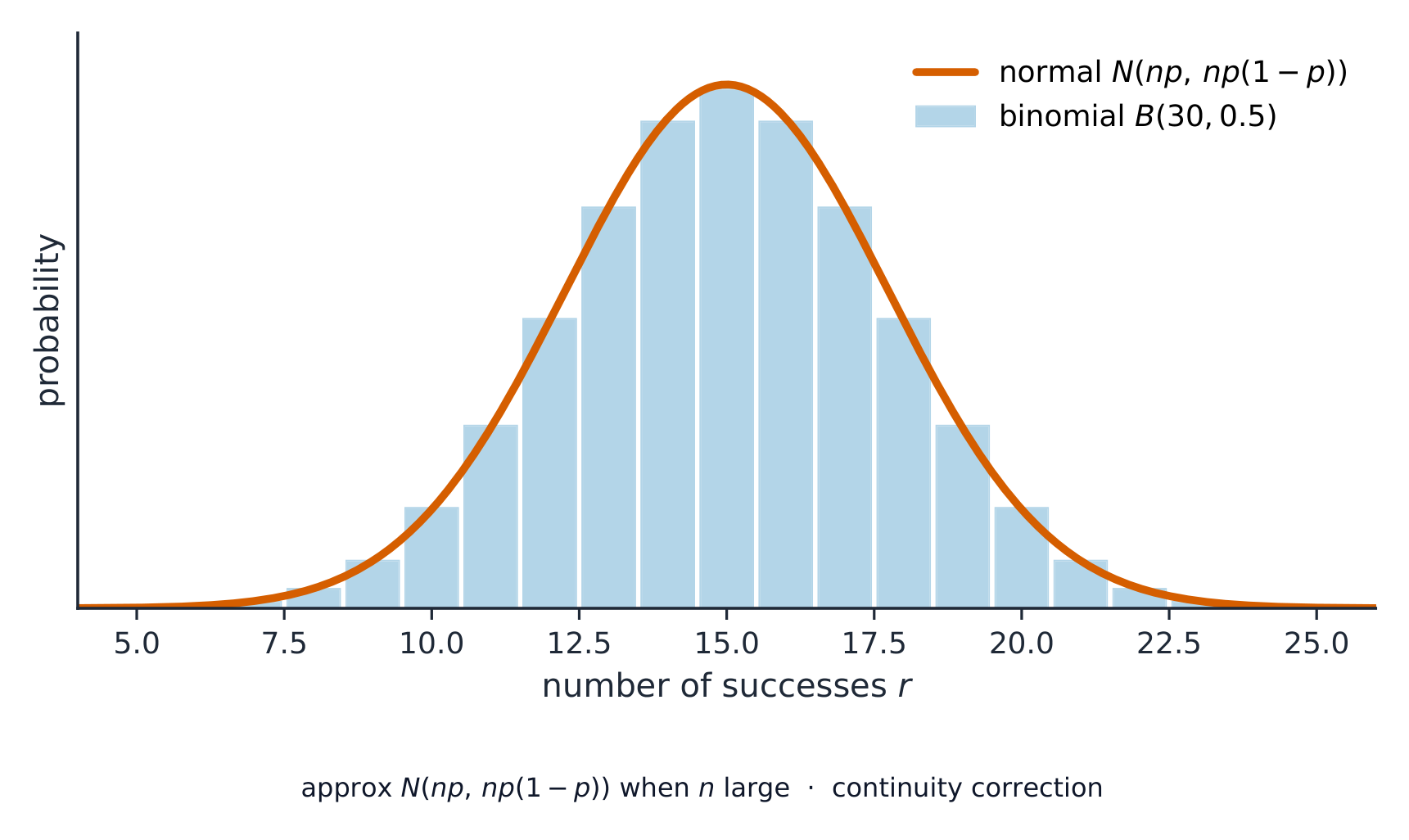
对大的 n,二项分布的条形紧密地跟随光滑的正态曲线 N(np, np(1−p))
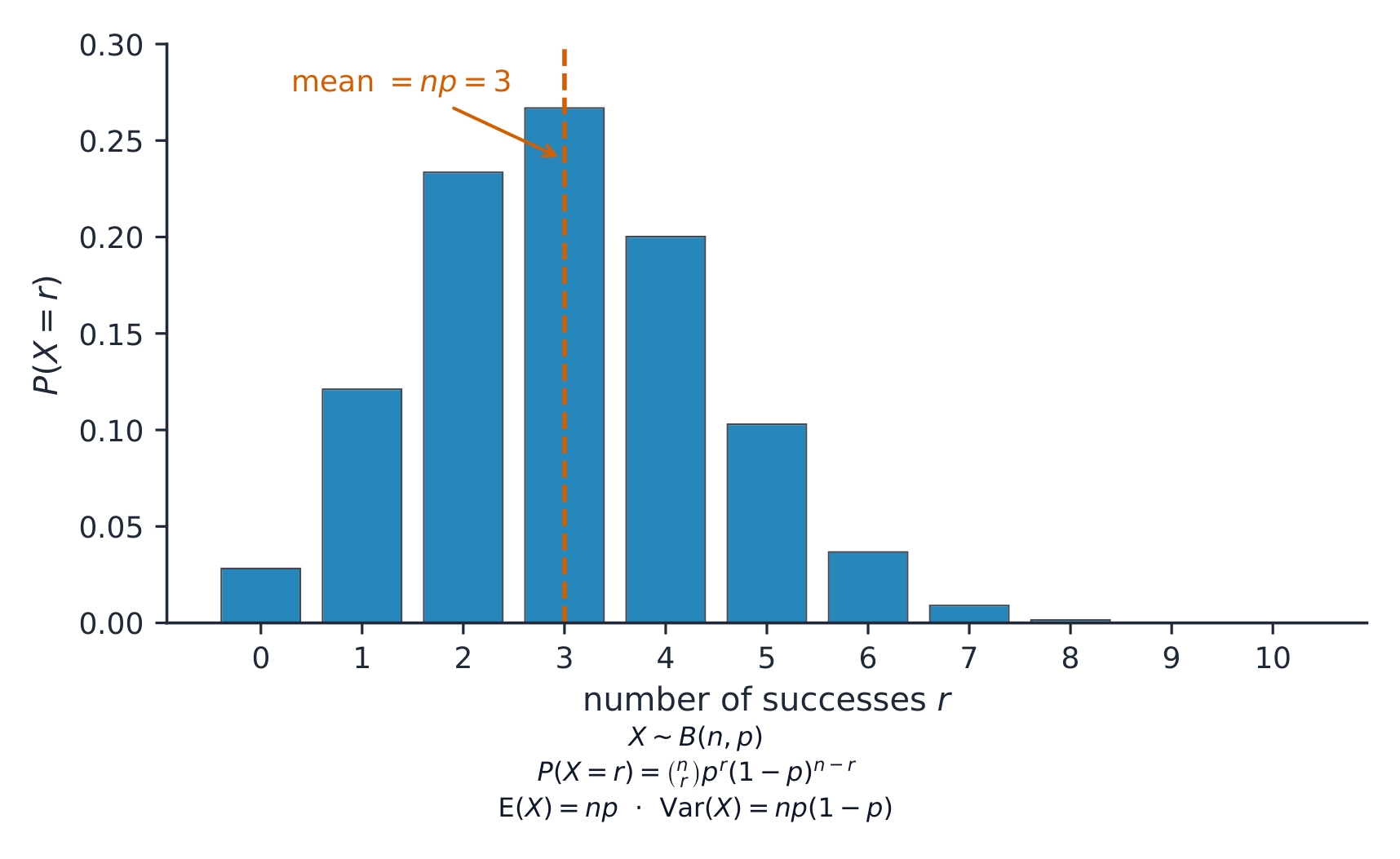
二项分布 B(10, 0.3);它的平均数是 np = 3
- 正态分布描述连续型随机变量(continuous random variable);用标准化(standardisation)$Z=(X-\mu)/\sigma$,并作为二项分布的近似(approximation)。
When the normal distribution approximates the binomial, a continuity correction of 0.5 is applied. · 当正态分布近似二项分布时,要应用一个 0.5 的连续性修正。
Replacing a discrete variable with a continuous one needs a ±0.5 continuity correction. · 用一个连续变量替换一个离散变量需要一个 ±0.5 的连续性修正。
You've got it
- $X \sim N(\mu, \sigma^2)$; standardize with $Z = \dfrac{X - \mu}{\sigma}$
- read probabilities as areas from the $\Phi$ table for $Z \sim N(0,1)$
- the normal approximates the binomial for large $n$ (use a continuity correction)
你掌握了
- $X \sim N(\mu, \sigma^2)$;用 $Z = \dfrac{X - \mu}{\sigma}$ 标准化
- 对 $Z \sim N(0,1)$ 从 $\Phi$ 表把概率读作面积
- 正态分布对大的 $n$ 近似二项分布(用一个连续性修正)