Logarithms, trigonometry and numerical methods (Pure 3) · 对数、三角学与数值方法(Pure 3)
| English | 中文 | Pinyin · 拼音 |
|---|---|---|
| logarithm/ˈlɒɡərɪθəm/ | 对数 | duì shù |
| exponential equation/ˌekspəˈnenʃl ɪˈkweɪʒn/ | 指数方程 | zhǐ shù fāng chéng |
| decay/dɪˈkeɪ/ | 衰减 | shuāi jiǎn |
| linearise/ˈlɪnɪəraɪz/ | 线性化 | xiàn xìng huà |
| convergence/kənˈvɜːdʒəns/ | 收敛 | shōu liǎn |
Building on what you know
- Pure 3 doesn't introduce entirely new ideas — it deepens and extends the skills from Pure 2.
- Logarithms 对数, trigonometry, and numerical methods return with harder problems and richer applications.
在你已知的之上构建
- Pure 3 不引入全新的想法——它加深并扩展 Pure 2 的技能。
- 对数、三角学和数值方法带着更难的问题和更丰富的应用回归。
Logarithms revisited
- The log laws with $e^x$ and $\ln x$ return in harder contexts: solving exponential equations 指数方程, modelling growth and decay 衰减, and linearising 线性化 data.
- Key skill: when the unknown is in the power, take logs of both sides.
Worked example. Solve $5e^{2x} = 30$. Divide: $e^{2x} = 6$. Take $\ln$: $2x = \ln 6$, so $x = \dfrac{\ln 6}{2} \approx 0.896$.
A line r = a + t b: start at a, then slide by t lots of the direction b
重温对数
- 带 $e^x$ 和 $\ln x$ 的对数法则在更难的情境中回归:求解指数方程、为增长和衰变建模、把数据线性化。
- 关键技能:当未知数在幂里时,对两边取对数。
算例。 解 $5e^{2x} = 30$。相除:$e^{2x} = 6$。取 $\ln$:$2x = \ln 6$,所以 $x = \dfrac{\ln 6}{2} \approx 0.896$。
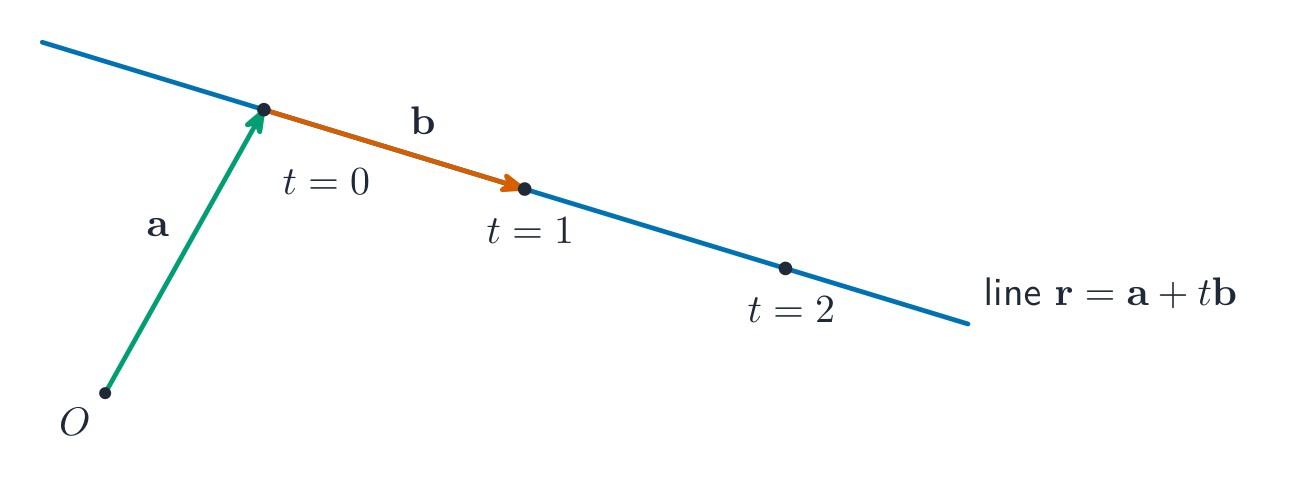
一条线 r = a + t b:从 a 开始,然后沿方向 b 滑动 t 倍
What is ln(e³)? · ln(e³) 是多少?
ln and e are inverses, so ln(e³) = 3. · ln 和 e 是互逆的,所以 ln(e³) = 3。
Solve 5e^(2x) = 30 for x (2 dp). · 解 5e^(2x) = 30,求 x(2 位小数)。
e^(2x) = 6, so 2x = ln 6, x = (ln 6)/2 ≈ 0.896 ≈ 0.90. · e^(2x) = 6,所以 2x = ln 6,x = (ln 6)/2 ≈ 0.896 ≈ 0.90。
Trigonometry revisited
- $\sec^2\theta \equiv 1 + \tan^2\theta$, $\csc^2\theta \equiv 1 + \cot^2\theta$.
- The compound- and double-angle formulae, and the $R$-form of $a\sin\theta + b\cos\theta$.
- These identities are essential for integration and solving trig equations.
Don't mix up the identities. $\sec^2\theta \equiv 1 + \tan^2\theta$ (plus sign), not $1 - \tan^2\theta$. The sign comes from dividing $\sin^2\theta + \cos^2\theta \equiv 1$ by $\cos^2\theta$.
重温三角学
- $\sec^2\theta \equiv 1 + \tan^2\theta$, $\csc^2\theta \equiv 1 + \cot^2\theta$.
- 倍角公式和 $R$-形式的 $a\sin\theta + b\cos\theta$。
- 这些恒等式对积分和求解三角方程必不可少。
不要把恒等式弄混。 $\sec^2\theta \equiv 1 + \tan^2\theta$(加号),不是 $1 - \tan^2\theta$。符号来自把 $\sin^2\theta + \cos^2\theta \equiv 1$ 除以 $\cos^2\theta$。
The unit circle · 单位圆
(cos θ, sin θ)
The R-formula rewrites a sin θ + b cos θ as one wave — and it all lives on this circle. · R 公式把 a sin θ + b cos θ 重写为一个波——而这一切都在这个圆上。
Using sec²θ ≡ 1 + tan²θ, if tan θ = 3, what is sec²θ? · 用 sec²θ ≡ 1 + tan²θ,如果 tan θ = 3,sec²θ 是多少?
sec²θ = 1 + 3² = 1 + 9 = 10. · sec²θ = 1 + 3² = 1 + 9 = 10。
sec²θ ≡ 1 − tan²θ. · sec²θ ≡ 1 − tan²θ。
The correct identity is sec²θ ≡ 1 + tan²θ (plus, not minus). · 正确的恒等式是 sec²θ ≡ 1 + tan²θ(加,不是减)。
Numerical methods revisited
- A sign change to trap a root, then an iterative formula $x_{n+1} = F(x_n)$.
- Convergence 收敛 requires $|F'(x)| < 1$ near the root.
allow_no_figure: Review lesson consolidating Pure 2 skills (logarithms, trigonometry, numerical methods) — no new visual concepts introduced.
重温数值方法
- 一个符号改变来困住一个根,然后一个迭代公式 $x_{n+1} = F(x_n)$。
- 收敛要求在根附近 $|F'(x)| < 1$。
allow_no_figure: 复习课巩固纯数学2技能(对数、三角学、数值方法)——未引入新的视觉概念。
A numerical root is found by a sign change, then repeatedly applying: · 一个数值根由一个符号改变找到,然后反复应用:
Iteration applies x_{n+1} = F(x_n) until the values converge to the root. · 迭代应用 x_{n+1} = F(x_n),直到这些值收敛到根。
Worked example — R-formula application
- Express $3\sin\theta + 4\cos\theta$ in the form $R\sin(\theta + \alpha)$.
- $R = \sqrt{3^2 + 4^2} = 5$. $\tan\alpha = \dfrac{4}{3} \Rightarrow \alpha \approx 53.1^{\circ}$.
- So $3\sin\theta + 4\cos\theta = 5\sin(\theta + 53.1^{\circ})$.
- Maximum value is $5$ (when $\sin(\theta + 53.1^{\circ}) = 1$).
- Plotting $\ln y$ against $x$ gives a line whose gradient and intercept find the constants (using indices and inverse functions); know the reciprocal trig functions secant, cosecant, cotangent; and iteration $x_{n+1}=F(x_n)$ shows convergence to a root.
算例——R 公式应用
- 把 $3\sin\theta + 4\cos\theta$ 表达成 $R\sin(\theta + \alpha)$ 的形式。
- $R = \sqrt{3^2 + 4^2} = 5$. $\tan\alpha = \dfrac{4}{3} \Rightarrow \alpha \approx 53.1^{\circ}$.
- 所以 $3\sin\theta + 4\cos\theta = 5\sin(\theta + 53.1^{\circ})$。
- 最大值是 $5$(当 $\sin(\theta + 53.1^{\circ}) = 1$ 时)。
- 把 $\ln y$ 对 $x$ 作图得到一条直线,其斜率(gradient)和截距(intercept)求出常数(用到指数 indices 和反函数 inverse functions);掌握倒数三角函数正割(secant)、余割(cosecant)、余切(cotangent);迭代(iteration)$x_{n+1}=F(x_n)$ 体现向根的收敛(convergence)。
For 3 sin θ + 4 cos θ = R sin(θ + α), what is R? · 对于 3 sin θ + 4 cos θ = R sin(θ + α),R 是多少?
R = √(3² + 4²) = √25 = 5. · R = √(3² + 4²) = √25 = 5。
You've got it
- 3.2 logs, 3.3 trig identities/angle formulae, 3.6 numerical methods = the Pure 2 skills
- use $\sec^2\theta \equiv 1 + \tan^2\theta$ and the R-formula as before
- find roots by a sign change then iteration $x_{n+1} = F(x_n)$
你掌握了
- 3.2 对数、3.3 三角恒等式/角公式、3.6 数值方法 = Pure 2 的技能
- 像以前一样用 $\sec^2\theta \equiv 1 + \tan^2\theta$ 和 R 公式
- 通过一个符号改变然后迭代 $x_{n+1} = F(x_n)$ 找根