Motion of a projectile · 抛体的运动
| English | 中文 | Pinyin · 拼音 |
|---|---|---|
| horizontal/ˌhɒrɪˈzɒntl/ | 水平 | shuǐ píng |
| vertical/ˈvɜːtɪkl/ | 竖直 | shù zhí |
| gravity/ˈɡrævɪti/ | 重力 | zhòng lì |
| projectile/prəˈdʒektaɪl/ | 抛射体 | pāo shè tǐ |
| parabola/pəˈræbələ/ | 抛物线 | pāo wù xiàn |
| range/reɪndʒ/ | 射程 | shè chéng |
| greatest height/ˈɡreɪtɪst haɪt/ | 最大高度 | zuì dà gāo dù |
The cannonball problem
- Fire a ball at an angle and it traces a smooth arch, then lands. Where, and how high?
- Galileo's insight: treat the horizontal 水平 and vertical 竖直 motions completely separately — they only share the clock.
炮弹问题
- 以一个角度发射一个球,它描绘出一道平滑的拱,然后落地。在哪里,有多高?
- 伽利略的洞见:把水平和竖直运动完全分开处理——它们只共享时钟。
Two independent motions
- Launched at speed $u$ and angle $\alpha$:
- Horizontal: constant velocity $u\cos\alpha$ (no force sideways).
- Vertical: gravity 重力 only, acceleration $g$ downward.
Water jets follow parabolic paths, the classic projectile 抛射体 motion under gravity
两个独立的运动
- 以速度 $u$ 和角度 $\alpha$ 发射:
- 水平:恒定速度 $u\cos\alpha$(侧向无力)。
- 竖直:只有重力,加速度 $g$ 向下。

水柱沿抛物线路径,经典的重力下抛体运动
Launch a projectile · 发射一个抛体
Fire the ball, then change the angle and speed. The horizontal motion is steady while gravity pulls it down — together they trace a parabola. Find the angle for the longest range, and try the Moon. · 发射球,然后改变角度和速度。水平运动是稳定的,而重力把它向下拉——它们一起描绘出一条抛物线。找出最长射程的角度,并试试月球。
During the flight, the horizontal velocity of a projectile (ignoring air resistance): · 在飞行期间,一个抛体的水平速度(忽略空气阻力):
There is no horizontal force, so u cos α is constant throughout. · 没有水平的力,所以 u cos α 始终恒定。
The initial horizontal velocity of a projectile launched at speed u and angle α is u ______ α. · 以速度 u 和角度 α 发射的一个抛体的初始水平速度是 u ______ α。
Horizontal component = u cos α; vertical = u sin α. · 水平分量 = u cos α;竖直 = u sin α。
The parabola 抛物线
- Eliminating $t$ leaves $y$ as a quadratic in $x$ — so the path is a parabola.
Horizontal speed stays constant; gravity bends the vertical motion into a parabola.
抛物线
- 消去 $t$ 留下 $y$ 作为 $x$ 的一个二次式——所以路径是一条抛物线(parabola)。
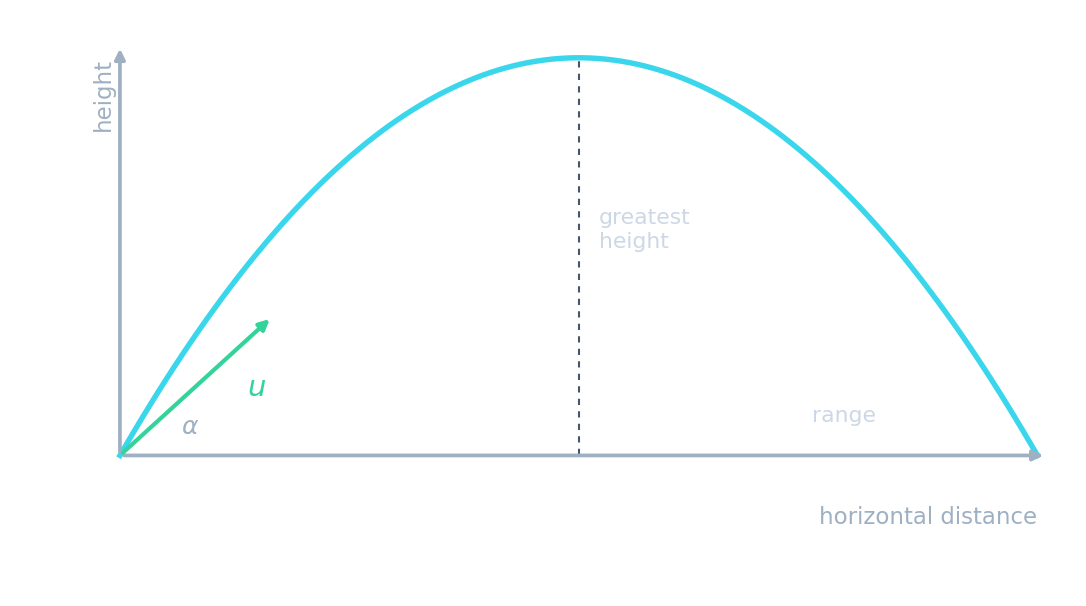
水平速度保持恒定;重力把竖直运动弯成一条抛物线。
The path of a projectile (no air resistance) is a: · 一个抛体的路径(无空气阻力)是一条:
Eliminating t gives y as a quadratic in x — a parabola. · 消去 t 给出 y 作为 x 的一个二次式——一条抛物线。
Range 射程 and greatest height 最大高度
- At the top, the vertical velocity is momentarily zero. The key results:
Worked example. $u = 20\ \tfrac{\text{m}}{\text{s}}$, $\alpha = 30^\circ$, $g = 10$. Greatest height $= \dfrac{400 \times 0.25}{20} = 5\ \text{m}$.
射程和最大高度
- 在顶部,竖直速度瞬间为零。关键结果:
例题。 $u = 20\ \tfrac{\text{m}}{\text{s}}$,$\alpha = 30^\circ$,$g = 10$。最大高度 $= \dfrac{400 \times 0.25}{20} = 5\ \text{m}$。
A ball is thrown at u = 20 m/s at 30°. Using height = u²sin²α/(2g) with g = 10, find the greatest height (m). · 一个球以 u = 20 m/s 在 30° 抛出。使用 height = u²sin²α/(2g),g = 10,求最大高度(m)。
400 × sin²30° / 20 = 400 × 0.25 / 20 = 5 m. · 400 × sin²30° / 20 = 400 × 0.25 / 20 = 5 m。
At what launch angle (degrees) is the range greatest? · 在什么发射角度(度)射程最大?
Range ∝ sin 2α, which is largest when 2α = 90°, i.e. α = 45°. · 射程 ∝ sin 2α,它在 2α = 90° 时最大,即 α = 45°。
At the highest point of the flight, the vertical component of velocity is zero. · 在飞行的最高点,速度的竖直分量是零。
Vertical velocity decreases to zero at the top, then becomes negative (downward). · 竖直速度在顶部减少到零,然后变成负的(向下)。
Common trap
Range is maximised at $45^\circ$, not $90^\circ$. $\sin 2\alpha$ peaks when $2\alpha = 90^\circ$. Firing straight up gives zero range — all the speed goes into height.
- Eliminating time gives the Cartesian equation of the path; all trajectories lie under a bounding parabola.
常见陷阱
射程在 $45^\circ$ 处最大,而不是 $90^\circ$。 $\sin 2\alpha$ 在 $2\alpha = 90^\circ$ 时达到顶峰。笔直向上发射给出零射程——所有的速度都进入高度。
- 消去时间得到路径的直角坐标方程(Cartesian equation);所有弹道都在一条包络抛物线(bounding parabola)之下。
You've got it
- resolve into horizontal ($u\cos\alpha$, constant) and vertical ($u\sin\alpha$, gravity) parts
- the path is a parabola
- range $= \dfrac{u^2\sin 2\alpha}{g}$ (max at $45^\circ$); greatest height $= \dfrac{u^2\sin^2\alpha}{2g}$
你掌握了
- 分解成水平($u\cos\alpha$,恒定)和竖直($u\sin\alpha$,重力)部分
- 路径是一条抛物线
- 射程 $= \dfrac{u^2\sin 2\alpha}{g}$(在 $45^\circ$ 处最大);最大高度 $= \dfrac{u^2\sin^2\alpha}{2g}$