Efficiency and market failure · 效率与市场失灵
| English | 中文 | Pinyin · 拼音 |
|---|---|---|
| allocative efficiency/ˈæləkətɪv ɪˈfɪʃənsi/ | 配置效率 | pèi zhì xiào lǜ |
| marginal cost/ˈmɑːdʒɪnl kɒst/ | 边际成本 | biān jì chéng běn |
| productive efficiency/prəˈdʌktɪv ɪˈfɪʃənsi/ | 生产效率 | shēng chǎn xiào lǜ |
| average cost/ˈævrɪdʒ kɒst/ | 平均成本 | píng jūn chéng běn |
| Pareto efficiency/pæˈriːtəʊ ɪˈfɪʃənsi/ | 帕累托效率 | pà lèi tuō xiào lǜ |
| deadweight loss/ˈdedweɪt lɒs/ | 无谓损失 | wú wèi sǔn shī |
What "efficient" really means
- "Efficient" is one of the most-used — and most-misused — words in economics.
- It has two precise meanings, and a market that misses either is failing.
"效率"真正的意思
- "效率"是经济学中使用最多——也最常被误用——的词之一。
- 它有两个精确的含义,而一个错失其中之一的市场是在失灵。
Allocative efficiency occurs where: · 配置效率发生在以下之处:
P = MC means the value of the last unit equals its cost — allocatively efficient. · P = MC 意味着最后一单位的价值等于它的成本——配置有效。
Allocative efficiency is where price equals marginal ______. · 配置效率是价格等于边际______之处。
P = MC. · P = MC。
Allocative efficiency 配置效率
- Allocative efficiency: resources go to what society values most — output where price = marginal cost 边际成本 (P = MC).
- At this point, the value of the last unit equals its cost — no reallocation could make society better off.
In perfect competition price equals marginal cost (P = MC) — the condition for allocative efficiency
配置效率
- 配置效率(allocative efficiency):资源去到社会最重视的东西——产出在价格 = 边际成本(P = MC)之处。
- 在这一点,最后一单位的价值等于它的成本——没有再配置能让社会更好。
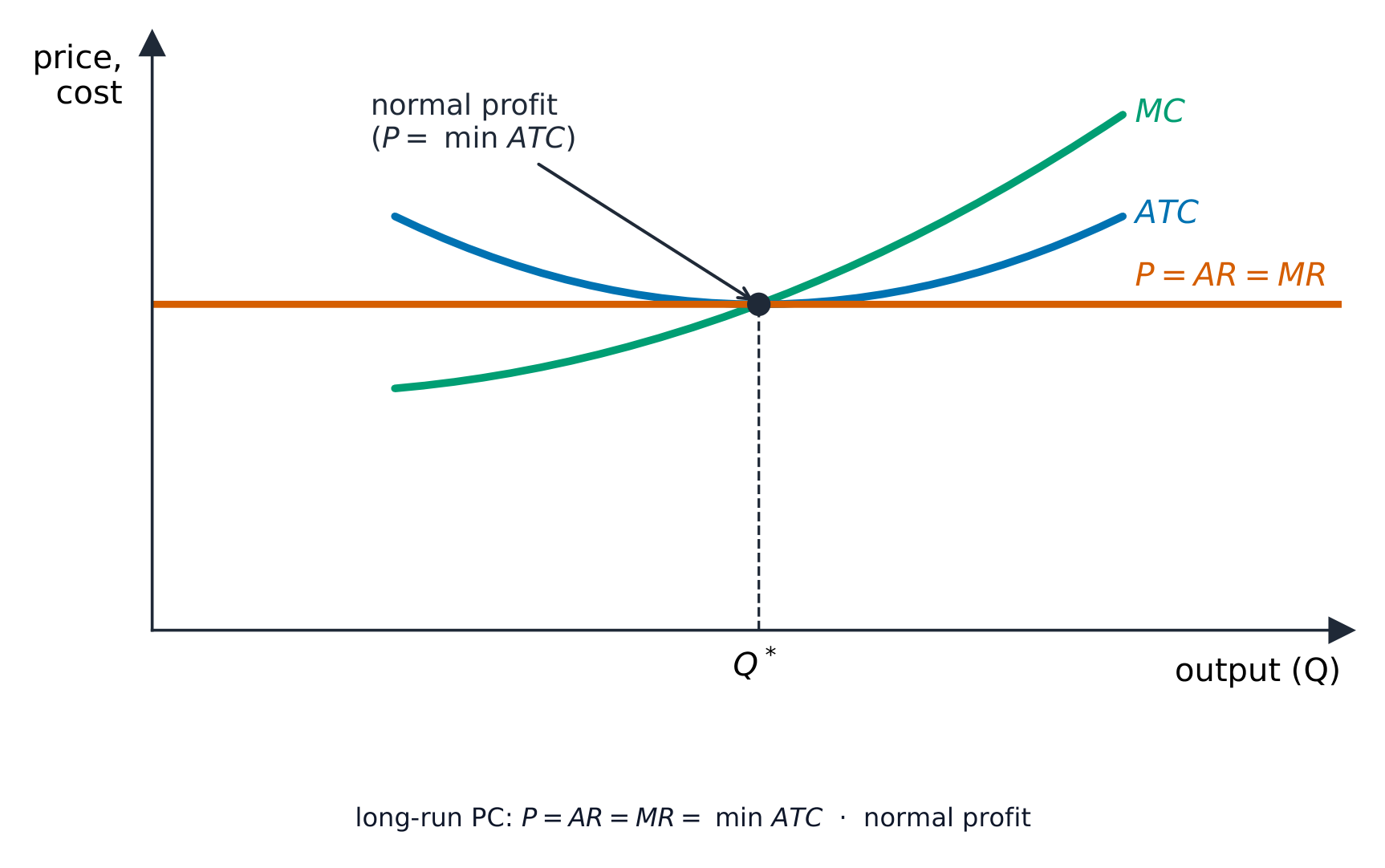
在完全竞争中价格等于边际成本(P = MC)——这是配置效率的条件
Allocative efficiency · 配置效率
The market is allocatively efficient where supply meets demand — price equals marginal cost. Market failure pushes it away from that point. · 市场在供给与需求相遇之处是配置有效的——价格等于边际成本。市场失灵把它推离那一点。
Productive efficiency is achieved at the: · 生产效率在以下实现:
Lowest cost per unit = the minimum point of AC. · 每单位最低成本 = AC 的最低点。
A Pareto-efficient allocation is one where no one can be made better off without making someone worse off. · 一个帕累托有效的配置是一个没有人能在不让某人更糟的情况下变得更好的配置。
That is the definition of Pareto efficiency. · 那就是帕累托效率的定义。
On a PPF, efficiency requires producing: · 在一条 PPF 上,效率要求生产在:
Producing on the curve uses all resources efficiently; inside is wasteful. · 在曲线上生产高效地使用所有资源;里面是浪费的。
Productive efficiency 生产效率
- Productive efficiency: goods are made at the lowest possible cost — producing at the minimum of the average cost 平均成本 curve.
- On a PPF, both efficiencies require producing on the frontier, not inside it.
Pareto efficiency 帕累托效率. An allocation is Pareto efficient if you can't make anyone better off without making someone else worse off — the benchmark for "no waste".
生产效率
- 生产效率(productive efficiency):商品以尽可能最低的成本制造——在平均成本曲线的最低点生产。
- 在一条 PPF 上,两种效率都要求在边界上生产,不是在它里面。
帕累托效率。 如果你不能在不让某人更糟的情况下让任何人更好,一个配置就是帕累托有效的——"没有浪费"的基准。
When markets fail
- Markets fail to reach these efficiencies because of externalities, public goods, market power and information gaps.
- The result: too much or too little produced, and a deadweight loss 无谓损失 of welfare.
当市场失灵时
- 市场因为外部性、公共物品、市场力量和信息差距而无法达到这些效率。
- 结果:生产太多或太少,以及福利的一个无谓损失。
You've got it
- allocative efficiency: P = MC (resources match what society values)
- productive efficiency: lowest cost (minimum of AC); both need producing on the PPF
- market failure (externalities, public goods, monopoly, info gaps) breaks efficiency → deadweight loss
你掌握了
- 配置效率:P = MC(资源匹配社会重视的)
- 生产效率:最低成本(AC 的最低点);两者都需要在 PPF 上生产
- 市场失灵(外部性、公共物品、垄断、信息差距)破坏效率 → 无谓损失