The interaction of demand and supply · 需求与供给的相互作用
| English | 中文 | Pinyin · 拼音 |
|---|---|---|
| equilibrium/ˌiːkwɪˈlɪbrɪəm/ | 均衡 | jūn héng |
| clears/klɪəz/ | 出清 | chū qīng |
| shortage/ˈʃɔːtɪdʒ/ | 短缺 | duǎn quē |
| surplus/ˈsɜːpləs/ | 过剩 | guò shèng |
How a market finds its price
- No committee sets the price of apples — yet markets settle on one. How?
- Demand and supply pull in opposite directions until they meet at the equilibrium 均衡 price, where the market just clears 出清.
一个市场如何找到它的价格
- 没有委员会定苹果的价格——但市场稳定在一个上。怎么做到的?
- 需求和供给向相反方向拉,直到它们在均衡(equilibrium)价格相遇,在那里市场刚好出清。
Equilibrium
- Equilibrium is where the demand and supply curves cross: quantity demanded = quantity supplied.
- At that price there is no shortage 短缺 and no surplus 过剩 — the market clears.
Where the curves cross, the price clears the market — quantity demanded equals quantity supplied.
均衡
- 均衡是需求和供给曲线相交的地方:需求量 = 供给量。
- 在那个价格没有短缺也没有过剩——市场出清(clears)。

在曲线相交的地方,价格出清市场——需求量等于供给量。
Demand & supply · 需求与供给
Where · 何地 demand meets supply sets the equilibrium price and quantity. · 需求与供给相遇之处决定均衡的价格和数量。
Market equilibrium occurs where: · 市场均衡发生在:
At equilibrium the curves cross: Qd = Qs and the market clears. · 在均衡时曲线相交:Qd = Qs 且市场出清。
At the equilibrium price the market just ______ — no shortage and no surplus. · 在均衡价格,市场恰好______——没有短缺也没有过剩。
Market clearing means quantity demanded equals quantity supplied. · 市场出清意味着需求量等于供给量。
Shortages and surpluses
- Below equilibrium: demand exceeds supply → a shortage → price is bid up.
- Above equilibrium: supply exceeds demand → a surplus → price is pushed down.
- Either way, price moves back to equilibrium — the self-correcting market.
Above equilibrium: excess supply; below: excess demand
短缺与过剩
- 低于均衡:需求超过供给 → 一个短缺(shortage)→ 价格被竞抬。
- 高于均衡:供给超过需求 → 一个过剩(surplus)→ 价格被压下。
- 无论哪种方式,价格都回到均衡——自我纠正的市场。
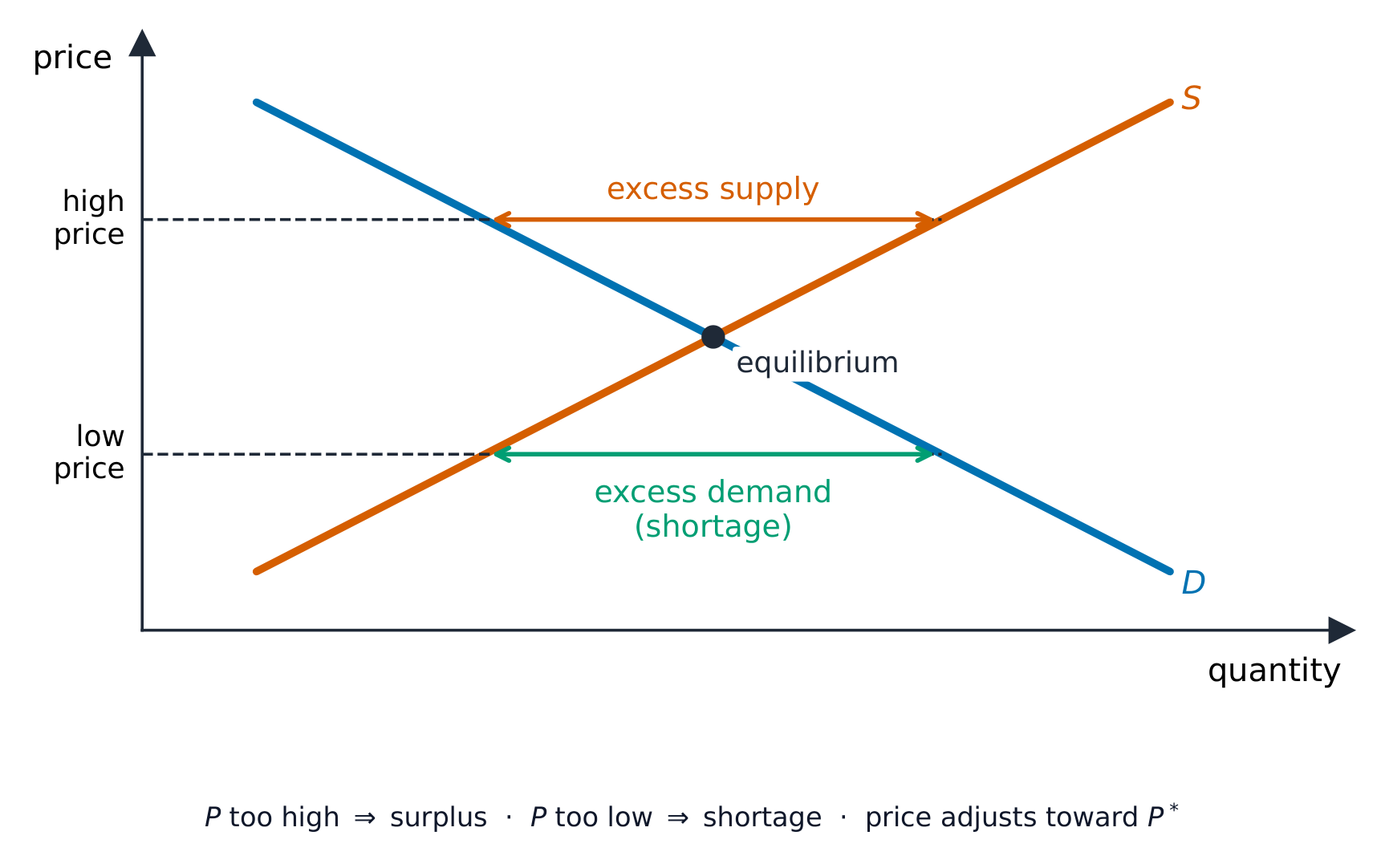
高于均衡:供给过剩;低于:需求过剩
If the price is set below equilibrium, the result is a: · 如果价格定在均衡之下,结果是一个:
Below equilibrium, demand exceeds supply → shortage → upward pressure on price. · 在均衡之下,需求超过供给 → 短缺 → 对价格的上升压力。
Shifts change the equilibrium
- A rise in demand → equilibrium price and quantity both rise.
- A rise in supply → equilibrium price falls, quantity rises.
- Work out the new crossing point by shifting the relevant curve.
Worked example. A frost destroys part of the coffee crop. Supply shifts left; the new equilibrium has a higher price and lower quantity.
移位改变均衡
- 一个需求的上升 → 均衡价格和数量都上升。
- 一个供给的上升 → 均衡价格下降,数量上升。
- 通过移位相关的曲线算出新的相交点。
算例。 一场霜冻摧毁部分咖啡作物。供给左移;新的均衡有一个更高的价格和更低的数量。
A rise in demand (supply unchanged) moves the equilibrium to: · 需求上升(供给不变)把均衡移到:
Demand shifts right along the supply curve → both P and Q rise. · 需求沿供给曲线右移 → P 和 Q 都上升。
A frost that destroys part of the coffee crop raises the equilibrium price of coffee. · 一场摧毁部分咖啡作物的霜冻提高咖啡的均衡价格。
Supply shifts left → higher equilibrium price, lower quantity. · 供给左移 → 更高的均衡价格、更低的数量。
You've got it
- equilibrium = where D and S cross; the market clears (Qd = Qs)
- below equilibrium → shortage (price rises); above → surplus (price falls)
- a demand rise raises P and Q; a supply rise lowers P, raises Q
你掌握了
- 均衡 = D 和 S 相交的地方;市场出清(Qd = Qs)
- 低于均衡 → 短缺(价格上升);高于 → 过剩(价格下降)
- 需求上升提高 P 和 Q;供给上升降低 P、提高 Q