Security measures and protecting data · 安全措施与保护数据
| English | 中文 | Pinyin · 拼音 |
|---|---|---|
| public key/ˈpʌblɪk kiː/ | 公钥 | gōng yào |
| private key/ˈpraɪvət kiː/ | 私钥 | sī yào |
| antivirus/ˌæntɪˈvaɪrəs/ | 杀毒软件 | shā dú ruǎn jiàn |
| backup/ˈbækʌp/ | 备份 | bèi fèn |
| encryption/enˈkrɪpʃn/ | 加密 | jiā mì |
| firewall/ˈfaɪəwɔːl/ | 防火墙 | fáng huǒ qiáng |
| user accounts/ˈjuːzə əˈkaʊnts/ | 用户账户 | yòng hù zhàng hù |
| audit logs/ˈɔːdɪt lɒɡz/ | 审计日志 | shěn jì rì zhì |
| anti-spyware/ˈænti ˈspaɪweə/ | 反间谍软件 | fǎn jiàn dié ruǎn jiàn |
| access rights/ˈækses raɪts/ | 访问权限 | fǎng wèn quán xiàn |
| authentication/ɔːˌθentɪˈkeɪʃn/ | 身份验证 | shēn fèn yàn zhèng |
| biometrics/ˌbaɪəʊˈmetrɪks/ | 生物识别 | shēng wù shí bié |
| two-factor authentication/tuː ˈfæktə ɔːˌθentɪˈkeɪʃn/ | 双因素认证 | shuāng yīn sù rèn zhèng |
| authorisation/ˌɔːθəraɪˈzeɪʃn/ | 授权 | shòu quán |
| VPN/ˌviː piː ˈen/ | 虚拟专用网 | xū nǐ zhuān yòng wǎng |
| ciphertext/ˈsaɪfətekst/ | 密文 | mì wén |
| least-privilege/liːst ˈprɪvɪlɪdʒ/ | 最小权限 | zuì xiǎo quán xiàn |
| plaintext/ˈpleɪntekst/ | 明文 | míng wén |
| symmetric encryption/sɪˈmetrɪk enˈkrɪpʃn/ | 对称加密 | duì chèn jiā mì |
| asymmetric encryption/ˌeɪsɪˈmetrɪk enˈkrɪpʃn/ | 非对称加密 | fēi duì chèn jiā mì |
| digital signature/ˈdɪdʒɪtl ˈsɪɡnɪtʃə/ | 数字签名 | shù zì qiān míng |
A lock anyone can close and only one person can open
- Every time you pay online, your card number crosses dozens of routers owned by strangers. Any of them could copy the bytes.
- What makes it safe is an idea from 1977: a lock that anyone can snap shut but only the holder of one particular key can open. You lock your card number with the shop's public key; only the shop's private key opens it.
- That is one measure among many. This lesson is the defences, from a single PC to the open internet, how each one works in the words the examiner awards, and which one fits which threat.
任何人都能锁上、只有一个人能打开的锁
- 每次在线付款,你的卡号都会经过几十台属于陌生人的路由器。其中任何一台都可以复制这些字节。
- 让它安全的是 1977 年的一个想法:一把任何人都能扣上、却只有某一把特定钥匙的持有者能打开的锁。你用商店的公钥锁住卡号;只有商店的私钥能打开它。
- 这只是众多措施中的一种。这一课讲防御——从一台 PC 到开放的互联网——每种措施用考官给分的措辞怎样工作,以及哪种措施对应哪种威胁。
A standalone PC
- A strong password: long, mixed characters, changed regularly, never shared.
- Antivirus 杀毒软件 kept up to date, prompt software updates, and a locked screen when you step away.
- A backup 备份 to separate media, kept off-site, so lost or corrupted data can be restored; full-disk encryption 加密 so a stolen laptop gives up nothing.
独立的 PC
- 强密码:长、字符混合、定期更换、从不共享。
- 保持更新的杀毒软件(antivirus),及时的软件更新,离开时锁屏。
- 到独立介质的备份(backup),异地保存,让丢失或损坏的数据可以恢复;全盘加密(encryption),让被盗的笔记本什么也交不出。
Which measures protect a standalone PC that is never networked? Select all · 所有 that apply. · 哪些措施保护一台从不联网的独立 PC?选出所有适用的。
Malware still arrives on USB sticks and downloads, and disks still fail, so password, antivirus and backups apply. Network log-in auditing is a networked-PC measure. · 恶意软件仍会通过 U 盘和下载到达,磁盘仍会损坏,所以密码、杀毒和备份都适用。网络登录审计是联网 PC 的措施。
A networked PC
- Everything above, plus a firewall 防火墙: it examines every incoming and outgoing transmission, compares it with set criteria such as a whitelist or blacklist of addresses, ports and protocols, blocks any that do not meet the criteria, and can warn of unauthorised access attempts.
- Central user accounts 用户账户 with per-user permissions: admin rights only for admins.
- Audit logs 审计日志 record who logged in and what they touched.
Traffic that fails the criteria never reaches the computer
联网的 PC
- 以上全部,再加防火墙(firewall):它检查每一次进出的传输,与设定的标准比较——例如地址、端口和协议的白名单或黑名单——阻止任何不合标准的传输,并能对未授权访问尝试发出警告。
- 集中管理的用户账户(user accounts),按用户设权限:管理员权限只给管理员。
- 审计日志(audit logs)记录谁登录了、动过什么。

不合标准的流量永远到不了计算机
A firewall mainly: · 一个防火墙主要:
A firewall controls which network traffic is allowed in or out, by a set of rules. · 一个防火墙按一套规则控制哪些网络流量被允许进出。
How the measures work, in the examiner's words
- Anti-virus and anti-spyware 反间谍软件 software scans files and programs against a database of known malware signatures, checks behaviour, quarantines or deletes what it finds, and must be updated so new malware is recognised.
- Passwords and user accounts: only a user who knows the password can log in; accounts lock after repeated failures; each account carries its own access rights.
- Access rights 访问权限: each user or group gets permissions for each file or table, such as read-only or read and write, so nobody sees or changes data that is not theirs.
- Backups: a copy on separate media, off-site, from which lost data is restored.
措施怎样工作,用考官的话说
- 杀毒和反间谍软件(anti-spyware)把文件和程序与已知恶意软件特征库比对,检查行为,隔离或删除发现的东西,并且必须更新才能识别新的恶意软件。
- 密码和用户账户:只有知道密码的用户能登录;多次失败后账户锁定;每个账户带有自己的访问权限。
- 访问权限(access rights):每个用户或用户组对每个文件或表获得权限——只读、读写等——所以没有人能看到或更改不属于自己的数据。
- 备份:独立介质上的副本,异地保存,丢失的数据从中恢复。
Authentication
- Authentication 身份验证 verifies who the user is: something they know (a password), something they have (a token or phone), or something they are (biometrics 生物识别).
- Biometrics: the device captures the face, fingerprint or iris, converts it to digital data, compares it with the stored data for that user and allows access only on a match. It cannot be forgotten, lent or guessed.
- Two-factor authentication 双因素认证 combines two factors, so a stolen password alone is not enough. Authorisation 授权 then decides what the verified user may do.
Something you have
Something you are
身份验证
- 身份验证(authentication)核实用户是谁:他们知道的东西(密码)、拥有的东西(令牌或手机),或他们本身的特征(生物识别,biometrics)。
- 生物识别:设备采集面部、指纹或虹膜,转换为数字数据,与该用户存储的数据比对,只在匹配时允许访问。它不会被忘记、借出或猜到。
- 双因素认证(two-factor authentication)组合两个因素,所以单独一个被盗的密码不够用。授权(authorisation)随后决定通过验证的用户可以做什么。

你拥有的东西

你本身的特征
A code from a phone app is an example of which authentication factor? · 来自一个手机应用的代码是哪个认证因素的一个例子?
A token/phone code is "something you have". Two-factor combines it with a password ("know") or biometric ("are"). · 一个令牌/手机代码是“你拥有的东西”。双因素把它与一个密码(“知道”)或生物特征(“是”)结合。
A fingerprint reader authenticates a user by something they ____. · 指纹读取器通过用户的"本身特征"来验证——用英文说,是 something they ____。
Know (password), have (token), are (biometric feature). A biometric cannot be forgotten, lent or guessed. · 知道(密码)、拥有(令牌)、本身(生物特征)。生物特征不会被忘记、借出或猜到。
Matching the measure to the threat
- Interception in transit: encrypt the data (HTTPS, a VPN 虚拟专用网). Intercepted ciphertext is useless without the key.
- Unauthorised access: strong authentication and two-factor, lock-out after failed logins. Internal misuse: the least-privilege 最小权限 principle, each user gets only what they need, plus auditing.
- Malware: anti-virus and anti-spyware with real-time scanning, and patching. Phishing: user training, email filtering, check the URL. DDoS: rate limiting and traffic filtering.
把措施与威胁配对
- 传输中被截获:加密数据(HTTPS、虚拟专用网 VPN)。截获的密文没有密钥就毫无用处。
- 未授权访问:强身份验证和双因素,登录失败后锁定。内部滥用:最小权限(least-privilege)原则——每个用户只得到所需的——加上审计。
- 恶意软件:带实时扫描的杀毒和反间谍软件,以及打补丁。网络钓鱼:用户培训、邮件过滤、核对网址。DDoS:限速和流量过滤。
Match each threat to the security measure that best counters it. · 把每个威胁与最好地对抗它的安全措施配对。
Each threat has a best-fit defence — encrypt against interception, authenticate against intruders, patch against malware, limit privilege against insiders. · 每个威胁有一个最匹配的防御——对拦截加密,对入侵者认证,对恶意软件打补丁,对内部人限制权限。
The best defence against data being intercepted in transit is to: · 对抗数据在传输中被拦截的最好防御是:
Encrypted data intercepted in transit is useless without the key. Authentication and antivirus address different threats. · 传输中被拦截的加密数据没有密钥就没用。认证和杀毒应对不同的威胁。
Encryption
- Encryption scrambles plaintext 明文 with a key into ciphertext 密文, so an intercepted copy cannot be understood without the key; the receiver uses a key to decrypt it. It protects data in transmission and in storage.
- Symmetric encryption 对称加密 (AES) uses one shared key to encrypt and decrypt: fast, but the key itself must reach the receiver safely.
- Asymmetric encryption 非对称加密 (RSA) uses a public key 公钥 to encrypt and the matching private key 私钥 to decrypt. The public key can be given to anyone, which solves the key-sharing problem.
One shared key, or a public key to lock and a private key to unlock
加密
- 加密用密钥把明文(plaintext)打乱成密文(ciphertext),所以截获的副本没有密钥就无法理解;接收者用密钥解密。它保护传输中和存储中的数据。
- 对称加密(symmetric encryption,AES)用同一个共享密钥加密和解密:快,但密钥本身必须安全地到达接收者。
- 非对称加密(asymmetric encryption,RSA)用公钥(public key)加密,用配对的私钥(private key)解密。公钥可以给任何人,这解决了密钥共享问题。
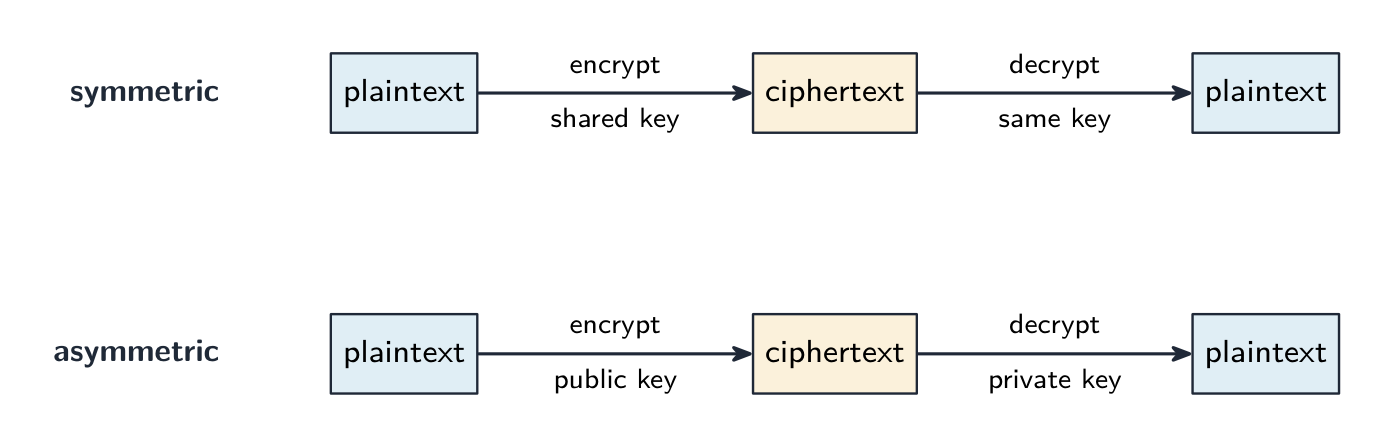
一个共享密钥,或用公钥锁、私钥开
Encrypt with a Caesar cipher · 用一个凯撒密码加密
Change the shift — that is the key. Each letter slides that many places along the alphabet to make the ciphertext, and the same key slides it back. That shared key is symmetric encryption in miniature. · 改变偏移量——那就是密钥。每个字母沿字母表滑动那么多位来生成密文,同样的密钥把它滑回来。那个共享的密钥就是缩小版的对称加密。
Asymmetric encryption (e.g. RSA) differs from symmetric (e.g. AES) because it: · 非对称加密(例如 RSA)与对称(例如 AES)不同,因为它:
Asymmetric uses a public/private key pair (solving key sharing); symmetric uses one shared key (fast). · 非对称用一个公钥/私钥对(解决密钥共享);对称用一个共享密钥(快)。
Put symmetric encryption in order, from sender to receiver. · 把对称加密按顺序排列,从发送者到接收者。
Symmetric encryption uses one shared key both to lock (encrypt) and unlock (decrypt) — anyone intercepting the ciphertext can't read it without that key. · 对称加密用一个共享密钥来锁(加密)和解锁(解密)——任何拦截密文的人没有那个密钥都读不了它。
Symmetric encryption uses one shared key, while asymmetric encryption uses a public key to encrypt and a private key to decrypt. · 对称加密用一个共享密钥,而非对称加密用一个公钥加密、一个私钥解密。
That public/private split is what lets asymmetric encryption solve the problem of sharing a key safely. · 那个公钥/私钥的分离正是让非对称加密解决安全共享密钥问题的原因。
Worked example: how a digital signature authenticates a document
- Explain how a digital signature is used to authenticate a document. [5]
- The sender puts the message through a hash function to produce a digest. The sender encrypts the digest with their private key; that encrypted digest is the digital signature 数字签名.
- The message and the signature are sent together. The receiver decrypts the signature with the sender's public key to recover the digest.
- The receiver hashes the received message and compares the two digests. A match proves who sent it (only the private key could have made the signature) and that it was not altered (any change would alter the hash).
Sign the hash, not the message
例题:数字签名怎样认证一份文档
- 解释数字签名怎样用于认证一份文档。[5]
- 发送者把消息通过哈希函数得到摘要。发送者用自己的私钥加密摘要;这个加密后的摘要就是数字签名(digital signature)。
- 消息和签名一起发送。接收者用发送者的公钥解密签名,恢复出摘要。
- 接收者对收到的消息做哈希,比较两个摘要。匹配就证明了是谁发的(只有那把私钥能做出这个签名),以及消息未被篡改(任何改动都会改变哈希)。

签的是哈希,不是消息
Put the steps of sending and checking a digital signature in order. · 把发送和检查数字签名的步骤按顺序排列。
Hash, sign with the private key, send, unlock with the public key, compare. A match proves the sender and that nothing changed. · 哈希、用私钥签名、发送、用公钥解开、比较。匹配证明了发送者,也证明了没有改动。
Worked example: confidential data crossing the internet
- A company sends confidential data to a branch over the internet. Describe a method to keep it secure. [3]
- Encryption: the data is encoded with a key into ciphertext, so an unauthorised person who intercepts it cannot read it, and only the intended receiver, who has the key, can decode it.
- The same answer covers a program file emailed to a tester: encrypt the file or send it over an encrypted connection, with a password sent separately.
- Say what encryption does and does not do: it stops the data being read, not being intercepted or deleted.
例题:保密数据穿越互联网
- 一家公司通过互联网向分公司发送保密数据。描述一种保证其安全的方法。[3]
- 加密:数据用密钥编码成密文,所以截获它的未授权者无法读取,只有持有密钥的预期接收者能解码。
- 同样的答案适用于通过邮件发给测试者的程序文件:加密文件,或通过加密连接发送,密码另行发送。
- 说清加密做什么、不做什么:它阻止数据被读取,而不是阻止被截获或删除。
Worked example: access rights in a database
- Describe how access rights protect the data in a database. [3]
- Each user is given an account with a username and password. The database administrator assigns each account permissions for each table: read-only, read and write, or no access.
- Users see only the tables and fields they are allowed to, so a customer cannot open the staff table and a clerk can read but not change the prices. The DBMS enforces this on every query.
例题:数据库中的访问权限
- 描述访问权限怎样保护数据库中的数据。[3]
- 每个用户获得一个带用户名和密码的账户。数据库管理员给每个账户分配对每个表的权限:只读、读写,或不可访问。
- 用户只能看到被允许的表和字段,所以顾客打不开员工表,职员能读但不能改价格。DBMS 在每次查询时执行这一点。
With access rights, a clerk can be given permission to read the prices table but not to change it. · 通过访问权限,可以让职员有权读取价格表但无权更改它。
Permissions are set per account and per table: read-only, read and write, or no access. The DBMS enforces them on every query. · 权限按账户、按表设置:只读、读写或不可访问。DBMS 在每次查询时执行。
Marks that slip away
- Encryption protects confidentiality, not integrity. Use a checksum, parity or a check digit for integrity.
- Encryption does not stop interception or deletion; it stops the intercepted copy being read.
- A digital signature encrypts the hash of the message with the private key, not the message itself.
- Name the measure and how it works. "Firewall" alone earns nothing; "compares traffic with set criteria and blocks what fails" does.
容易丢掉的分
- 加密保护保密性,不保护完整性。完整性要用校验和、奇偶校验或校验位。
- 加密不阻止截获或删除;它阻止截获的副本被读懂。
- 数字签名用私钥加密的是消息的哈希,不是消息本身。
- 既要说出措施也要说它怎样工作。单独一个"防火墙"不得分;"把流量与设定标准比较并阻止不合格的"才得分。
You've got it
- layer the defences: password, antivirus, updates, backup, encryption → plus firewall, user accounts, access rights, audit logs → plus VPN, HTTPS, digital signatures
- authentication is something you know / have / are; 2FA combines two; biometrics compares a captured feature with stored data
- match measure to threat: interception → encryption; unauthorised access → authentication; internal → least privilege; malware → anti-virus and patching
- symmetric = one shared key; asymmetric = public key encrypts, private key decrypts; a digital signature is the hash encrypted with the private key
你掌握了
- 分层防御:密码、杀毒、更新、备份、加密 → 加防火墙、用户账户、访问权限、审计日志 → 加 VPN、HTTPS、数字签名
- 身份验证是你知道 / 拥有 / 本身的东西;双因素组合两个;生物识别把采集的特征与存储数据比对
- 措施配威胁:截获 → 加密;未授权访问 → 身份验证;内部 → 最小权限;恶意软件 → 杀毒和打补丁
- 对称 = 一个共享密钥;非对称 = 公钥加密、私钥解密;数字签名是用私钥加密的哈希