Side-chain, ring and directing effects · 侧链、环和定向效应
| English | 中文 | Pinyin · 拼音 |
|---|---|---|
| side-chain/saɪd tʃeɪn/ | 侧链 | cè liàn |
| directing effect/daɪˈrektɪŋ ɪˈfekt/ | 定位效应 | dìng wèi xiào yìng |
| electron-donating/ɪˈlektrɒn dəʊˈneɪtɪŋ/ | 给电子 | gěi diàn zi |
| activated/ˈæktɪveɪtɪd/ | 活化 | huó huà |
| electron-withdrawing/ɪˈlektrɒn wɪθˈdrɔːɪŋ/ | 吸电子 | xī diàn zi |
| deactivated/diːˈæktɪveɪtɪd/ | 钝化 | dùn huà |
Side-chain 侧链 or ring, and directing
- A halogen can react in the ring or the side-chain.
- The conditions decide which.
- A group already on the ring directs the next one.
侧链或环,以及定向
- 一个卤素可以在环或侧链中反应。
- 条件决定哪个。
- 一个已经在环上的基团定向下一个。
Directing effects lab · 定向效应实验室
Classify substituents by how they affect the benzene ring. · 按取代基如何影响苯环来分类它们。
Groups already on a benzene ring direct where the next group attaches. · 已经在一个苯环上的基团定向下一个基团附着的位置。
This is the directing effect. · 这是定向效应。
Side-chain vs ring
- with a halogen-carrier catalyst (AlCl₃) and no UV → substitution in the ring.
- with UV light and no catalyst → free-radical substitution in the side-chain.
The conditions choose the site: catalyst + no UV → ring; UV + no catalyst → side-chain
Directing effects 定位效应 of groups on a benzene ring
侧链 vs 环
- 用一个卤素载体催化剂(AlCl₃)且无紫外光 → 在环中取代。
- 用紫外光且无催化剂 → 在侧链中自由基取代。
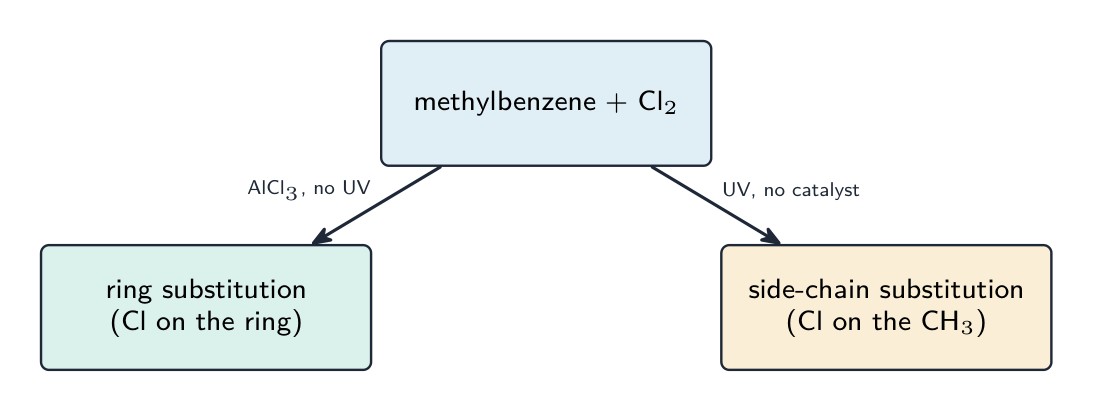
条件选择位置:催化剂 + 无紫外光 → 环;紫外光 + 无催化剂 → 侧链
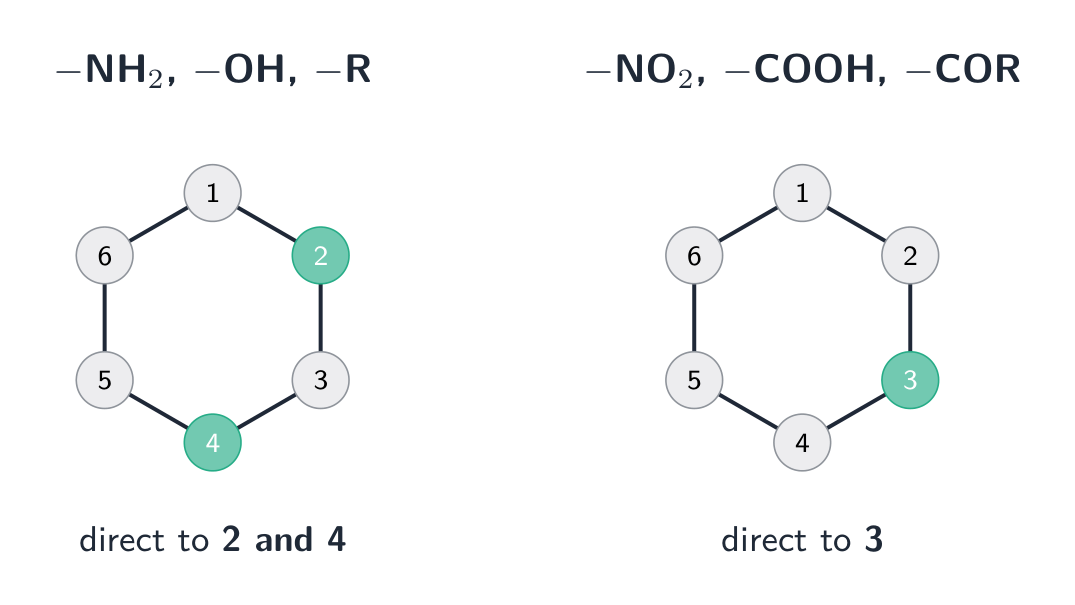
基团在苯环上的定向效应
A halogen reacts in the ring (not the side-chain) when there is: · 当有以下情况时,一个卤素在环中(不是侧链)反应:
The catalyst makes the electrophile for ring substitution; UV with no catalyst gives side-chain free-radical substitution. · 催化剂为环取代生成亲电试剂;无催化剂的紫外光给出侧链自由基取代。
Under UV light with no catalyst, the halogen substitutes: · 在无催化剂的紫外光下,卤素取代在:
UV light starts free-radical substitution in the alkyl side-chain. · 紫外光在烷基侧链中开始自由基取代。
Directing effects
| Group already present | Directs the new group to |
|---|---|
| $\text{–NH}_2$, $\text{–OH}$, $\text{–R}$ | positions 2 and 4 |
| $\text{–NO}_2$, $\text{–COOH}$, $\text{–COR}$ | position 3 |
Electrophilic substitution: nitration of benzene
定向效应
| 已经存在的基团 | 把新基团定向到 |
|---|---|
| $\text{–NH}_2$、$\text{–OH}$、$\text{–R}$ | 位置 2 和 4 |
| $\text{–NO}_2$、$\text{–COOH}$、$\text{–COR}$ | 位置 3 |
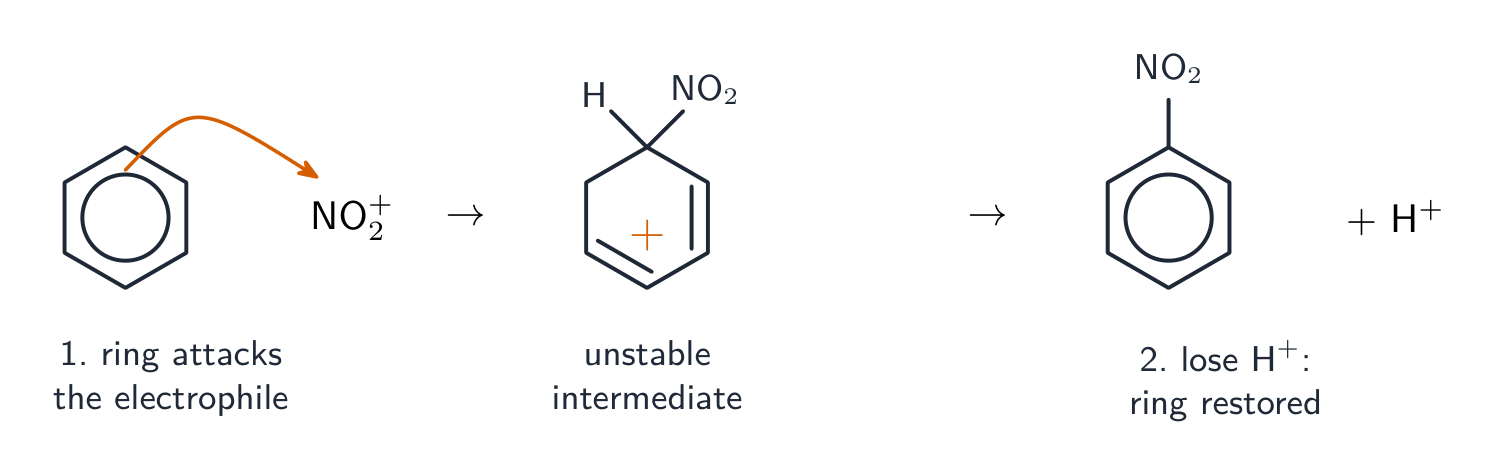
亲电取代:苯的硝化
An –OH group already on the ring directs the next substituent to: · 一个已经在环上的 –OH 基团把下一个取代基定向到:
–NH₂, –OH and –R are 2,4-directing; –NO₂, –COOH and –COR are 3-directing. · –NH₂、–OH 和 –R 是 2,4-定向;–NO₂、–COOH 和 –COR 是 3-定向。
Match each group to where it directs the next substituent. · 匹配每个基团和它把下一个取代基定向到哪里。
Activating groups (–OH, –NH₂, –R) direct to 2,4; deactivating groups (–NO₂, –COOH, –COR) direct to 3. · 活化基团(–OH、–NH₂、–R)定向到 2,4;钝化基团(–NO₂、–COOH、–COR)定向到 3。
Activators and deactivators
- Electron-donating 给电子 groups (–NH₂, –OH, –R) push electrons into the ring → it reacts faster (activated 活化) and they direct to 2,4.
- Electron-withdrawing 吸电子 groups (–NO₂, –COOH) pull electrons out → the ring reacts slower (deactivated 钝化) and they direct to 3.
Nitrating phenol: the –OH is electron-donating, so it activates the ring and directs to 2,4.
- Products: 2-nitrophenol and 4-nitrophenol.
- And phenol nitrates faster than benzene — so easily it even reacts with dilute nitric acid.
活化剂和钝化剂
- 给电子基团(–NH₂、–OH、–R)把电子推入环 → 它反应更快(被活化)并定向到 2,4。
- 吸电子基团(–NO₂、–COOH)把电子拉出 → 环反应更慢(被钝化)并定向到 3。
硝化苯酚: –OH 是给电子的,所以它活化环并定向到 2,4。
- 产物:2-硝基苯酚和4-硝基苯酚。
- 而且苯酚比苯硝化更快——如此容易,它甚至与稀硝酸反应。
You've got it
- ring substitution: catalyst (AlCl₃) + no UV; side-chain: UV + no catalyst (free-radical)
- a group already on the ring directs the next: –NH₂/–OH/–R → 2,4; –NO₂/–COOH/–COR → 3
- donating groups activate (react faster); withdrawing groups deactivate (react slower)
你掌握了
- 环取代:催化剂(AlCl₃)+ 无紫外光;侧链:紫外光 + 无催化剂(自由基)
- 一个已经在环上的基团定向下一个:–NH₂/–OH/–R → 2,4;–NO₂/–COOH/–COR → 3
- 给电子基团活化(反应更快);吸电子基团钝化(反应更慢)