Stability constants · 稳定常数
| English | 中文 | Pinyin · 拼音 |
|---|---|---|
| stability constant/stəˈbɪlɪti ˈkɒnstənt/ | 稳定常数 | wěn dìng cháng shù |
| ligand exchange/ˈlɪɡænd eksˈtʃeɪndʒ/ | 配体交换 | pèi tǐ jiāo huàn |
| chelate effect/ˈtʃeleɪt ɪˈfekt/ | 螯合效应 | áo hé xiào yìng |
| multidentate/ˌmʌltɪˈdenteɪt/ | 多齿 | duō chǐ |
| entropy/ˈentrəpi/ | 熵 | shāng |
How stable is the complex?
- The stability constant 稳定常数 $K_{\text{stab}}$ measures how stable a complex is.
- It is the equilibrium constant for forming the complex in solution.
- It decides the direction of ligand exchange 配体交换 — which complex wins.
配合物有多稳定?
- 稳定常数(stability constant)$K_{\text{stab}}$ 衡量一个配合物有多稳定。
- 它是在溶液中形成配合物的平衡常数。
- 它决定配体交换的方向——哪个配合物胜出。
Stability constant lab · 稳定常数实验室
larger Kstab favours complex · 更大的 Kstab 有利于配合物
Increase ligand binding strength and see complex formation become more complete. · 增加配体结合强度,看配合物形成变得更完全。
The stability constant K_stab is: · 稳定常数 K_stab 是:
K_stab is the equilibrium constant for the complex-forming reaction; water is omitted. · K_stab 是配合物形成反应的平衡常数;水被省略。
The equilibrium constant for the formation of a complex from its aqua ion is the ______ constant. · 从它的水合离子形成一个配合物的平衡常数是 ______ 常数。
A larger value means a more stable complex. · 一个更大的值意味着一个更稳定的配合物。
A larger stability constant means the complex is more stable than the aqua ion. · 一个更大的稳定常数意味着配合物比水合离子更稳定。
Ligand exchange is favoured. · 配体交换被偏好。
What $K_{\text{stab}}$ tells you
- $K_{\text{stab}}$ is the equilibrium constant for forming a complex from the metal ion and its ligands (water is left out of the expression).
- A large $K_{\text{stab}}$ means a very stable complex.
Complex shapes by coordination number
$K_{\text{stab}}$ 告诉你什么
- $K_{\text{stab}}$ 是从金属离子和它的配体形成一个配合物的平衡常数(水被排除在表达式之外)。
- 一个大的 $K_{\text{stab}}$ 意味着一个非常稳定的配合物。
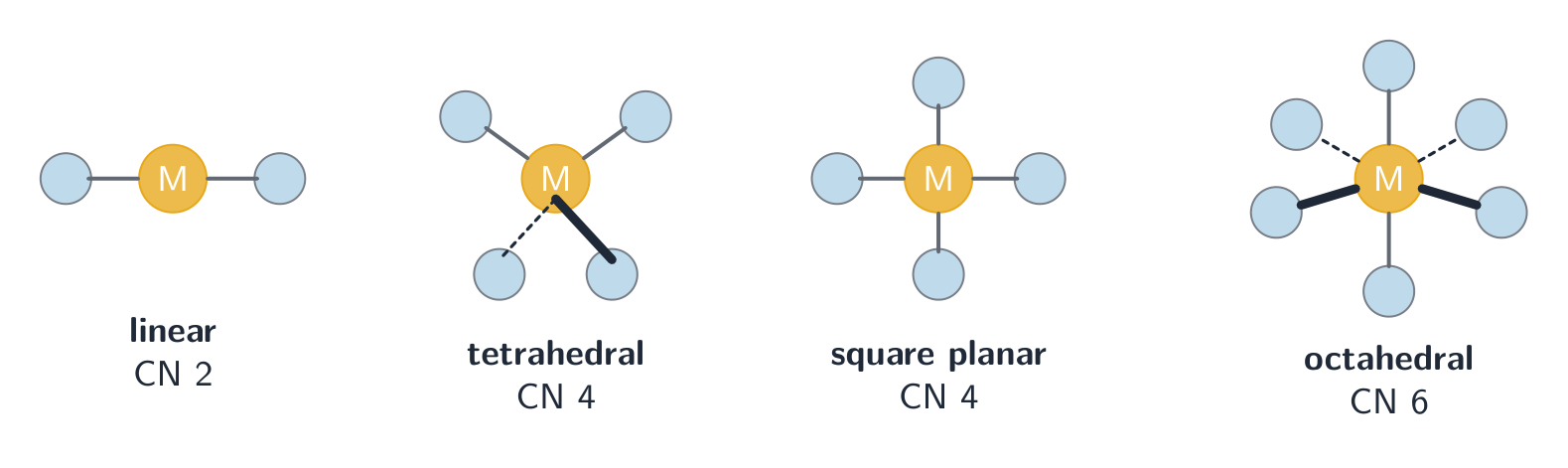
按配位数的配合物形状
A large K_stab means the complex is: · 一个大的 K_stab 意味着配合物是:
A large stability constant indicates a strongly favoured, stable complex. · 一个大的稳定常数表明一个强烈有利的、稳定的配合物。
Direction of ligand exchange
- In a ligand exchange, the equilibrium shifts towards the complex with the larger $K_{\text{stab}}$.
- So a ligand that forms a more stable complex can push out a weaker one.
配体交换的方向
- 在一个配体交换中,平衡移向有更大 $K_{\text{stab}}$ 的配合物。
- 所以一个形成更稳定配合物的配体可以挤出一个更弱的。
In a ligand exchange, the equilibrium shifts towards the complex with the: · 在一个配体交换中,平衡移向有以下情况的配合物:
The more stable complex (larger K_stab) is favoured, so a stronger ligand can displace a weaker one. · 更稳定的配合物(更大的 K_stab)被偏好,所以一个更强的配体可以置换一个更弱的。
The chelate effect 螯合效应
- A multidentate 多齿 (chelating) ligand forms a far more stable complex than several separate ligands.
- The reason is entropy 熵: swapping many small ligands for a few big ones increases the number of free particles.
[Ni(H₂O)₆]²⁺ + 3 en (a bidentate ligand) → [Ni(en)₃]²⁺ + 6 H₂O.
- 4 particles become 7 free particles — a big entropy rise.
- So $K_{\text{stab}}$ is huge, and the en complex easily displaces the water (or ammonia) ligands.
- This chelate effect is why EDTA (which grabs a metal ion at six points) binds so tightly.
螯合效应
- 一个多齿(螯合)配体形成一个比几个分开的配体稳定得多的配合物。
- 原因是熵:把许多小配体换成几个大的增加了自由粒子的数量。
[Ni(H₂O)₆]²⁺ + 3 en(一个双齿配体)→ [Ni(en)₃]²⁺ + 6 H₂O。
- 4 个粒子变成 7 个自由粒子——一个大的熵升高。
- 所以 $K_{\text{stab}}$ 是巨大的,en 配合物容易置换水(或氨)配体。
- 这个螯合效应是为什么 EDTA(它在六个点抓住一个金属离子)结合得如此紧密。
You've got it
- $K_{\text{stab}}$ = equilibrium constant for forming a complex (water omitted)
- a large $K_{\text{stab}}$ = a very stable complex
- ligand exchange moves towards the complex with the larger $K_{\text{stab}}$
- the chelate effect: multidentate ligands give a bigger $K_{\text{stab}}$, driven by the entropy rise
你掌握了
- $K_{\text{stab}}$ = 形成一个配合物的平衡常数(水被省略)
- 一个大的 $K_{\text{stab}}$ = 一个非常稳定的配合物
- 配体交换移向有更大 $K_{\text{stab}}$ 的配合物
- 螯合效应:多齿配体给出一个更大的 $K_{\text{stab}}$,由熵的升高驱动