Why complexes are coloured · 为什么配合物是有色的
| English | 中文 | Pinyin · 拼音 |
|---|---|---|
| degenerate/dɪˈdʒenəreɪt/ | 简并 | jiǎn bìng |
| octahedral/ˌɒktəˈhiːdrəl/ | 八面体形 | bā miàn tǐ xíng |
| tetrahedral/ˌtetrəˈhiːdrəl/ | 四面体形 | sì miàn tǐ xíng |
| complementary colour/ˌkɒmplɪˈmentəri ˈkʌlə/ | 互补色 | hù bǔ sè |
| spectrochemical series/ˌspektrəʊˈkemɪkl ˈsɪəriːz/ | 光谱化学序列 | guāng pǔ huà xué xù liè |
Where the colour comes from
- In a free ion the five d orbitals are degenerate 简并 (same energy).
- Ligands split them into two sets.
- Absorbing light across the gap gives the colour we see.
颜色从哪里来
- 在一个自由离子中,五个 d 轨道是简并的(degenerate)(相同能量)。
- 配体把它们分裂成两组。
- 吸收跨越能隙的光给出我们看到的颜色。
Complex colour route · 配合物颜色途径
Follow light absorption from d-orbital splitting to observed colour. · 从 d 轨道分裂到观察到的颜色跟随光吸收。
In a free transition-metal ion, the five d orbitals are: · 在一个自由的过渡金属离子中,五个 d 轨道是:
They are degenerate until ligands approach and split them into two sets. · 它们是简并的,直到配体接近并把它们分裂成两组。
Transition-metal complexes are coloured because d-electrons absorb part of the ______ spectrum. · 过渡金属配合物是有色的,因为 d 电子吸收 ______ 光谱的一部分。
The complementary colour is transmitted. · 互补色被透射。
Splitting the d orbitals
- ligands split the d orbitals, separated by an energy gap $\Delta E$:
- octahedral 八面体形: three lower + two higher.
- tetrahedral 四面体形: two lower + three higher.
分裂 d 轨道
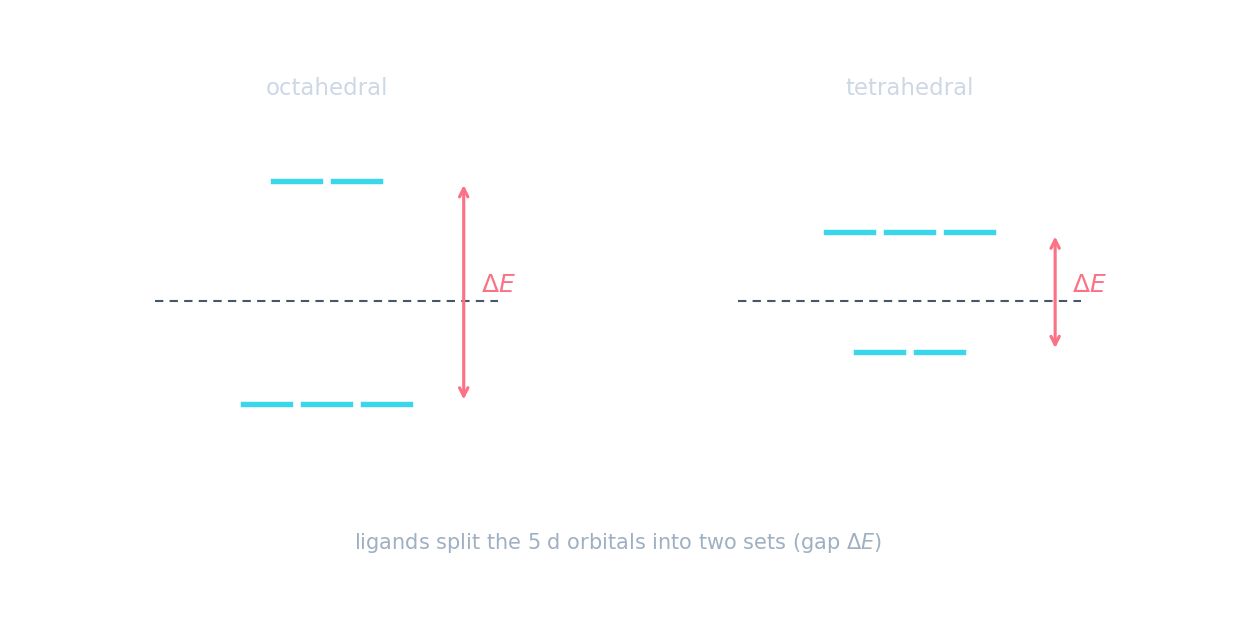
- 配体分裂 d 轨道,由一个能隙 $\Delta E$ 分隔:
- 八面体:三个较低 + 两个较高。
- 四面体:两个较低 + 三个较高。
In an octahedral complex, the d orbitals split into: · 在一个八面体配合物中,d 轨道分裂成:
Octahedral: 3 lower + 2 upper; tetrahedral is the reverse (2 lower + 3 upper). · 八面体:3 个较低 + 2 个较高;四面体是相反的(2 个较低 + 3 个较高)。
Match each colour-theory idea. · 匹配每个颜色理论概念。
Each item links the term to its correct meaning. · 每一项把术语链接到它正确的含义。
The colour we see
- A complex absorbs light whose frequency matches $\Delta E$, promoting an electron to a higher d orbital.
- We see the complementary colour 互补色 of the light absorbed.
- (A d⁰ or d¹⁰ ion — like Zn²⁺ — has no possible jump, so it is colourless.)
我们看到的颜色
- 一个配合物吸收频率匹配 $\Delta E$ 的光,把一个电子提升到一个更高的 d 轨道。
- 我们看到被吸收的光的互补色(complementary colour)。
- (一个 d⁰ 或 d¹⁰ 离子——像 Zn²⁺——没有可能的跃迁,所以它是无色的。)
The colour we see for a complex is: · 我们看到的一个配合物的颜色是:
The complex absorbs light of energy ΔE; we see the complementary colour of what was absorbed. · 配合物吸收能量 ΔE 的光;我们看到被吸收的东西的互补色。
Ligand exchange changes the colour because different ligands: · 配体交换改变颜色,因为不同的配体:
A different ligand changes the size of the d-orbital splitting (ΔE), so a different colour is seen. · 一个不同的配体改变 d 轨道分裂的大小(ΔE),所以看到一个不同的颜色。
What changes the colour
- Change $\Delta E$ and you change the colour. Three things change $\Delta E$:
- the ligand (a spectrochemical series 光谱化学序列: CN⁻ > NH₃ > H₂O > Cl⁻);
- the metal's oxidation state (higher charge → bigger $\Delta E$);
- the coordination number / geometry (octahedral vs tetrahedral).
Add ammonia to pale-blue [Cu(H₂O)₆]²⁺ → deep-blue [Cu(NH₃)₄(H₂O)₂]²⁺.
Swapping H₂O for the stronger-field NH₃ widens $\Delta E$, so a different colour of light is absorbed — and the solution visibly changes colour.
什么改变颜色
- 改变 $\Delta E$ 你就改变颜色。三件事改变 $\Delta E$:
- 配体(一个光化学序:CN⁻ > NH₃ > H₂O > Cl⁻);
- 金属的氧化态(更高的电荷 → 更大的 $\Delta E$);
- 配位数 / 几何形状(八面体 vs 四面体)。
向浅蓝色 [Cu(H₂O)₆]²⁺ 加氨 → 深蓝色 [Cu(NH₃)₄(H₂O)₂]²⁺。
把 H₂O 换成更强场的 NH₃ 拓宽了 $\Delta E$,所以一个不同颜色的光被吸收——溶液明显改变颜色。
You've got it
- a free ion's five d orbitals are degenerate; ligands split them by a gap $\Delta E$
- octahedral = 3 lower + 2 upper; tetrahedral = 2 lower + 3 upper
- the complex absorbs light matching $\Delta E$; we see the complementary colour
- $\Delta E$ (and the colour) changes with the ligand, the oxidation state and the geometry
你掌握了
- 一个自由离子的五个 d 轨道是简并的;配体把它们分裂一个能隙 $\Delta E$
- 八面体 = 3 个较低 + 2 个较高;四面体 = 2 个较低 + 3 个较高
- 配合物吸收匹配 $\Delta E$ 的光;我们看到互补色
- $\Delta E$(和颜色)随配体、氧化态和几何形状改变