Buffer solutions · 缓冲溶液
| English | 中文 | Pinyin · 拼音 |
|---|---|---|
| buffer/ˈbʌfə/ | 缓冲溶液 | huǎn chōng róng yè |
| weak acid/wiːk ˈæsɪd/ | 弱酸 | ruò suān |
| conjugate base/ˈkɒndʒuːɡeɪt beɪs/ | 共轭碱 | gòng è jiǎn |
Solutions that resist change
- A buffer 缓冲溶液 resists a change in pH when a little acid or alkali is added.
- It is made from a weak acid 弱酸 and its conjugate base 共轭碱.
- It is vital in living things — like your blood.
抵抗变化的溶液
- 一个缓冲液(buffer)在加入一点酸或碱时抵抗 pH 的变化。
- 它由一个弱酸和它的共轭碱制造。
- 它在活的东西中至关重要——像你的血液。
A buffer solution is made from: · 一个缓冲溶液由以下哪种制造:
A weak acid and its conjugate base (e.g. ethanoic acid + sodium ethanoate) make a buffer. · 一个弱酸和它的共轭碱(例如乙酸 + 乙酸钠)制造一个缓冲液。
A buffer keeps the pH almost constant when a small amount of acid or alkali is added. · 当加入少量酸或碱时,一个缓冲液保持 pH 几乎恒定。
That is exactly what a buffer does — it resists changes in pH. · 那正是一个缓冲液做的——它抵抗 pH 的变化。
A buffer resists changes in pH when small amounts of acid or base are added. · 当加入少量酸或碱时,一个缓冲液抵抗 pH 的变化。
It contains a weak acid and its conjugate base. · 它含有一个弱酸和它的共轭碱。
How a buffer works
It holds a store of both partners:
- added $\text{H}^+$ is removed by the conjugate base: $\text{CH}_3\text{COO}^- + \text{H}^+ \rightarrow \text{CH}_3\text{COOH}$.
- added $\text{OH}^-$ is removed by the weak acid: $\text{CH}_3\text{COOH} + \text{OH}^- \rightarrow \text{CH}_3\text{COO}^- + \text{H}_2\text{O}$.
So the pH barely changes.
A buffer mops up added acid or alkali
一个缓冲液如何工作
它持有两个伙伴的一个储备:
- 加入的 $\text{H}^+$ 被共轭碱移除:$\text{CH}_3\text{COO}^- + \text{H}^+ \rightarrow \text{CH}_3\text{COOH}$。
- 加入的 $\text{OH}^-$ 被弱酸移除:$\text{CH}_3\text{COOH} + \text{OH}^- \rightarrow \text{CH}_3\text{COO}^- + \text{H}_2\text{O}$。
所以 pH 几乎不变。
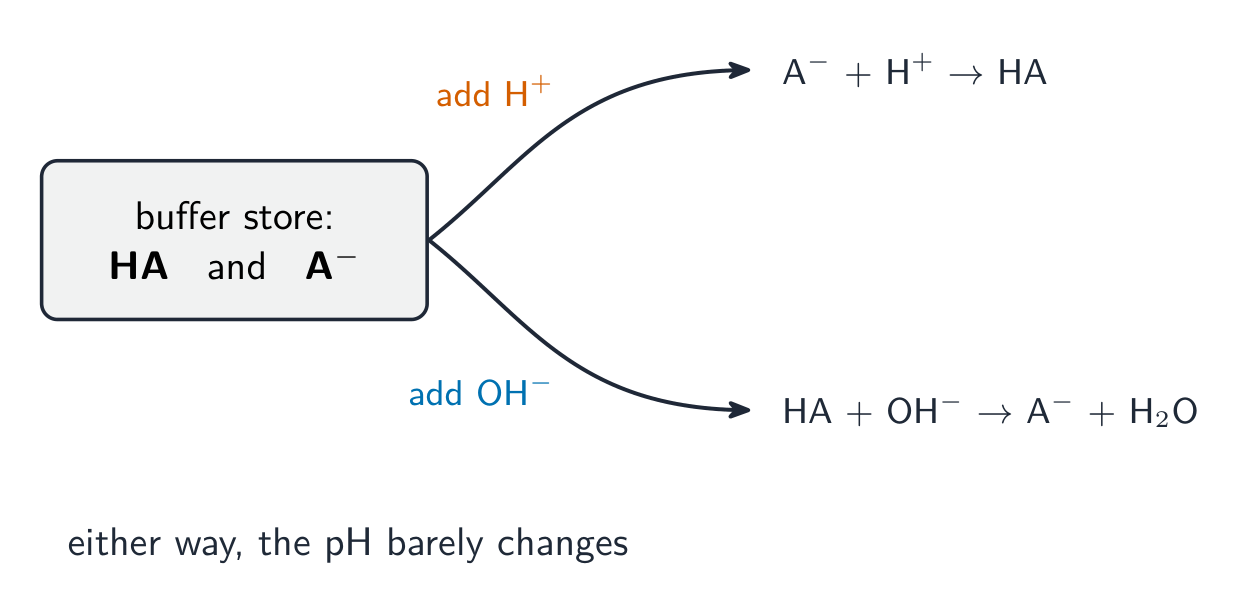
一个缓冲液吸收加入的酸或碱
The buffer region · 缓冲区域
On the curve, a buffer is the flat stretch where added acid or base barely moves the pH — then it jumps at the equivalence point. · 在曲线上,缓冲区是那段平坦的部分:加入酸或碱时 pH 几乎不动——然后在等当点处突跃。
When a little acid (H⁺) is added to a buffer, it is removed by: · 当一点酸(H⁺)被加到一个缓冲液时,它被以下哪种移除:
The conjugate base mops up added H⁺; the weak acid mops up added OH⁻, so the pH barely changes. · 共轭碱吸收加入的 H⁺;弱酸吸收加入的 OH⁻,所以 pH 几乎不变。
Match each buffer idea. · 匹配每个缓冲概念。
Each item links the term to its correct meaning. · 每一项把术语链接到它正确的含义。
Finding the pH and uses
- Put the concentrations of the acid and its salt into the $K_a$ expression: $[\text{H}^+] = K_a \times \dfrac{[\text{acid}]}{[\text{salt}]}$.
- Buffers matter in life: $\text{HCO}_3^-$ keeps the pH of blood close to 7.4.
找 pH 和用途
- 把酸和它的盐的浓度放进 $K_a$ 表达式:$[\text{H}^+] = K_a \times \dfrac{[\text{acid}]}{[\text{salt}]}$。
- 缓冲液在生命中很重要:$\text{HCO}_3^-$ 把血液的 pH 保持在接近 7.4。
In blood, the pH is kept close to 7.4 by the buffer ion: · 在血液中,pH 由缓冲离子以下哪个保持在接近 7.4:
The hydrogencarbonate ion buffers blood, keeping its pH around 7.4. · 碳酸氢根离子缓冲血液,把它的 pH 保持在约 7.4。
Working out the pH
A buffer is 0.10 mol/dm³ ethanoic acid ($K_a = 1.8 \times 10^{-5}$) + 0.10 mol/dm³ sodium ethanoate.
- $[\text{H}^+] = K_a \times \dfrac{[\text{acid}]}{[\text{salt}]} = 1.8 \times 10^{-5} \times \dfrac{0.10}{0.10} = 1.8 \times 10^{-5}$
- $\text{pH} = -\log(1.8 \times 10^{-5}) = \mathbf{4.74}$
When acid and salt concentrations are equal, $[\text{H}^+] = K_a$, so the pH equals $\text{p}K_a$.
算出 pH
一个缓冲液是 0.10 mol/dm³ 乙酸($K_a = 1.8 \times 10^{-5}$)+ 0.10 mol/dm³ 乙酸钠。
- $[\text{H}^+] = K_a \times \dfrac{[\text{acid}]}{[\text{salt}]} = 1.8 \times 10^{-5} \times \dfrac{0.10}{0.10} = 1.8 \times 10^{-5}$
- $\text{pH} = -\log(1.8 \times 10^{-5}) = \mathbf{4.74}$
当酸和盐浓度相等时,$[\text{H}^+] = K_a$,所以 pH 等于 $\text{p}K_a$。
You've got it
- a buffer = weak acid + its conjugate base; it resists pH change
- added $\text{H}^+$ is mopped up by A⁻; added $\text{OH}^-$ by HA
- find its pH from $[\text{H}^+] = K_a \times \frac{[\text{acid}]}{[\text{salt}]}$ (equal concentrations ⇒ pH = p$K_a$)
- blood is buffered by $\text{HCO}_3^-$ near pH 7.4
你掌握了
- 一个缓冲液 = 弱酸 + 它的共轭碱;它抵抗 pH 变化
- 加入的 $\text{H}^+$ 被 A⁻ 吸收;加入的 $\text{OH}^-$ 被 HA 吸收
- 从 $[\text{H}^+] = K_a \times \frac{[\text{acid}]}{[\text{salt}]}$ 找它的 pH(相等浓度 ⇒ pH = p$K_a$)
- 血液由 $\text{HCO}_3^-$ 缓冲在接近 pH 7.4