Addition polymerisation · 加聚
| English | 中文 | Pinyin · 拼音 |
|---|---|---|
| addition polymerisation/əˈdɪʃn ˌpɒlɪməraɪˈzeɪʃn/ | 加成聚合 | jiā chéng jù hé |
| monomer/ˈmɒnəʊmə/ | 单体 | dān tǐ |
| polymer/ˈpɒlɪmə/ | 聚合物 | jù hé wù |
| repeat unit/rɪˈpiːt ˈjuːnɪt/ | 重复单元 | chóng fù dān yuán |
| non-biodegradable/nɒn ˌbaɪəʊdɪˈɡreɪdəbl/ | 不可生物降解 | bù kě shēng wù jiàng jiě |
Plastics from double bonds
- In addition polymerisation 加成聚合, many small molecules join into one long chain — with no other product.
- Each small molecule is a monomer 单体; it must have a C=C double bond.
- The long chain is the polymer 聚合物.
来自双键的塑料
- 在加聚(addition polymerisation)中,许多小分子结合成一个长链——没有其他产物。
- 每个小分子是一个单体(monomer);它必须有一个 C=C 双键。
- 长链是聚合物(polymer)。
Addition polymerisation route · 加聚途径
Watch alkene monomers join by opening their double bonds.
In addition polymerisation, the monomers must have:
The C=C double bond opens up to let the monomers link into a long chain, with no other product.
Addition polymers are made from monomers containing a C=C ______ bond.
The double bond opens to join the units.
Repeat units 重复单元
- The repeat unit is the small part copied along the chain. To find it: change the C=C to a single C–C and draw bonds out at each end.
$$n\,\text{CH}_2{=}\text{CH}_2 \rightarrow -(\text{CH}_2{-}\text{CH}_2)_n-$$
- Examples: poly(ethene) from ethene; poly(chloroethene) (PVC) from chloroethene.
Most addition polymers are non-biodegradable 不可生物降解, so they build up as waste.
Poly(alkene) waste is non-biodegradable and burning PVC gives toxic HCl
重复单元
- 重复单元(repeat unit)是沿链复制的小部分。要找到它:把 C=C 变成单 C–C 并在每一端画出键。
$$n\,\text{CH}_2{=}\text{CH}_2 \rightarrow -(\text{CH}_2{-}\text{CH}_2)_n-$$
- 例子:由乙烯的聚乙烯(poly(ethene));由氯乙烯的聚氯乙烯(PVC)(poly(chloroethene))。
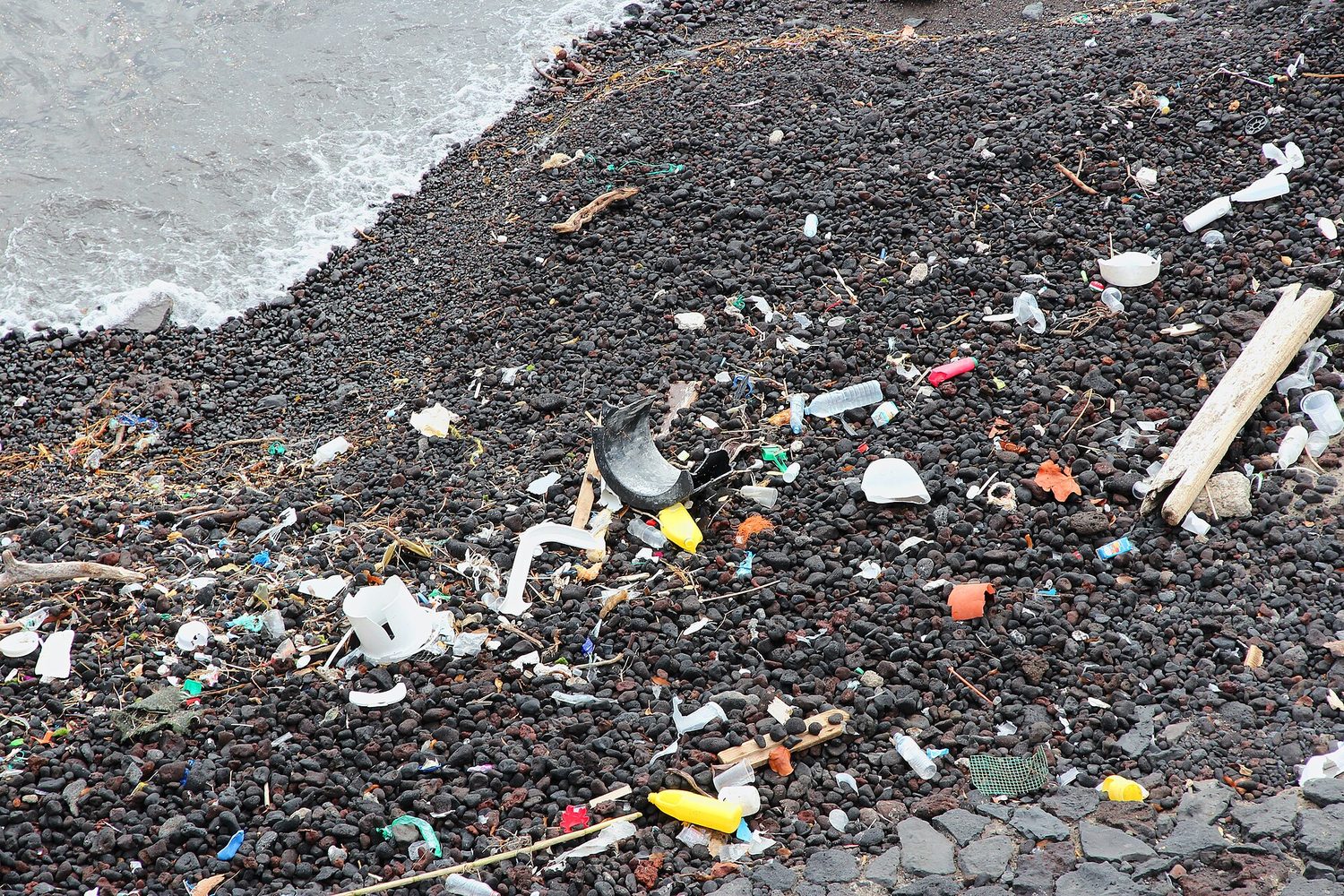
大多数加聚物是不可生物降解的,所以它们作为废物积累。
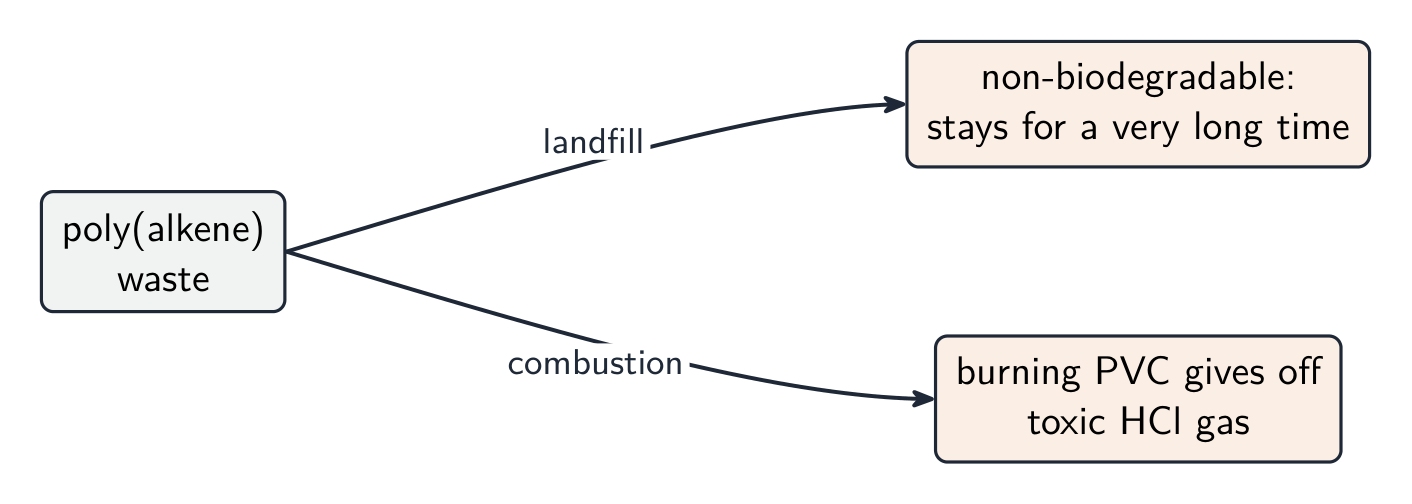
聚(烯烃)废物是不可生物降解的,烧 PVC 给出有毒的 HCl
To draw the repeat unit from a monomer, you:
Open the double bond (C=C → C–C) and put a bond out at each end to show the chain continues.
Match each addition-polymer fact.
Each item links the term to its correct meaning.
Making poly(ethene) by addition polymerisation also produces water.
The monomer atoms all enter the polymer. Addition polymerisation has no small-molecule by-product.
Finding the monomer
- Go the other way: take one repeat unit and put the C=C double bond back.
- That gives you the monomer.
Poly(ethene) is supplied as tiny pellets a few millimetres across, which are then melted and moulded into bottles, bags and other products
找出单体
- 反向走:取一个重复单元并把 C=C 双键放回去。
- 那给你单体。
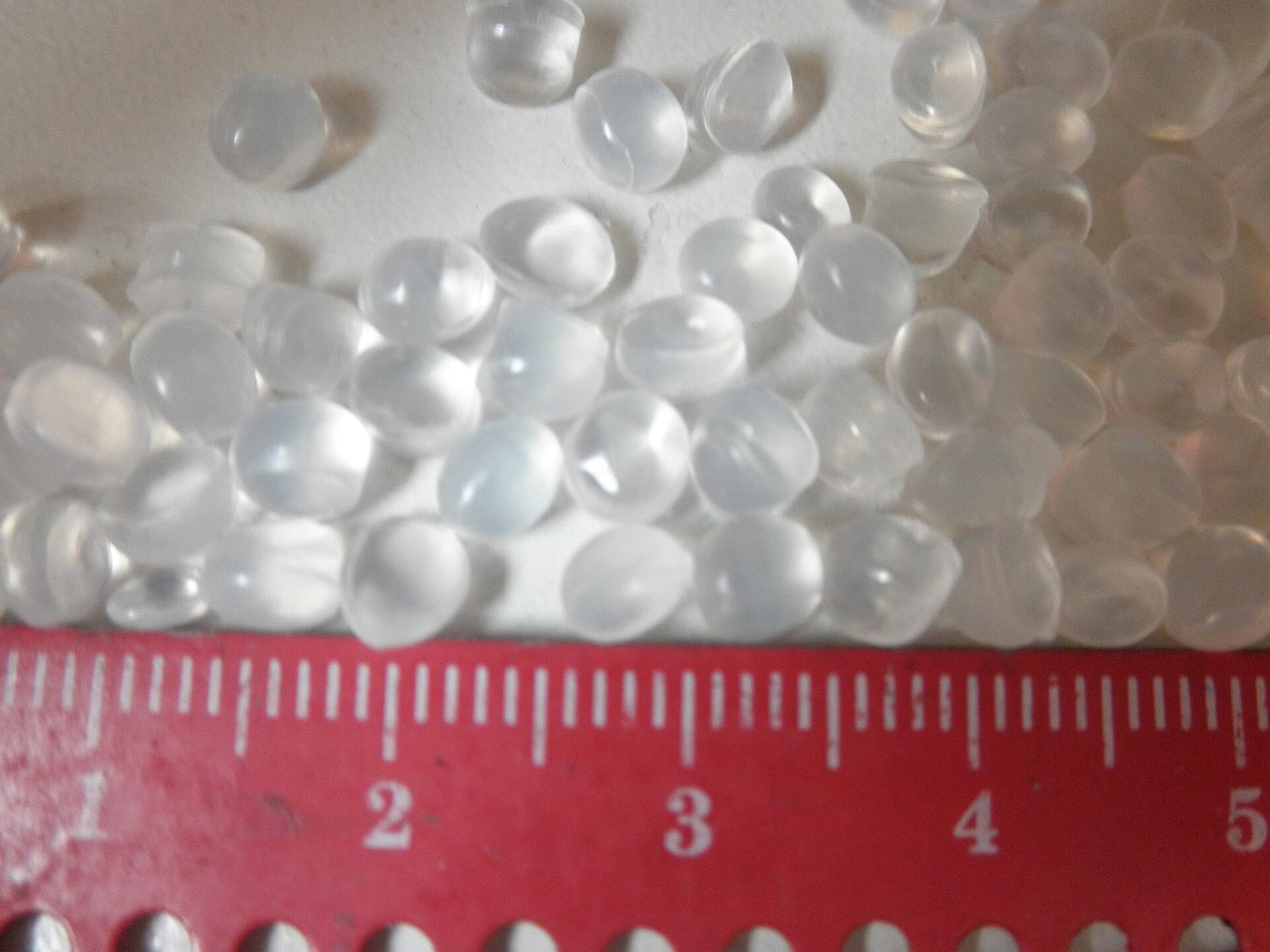
聚乙烯以几毫米大小的微小颗粒供应,然后被熔化并模制成瓶子、袋子和其他产品
To find the monomer from a polymer's repeat unit, you:
Reversing the process, restore the C=C double bond in one repeat unit to get the monomer.
The repeat unit –CH₂–CH(CH₃)– comes from the monomer ____.
Restore the C=C between the two backbone carbons: CH₂=CHCH₃, which is propene.
The repeat unit –CH₂–CH(CH₃)– contains how many carbon atoms?
Two carbons form the backbone and one is in the methyl side group: three in total.
The disposal problem
- Poly(alkene)s are non-biodegradable — microbes can't break them down, so they linger for a very long time.
- Burning them can release harmful gases — e.g. burning PVC gives off toxic hydrogen chloride.
Monomer and repeat unit for PVC
处置问题
- 聚(烯烃)是不可生物降解(non-biodegradable)的——微生物不能分解它们,所以它们停留很长时间。
- 燃烧它们能释放有害气体——例如烧 PVC 放出有毒的氯化氢。
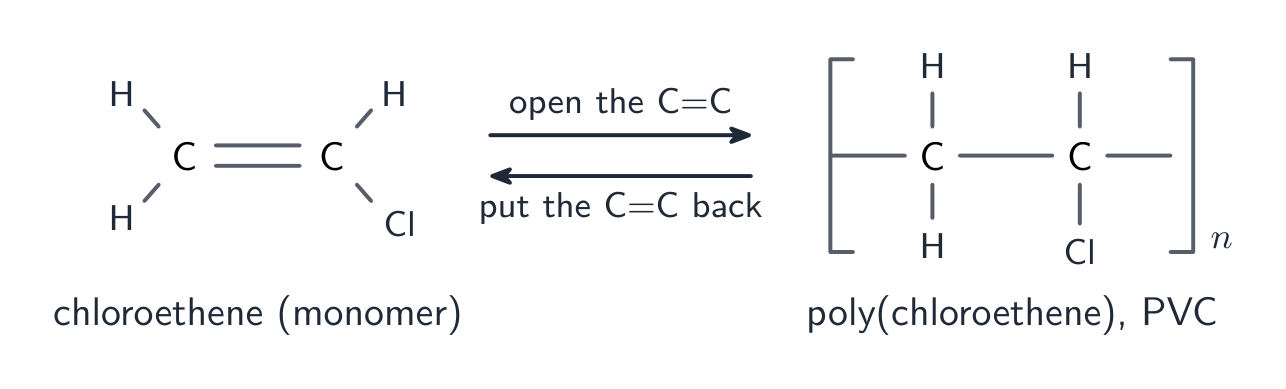
PVC 的单体和重复单元
Why are poly(alkene)s hard to dispose of?
Microbes cannot break them down (non-biodegradable); burning PVC releases toxic hydrogen chloride.
You've got it
- addition polymerisation: many C=C monomers join into one polymer (no other product)
- repeat unit: change the C=C to a single bond, bonds out at each end
- find the monomer by putting the C=C back
- poly(alkene)s are non-biodegradable; burning PVC releases toxic HCl
你掌握了
- 加聚:许多 C=C 单体结合成一个聚合物(没有其他产物)
- 重复单元:把 C=C 变成一个单键,在每一端画出键
- 通过把 C=C 放回去找出单体
- 聚(烯烃)是不可生物降解的;烧 PVC 释放有毒的 HCl