Bond energies and calorimetry · 键能和量热法
| English | 中文 | Pinyin · 拼音 |
|---|---|---|
| bond energy/bɒnd ˈenədʒi/ | 键能 | jiàn néng |
| endothermic/ˌendəʊˈθɜːmɪk/ | 吸热 | xī rè |
| exothermic/eɡzəˈðɜːmɪk/ | 放热 | fàng rè |
| specific heat capacity/spəˈsɪfɪk hiːt kəˈpæsɪti/ | 比热容 | bǐ rè róng |
| calorimetry/ˌkælɔːˈrɪmətri/ | 量热法 | liàng rè fǎ |
Counting energy in bonds
- During a reaction, old bonds break and new bonds form.
- Breaking takes energy in; making gives energy out.
- We can also measure $\Delta H$ in the lab.
数键中的能量
- 在一个反应期间,旧键断裂,新键形成。
- 断裂吸收能量;形成放出能量。
- 我们也能在实验室测量 $\Delta H$。
Which statement is correct? · 哪个陈述是正确的?
Energy is needed to break bonds and released when bonds form; ΔH is the difference. · 断键需要能量,形成键时释放能量;ΔH 是差。
Breaking bonds is endothermic and making bonds is exothermic. · 断裂键是吸热的,形成键是放热的。
ΔH = bonds broken − bonds made. · ΔH = 断裂键 − 形成键。
Bond energy 键能 calculations
- Breaking a bond is endothermic 吸热; making a bond is exothermic 放热.
- The bond energy is the energy to break one mole of a bond (gas state) — always positive.
- Some values are exact; others are averages over many molecules, so the answer is approximate.
Breaking bonds takes in energy and making bonds gives it out
键能计算
- 断裂一个键是吸热的;形成一个键是放热的。
- 键能(bond energy)是断裂一摩尔一个键(气态)的能量——总是正的。
- 有些值是精确的;其他的是许多分子上的平均值,所以答案是近似的。
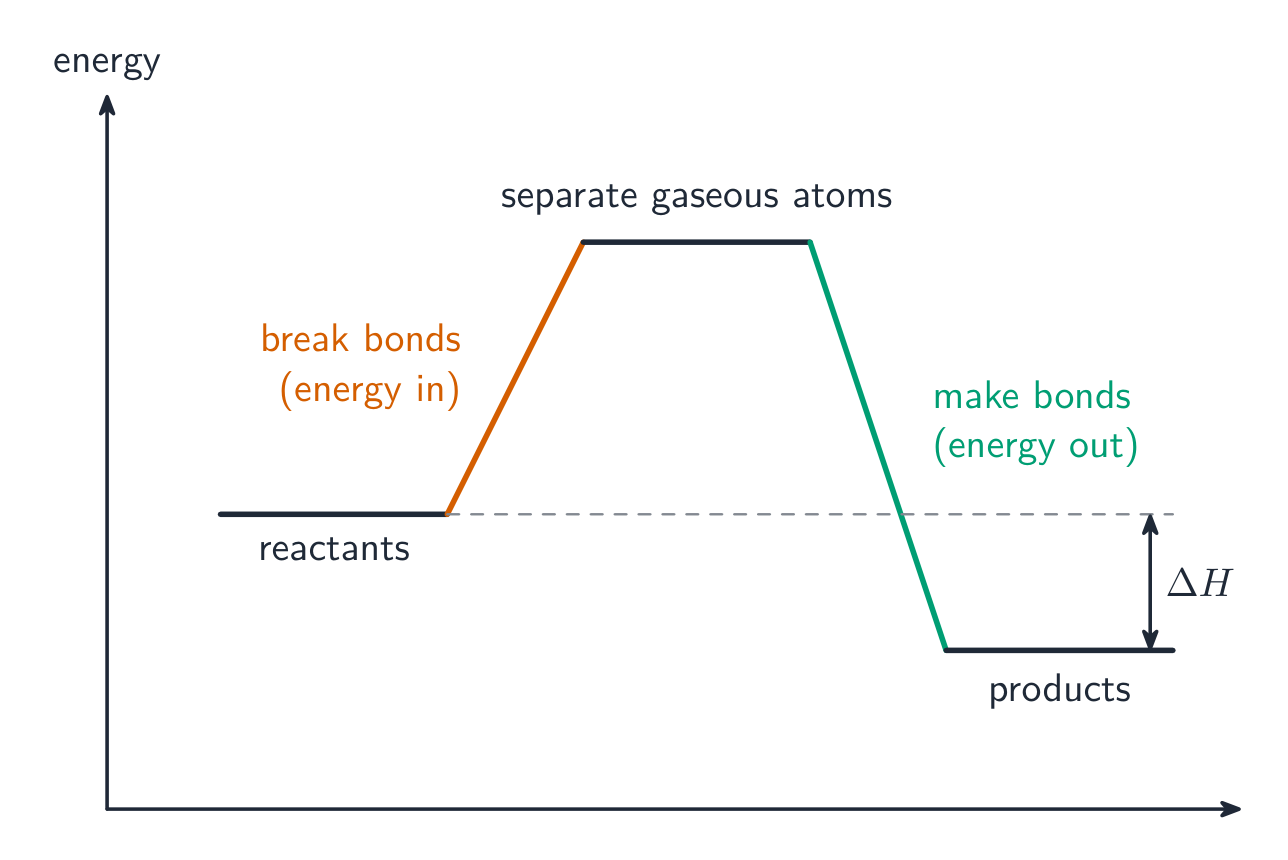
断裂键吸收能量,形成键放出它
Energy in, energy out · 能量进,能量出
ΔH = (energy to break bonds) − (energy released forming bonds). Adjust the activation energy and the overall change to compare exothermic and endothermic profiles. · ΔH =(断键的能量)−(形成键释放的能量)。调整活化能和总变化,以比较放热和吸热的能量图。
Using bond energies, ΔH of reaction equals: · 使用键能,反应的 ΔH 等于:
ΔH = Σ(bonds broken) − Σ(bonds made); energy in to break minus energy out to make. · ΔH = Σ(断裂键)− Σ(形成键);断键吸收的能量减去成键放出的能量。
Why are calculations using average bond energies only approximate? · 为什么使用平均键能的计算只是近似的?
Average bond energies are means over many molecules, so they don't match any single molecule exactly. · 平均键能是许多分子上的平均值,所以它们不精确匹配任何单个分子。
Measuring in the lab
- When a reaction heats a known mass of solution, the heat transferred is:
- ($m$ = mass, $c$ = specific heat capacity 比热容, $\Delta T$ = temperature change.) Then per mole:
- The minus sign makes $\Delta H$ negative when the temperature rises (exothermic).
Burning fuel is exothermic, releasing energy to the surroundings
在实验室测量
- 当一个反应加热已知质量的溶液时,转移的热是:
- ($m$ = 质量,$c$ = 比热容,$\Delta T$ = 温度变化。)然后每摩尔:
- 当温度上升(放热)时,负号使 $\Delta H$ 为负。
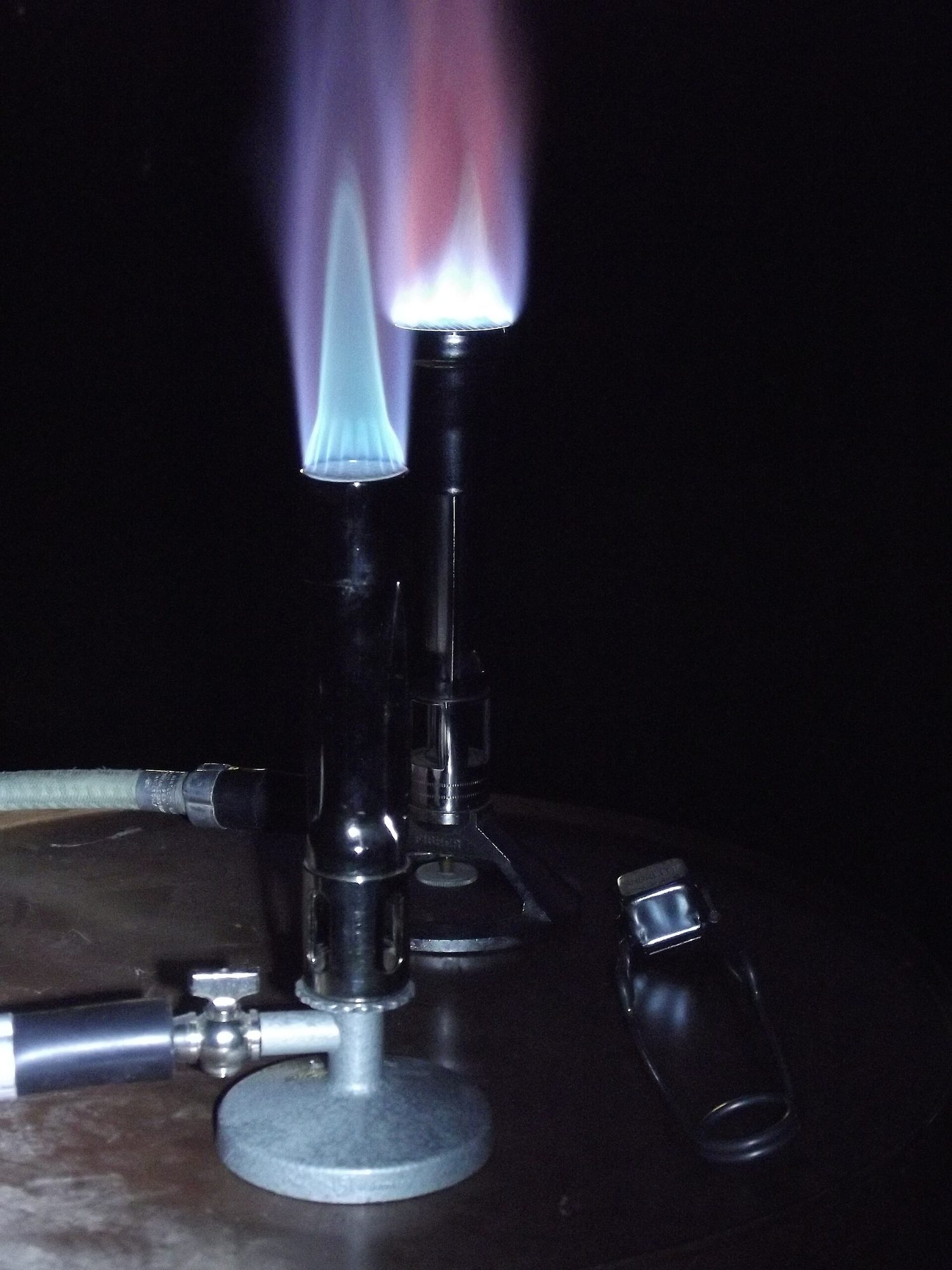
燃烧燃料是放热的,把能量释放给周围环境
The heat transferred to a solution is calculated with: · 转移到一个溶液的热用以下哪个计算:
q = mcΔT (mass × specific heat capacity × temperature change); ΔH per mole = −mcΔT/n. · q = mcΔT(质量 × 比热容 × 温度变化);每摩尔 ΔH = −mcΔT/n。
Match each idea to what it means. · 把每个概念匹配到它的含义。
Each item links the term to its correct meaning. · 每一项把术语链接到它正确的含义。
A bond-energy calculation
Worked example. ΔH = (bonds broken) − (bonds made). If breaking needs +1500 kJ and making releases −1800 kJ, ΔH = 1500 − 1800 = −300 kJ/mol (exothermic).
Measuring the temperature change of a known mass of solution
一个键能计算
例题。 ΔH =(键断裂)−(键形成)。如果断裂需要 +1500 kJ,形成释放 −1800 kJ,ΔH = 1500 − 1800 = −300 kJ/mol(放热)。
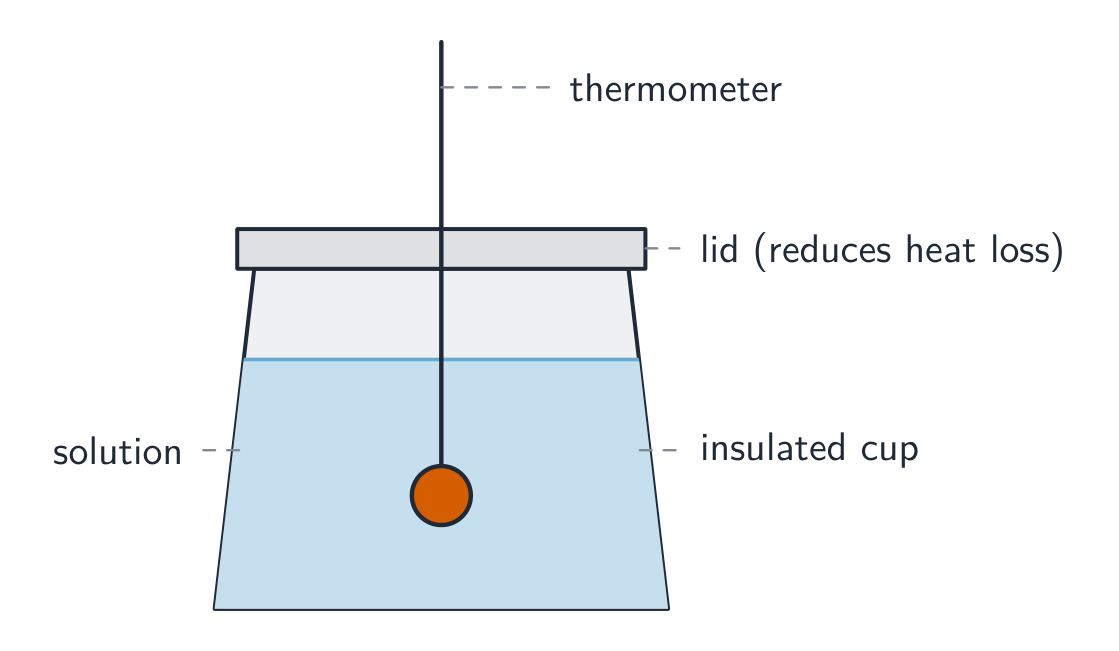
测量已知质量溶液的温度变化
You've got it
- breaking bonds is endothermic; making bonds is exothermic
- $\Delta H_r = \sum(\text{bonds broken}) - \sum(\text{bonds made})$
- average bond energies give only an approximate answer
- calorimetry 量热法: $q = mc\Delta T$, then $\Delta H = -\dfrac{mc\Delta T}{n}$
你掌握了
- 断裂键是吸热的;形成键是放热的
- $\Delta H_r = \sum(\text{bonds broken}) - \sum(\text{bonds made})$
- 平均键能只给出一个近似的答案
- 量热法:$q = mc\Delta T$,然后 $\Delta H = -\dfrac{mc\Delta T}{n}$