Respiratory substrates and RQ · 呼吸底物与RQ
| English | 中文 | Pinyin · 拼音 |
|---|---|---|
| respiratory substrate/rɪˈspɪrətəri ˈsʌbstreɪt/ | 呼吸底物 | hū xī dǐ wù |
| aerobic respiration/eəˈrəʊbɪk ˌrespɪˈreɪʃn/ | 有氧呼吸 | yǒu yǎng hū xī |
| respiratory quotient/rɪˈspɪrətəri ˈkwəʊʃənt/ | 呼吸商 | hū xī shāng |
| respirometer/rɪspɪˈrɒmɪtə/ | 呼吸计 | hū xī jì |
Burning more than just sugar
- A respiratory substrate 呼吸底物 is a molecule broken down to release energy.
- Different substrates release different amounts of energy.
- The gases they use tell us which one is being respired.
燃烧的不只是糖
- 一种 呼吸底物(respiratory substrate) 是一种被分解以释放能量的分子。
- 不同的底物释放不同量的能量。
- 它们使用的气体告诉我们哪一种正在被呼吸。
Respiratory quotient lab · 呼吸商实验
RQ = CO2 produced / O2 used · RQ = CO₂产生量 / O₂消耗量
Change oxygen use and see how RQ compares fuels. · 改变氧气消耗量,观察RQ如何比较不同燃料。
The respiratory quotient (RQ) is the ratio of CO₂ produced to: · 呼吸商(RQ)是CO₂产生量与:
RQ = CO₂ produced ÷ O₂ used. · RQ = CO₂产生量 ÷ O₂消耗量。
Which respiratory substrate releases the most energy per gram? · 哪种呼吸底物每克释放的能量最多?
Lipids release the most energy per gram (most hydrogen); then proteins, then carbohydrates. · 脂类每克释放能量最多(含氢最多);其次是蛋白质,然后是碳水化合物。
Energy per gram
- Per gram, lipids release the most energy (they have the most hydrogen).
- Proteins are next.
- Carbohydrates release the least.
The four stages of aerobic respiration 有氧呼吸 and where they happen
每克的能量
- 每克,脂质 释放 最多 的能量(它们有最多的氢)。
- 蛋白质 次之。
- 碳水化合物 释放 最少。
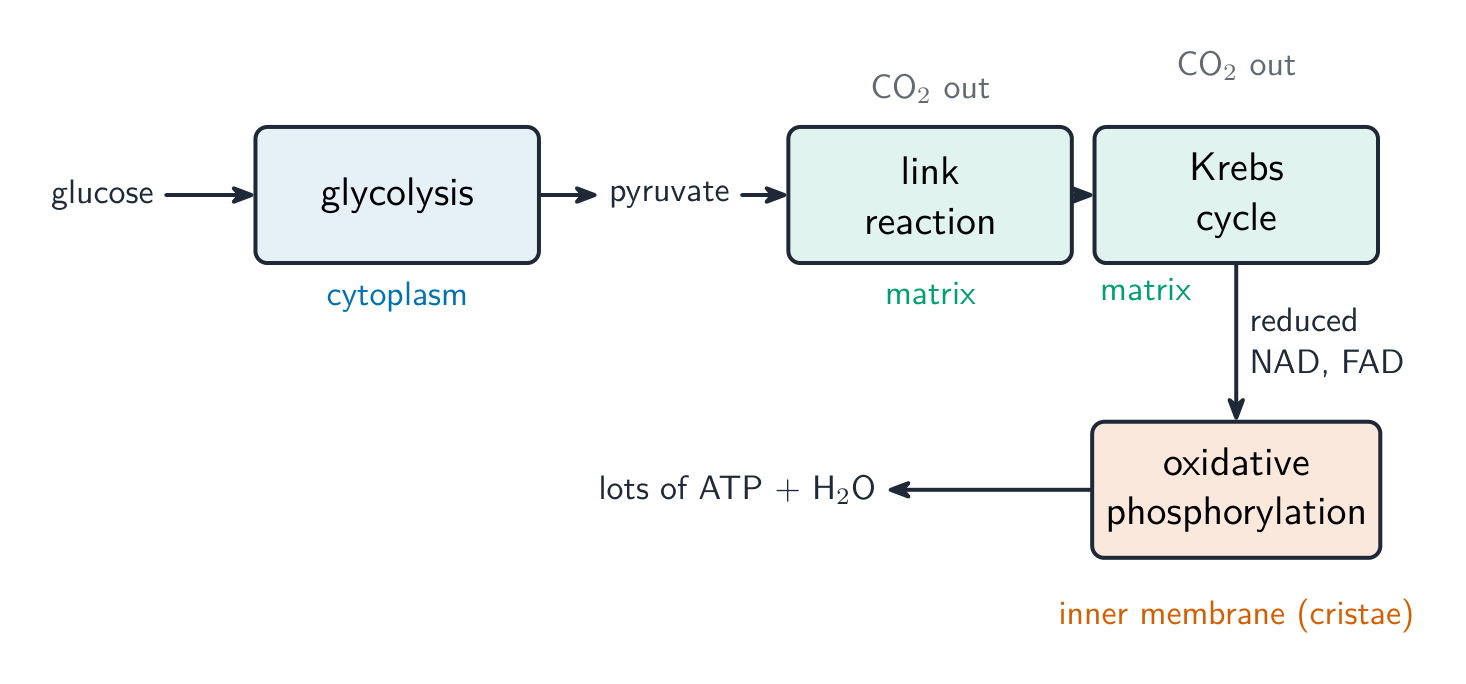
有氧呼吸的四个阶段以及它们在哪里发生
The respiratory quotient 呼吸商 (RQ)
- Typical values: carbohydrate ≈ 1.0, lipid ≈ 0.7, protein ≈ 0.9.
- You can work out RQ from a respiration equation.
呼吸商(RQ)
- 典型值:碳水化合物 ≈ 1.0、脂质 ≈ 0.7、蛋白质 ≈ 0.9。
- 你可以从一个呼吸方程式算出 RQ。
An organism produces 4 molecules of CO₂ and takes in 5 molecules of O₂. What is its RQ? · 某生物产生了4个分子的CO₂并摄入了5个分子的O₂。其RQ是多少?
RQ = CO₂ produced ÷ O₂ taken in = 4 ÷ 5 = 0.8. · RQ = CO₂产生量 ÷ O₂摄入量 = 4 ÷ 5 = 0.8。
An organism makes 7 molecules of CO₂ and uses 10 molecules of O₂. What is its RQ? · 某生物产生了7个分子的CO₂并消耗了10个分子的O₂。其RQ是多少?
RQ = 7 ÷ 10 = 0.7 — a value near 0.7 suggests it is respiring lipid. · RQ = 7 ÷ 10 = 0.7 —— 接近0.7的值表明其正在呼吸脂类。
Match each substrate to its typical RQ. · 将每种底物与其典型RQ匹配。
Carbohydrate gives RQ ≈ 1.0, protein ≈ 0.9, lipid ≈ 0.7 — and lipid also releases the most energy per gram. · 碳水化合物给出RQ ≈ 1.0,蛋白质 ≈ 0.9,脂类 ≈ 0.7——且脂类每克释放的能量也最多。
RQ = carbon dioxide produced ÷ oxygen . · RQ = 二氧化碳产生量 ÷ 氧气。
You measure CO₂ given out and O₂ taken in (e.g. with a respirometer) and divide. · 测量CO₂排出量和O₂摄入量(例如使用呼吸计),然后相除。
The respirometer 呼吸计
- A respirometer measures the oxygen taken in by living things — e.g. germinating seeds or small invertebrates.
- From the gases exchanged, you can find their RQ, or test how temperature changes the rate of oxygen uptake.
A respirometer measures the oxygen taken in by small organisms; the coloured liquid moves as oxygen is used
呼吸计
- 一个 呼吸计(respirometer) 测量生物 摄入的氧气——例如发芽的种子或小无脊椎动物。
- 从交换的气体,你可以求出它们的 RQ,或测试温度如何改变氧气摄入的速率。
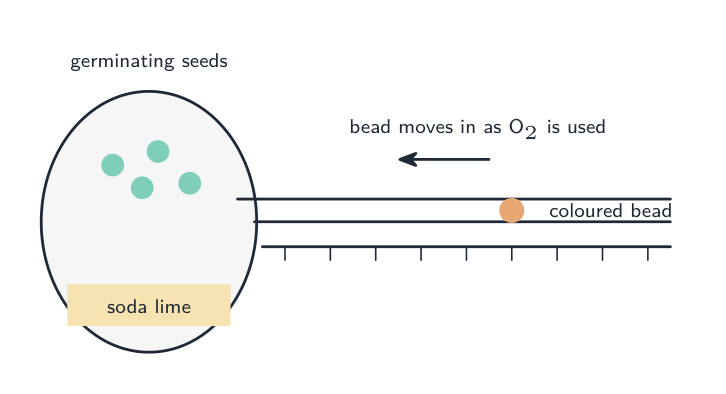
一个呼吸计测量小生物摄入的氧气;随着氧气被用掉,有色液体移动
A respirometer is used to measure: · 呼吸计用于测量:
A respirometer measures oxygen uptake (e.g. of germinating seeds or invertebrates), used to find RQ. · 呼吸计测量氧气吸收量(例如萌发种子或无脊椎动物),用于计算RQ。
You've got it
- respiratory substrate = molecule broken down for energy; per gram lipid > protein > carbohydrate
- $\text{RQ} = \dfrac{\text{CO}_2 \text{ produced}}{\text{O}_2 \text{ used}}$
- RQ values: carbohydrate ≈ 1.0, lipid ≈ 0.7, protein ≈ 0.9
- a respirometer measures oxygen uptake (germinating seeds / invertebrates) to find RQ
你掌握了
- 呼吸底物 = 为能量被分解的分子;每克 脂质 > 蛋白质 > 碳水化合物
- $\text{RQ} = \dfrac{\text{CO}_2 \text{ produced}}{\text{O}_2 \text{ used}}$
- RQ 值:碳水化合物 ≈ 1.0、脂质 ≈ 0.7、蛋白质 ≈ 0.9
- 一个 呼吸计 测量氧气摄入(发芽的种子 / 无脊椎动物)以求 RQ