The circulatory system · 循环系统
| English | 中文 | Pinyin · 拼音 |
|---|---|---|
| closed double circulation/kləʊzd ˈdʌbl ˌsɜːkjʊˈleɪʃn/ | 闭锁双循环 | bì suǒ shuāng xún huán |
| pulmonary circulation/ˈpʌlmənəri ˌsɜːkjʊˈleɪʃn/ | 肺循环 | fèi xún huán |
| systemic circulation/sɪˈstemɪk ˌsɜːkjʊˈleɪʃn/ | 体循环 | tǐ xún huán |
| vein/veɪn/ | 静脉 | jìng mài |
| artery/ˈɑːtəri/ | 动脉 | dòng mài |
| aorta/eɪˈɔːtə/ | 主动脉 | zhǔ dòng mài |
| lumen/ˈluːmen/ | 管腔 | guǎn qiāng |
| capillary/kəˈpɪləri/ | 毛细血管 | máo xì xuè guǎn |
The body's transport network
- Mammals have a closed double circulation 闭锁双循环.
- Closed: blood stays inside vessels the whole time.
- Double: blood passes through the heart twice per full trip.
身体的运输网络
- 哺乳动物有一个 封闭的双循环(closed double circulation)。
- 封闭:血液始终留在血管内。
- 双:血液每完整一趟通过心脏 两次。
A "closed double circulation" means that: · 一个“封闭的双循环”意味着:
Closed = blood always in vessels; double = it passes through the heart twice (pulmonary then systemic). · 封闭 = 血液始终在血管中;双 = 它通过心脏两次(肺循环然后体循环)。
Two loops
- The pulmonary circulation 肺循环 carries blood from the heart to the lungs and back.
- The systemic circulation 体循环 carries blood from the heart to the rest of the body and back.
- Blood flows: arteries → arterioles → capillaries → venules → veins 静脉.
Closed double circulation through the heart, lungs and body
两个回路
- 肺循环(pulmonary circulation) 把血液从心脏运到 肺 再运回。
- 体循环(systemic circulation) 把血液从心脏运到身体其余部分再运回。
- 血液流动:动脉 → 小动脉 → 毛细血管 → 小静脉 → 静脉。
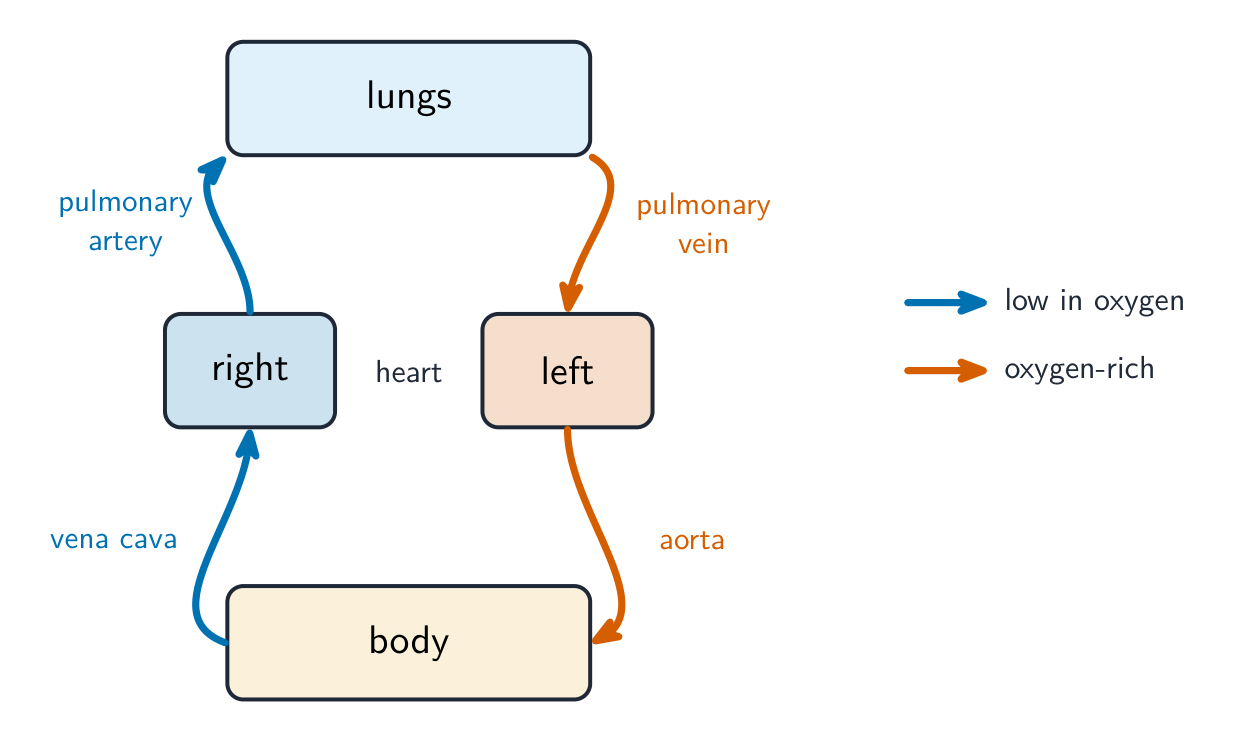
通过心脏、肺和身体的封闭双循环
Double circulation · 双循环
Follow one red blood cell around the loop. It passes through the heart twice each circuit — once to the lungs, once to the body. · 跟随一个红血球绕这个回路走。它每个循环通过心脏两次——一次到肺,一次到身体。
The circulation that carries blood from the heart to the lungs and back is the ______ circulation. · 把血液从心脏运到肺再运回的循环是 ______ 循环。
Pulmonary = to the lungs; systemic = to the rest of the body. · 肺循环 = 到肺;体循环 = 到身体其余部分。
The main vessels
- pulmonary artery 动脉 — heart → lungs (low oxygen).
- pulmonary vein — lungs → heart (oxygen-rich).
- aorta 主动脉 — heart → body (oxygen-rich).
- vena cava — body → heart (oxygen-poor).
主要血管
- 肺动脉——心脏 → 肺(低氧)。
- 肺静脉——肺 → 心脏(富氧)。
- 主动脉——心脏 → 身体(富氧)。
- 腔静脉——身体 → 心脏(缺氧)。
Vessels suited to their jobs
| Vessel | Structure | Function |
|---|---|---|
| artery | thick muscle + elastic wall, narrow lumen 管腔 | high-pressure flow away from heart; walls recoil to smooth flow |
| capillary 毛细血管 | wall just one cell thick | short distance for exchange with cells |
| vein | thin wall, wide lumen, valves | low-pressure return to heart; valves stop backflow |
Cross-sections of an artery (thick wall), vein (wide lumen, valves) and capillary (one cell thick)
适合其工作的血管
| 血管 | 结构 | 功能 |
|---|---|---|
| 动脉 | 厚肌肉 + 弹性壁,窄管腔 | 高压地从心脏流出;壁回弹使血流平稳 |
| 毛细血管 | 壁只有 一个细胞 厚 | 与细胞交换的短距离 |
| 静脉 | 薄壁,宽管腔,瓣膜 | 低压地回到心脏;瓣膜阻止回流 |

一条动脉(厚壁)、静脉(宽管腔、瓣膜)和毛细血管(一个细胞厚)的横截面
Match each vessel to its feature. · 把每条血管与它的特征配对。
Arteries carry high-pressure blood away; veins return it (valves stop backflow); capillaries are where exchange happens. · 动脉把高压血液运走;静脉把它运回(瓣膜阻止回流);毛细血管是交换发生的地方。
Arteries have thick, elastic, muscular walls because they: · 动脉有厚的、弹性的、肌肉的壁,因为它们:
High-pressure blood leaving the heart needs strong walls that stretch and recoil to smooth the flow. · 离开心脏的高压血液需要能伸展和回弹以使血流平稳的强壁。
Veins carry blood at low pressure, so they contain valves to stop it flowing backwards. · 静脉低压地运输血液,所以它们含有瓣膜以阻止它向后流。
Low-pressure blood could flow back, so valves keep it moving one way toward the heart. · 低压的血液可能向后流,所以瓣膜保持它向心脏单向移动。
A capillary wall is just one cell thick because this: · 一条毛细血管壁只有一个细胞厚,因为这:
A one-cell-thick wall means a short diffusion distance, so substances exchange quickly. · 一个细胞厚的壁意味着短的扩散距离,所以物质快速交换。
You've got it
- closed double circulation: blood in vessels, through the heart twice
- pulmonary loop = lungs; systemic loop = body
- artery: thick wall, high pressure, away from heart; vein: valves, low pressure, back to heart
- capillary: one cell thick → fast exchange
你掌握了
- 封闭的双循环:血液在血管中,通过心脏 两次
- 肺 回路 = 肺;体 回路 = 身体
- 动脉:厚壁,高压,从心脏流出;静脉:瓣膜,低压,回到心脏
- 毛细血管:一个细胞厚 → 快速交换