Water potential and living cells · 水势与活细胞
| English | 中文 | Pinyin · 拼音 |
|---|---|---|
| water potential/ˈwɔːtə pəˈtenʃl/ | 水势 | shuǐ shì |
| solute/ˈsɒljuːt/ | 溶质 | róng zhì |
| turgid/ˈtɜːdʒɪd/ | 膨胀 | péng zhàng |
| plasmolysis/plæzˈmɒləsɪs/ | 质壁分离 | zhì bì fēn lí |
| haemolysis/hiːˈmɒləsɪs/ | 溶血 | róng xuè |
Which way will water move?
- Water potential 水势 measures how likely water is to leave a solution.
- It decides which way water moves by osmosis.
- It explains why a wilted plant perks up in water — and why a cell can burst.
水会往哪个方向移动?
- 水势(water potential) 衡量水 离开 一个溶液的可能性有多大。
- 它决定水通过渗透往哪个方向移动。
- 它解释了为什么一株枯萎的植物在水中振作起来——以及为什么一个细胞会胀破。
What changes water potential
- Pure water has the highest water potential.
- Adding a solute 溶质 (a dissolved substance) lowers it.
- Water always moves by osmosis from higher to lower water potential.
- To estimate the water potential of plant tissue: soak pieces in sucrose solutions; the one causing no change in mass/length matches the tissue.
How plant and animal cells respond to solutions of different water potential
什么改变水势
- 纯水 有最高的水势。
- 加一种 溶质(solute)(一种溶解的物质)降低 它。
- 水总是通过渗透从 较高 移动到 较低水势。
- 要估计植物组织的水势:把片段浸在蔗糖溶液中;引起质量/长度 无变化 的那个与组织匹配。
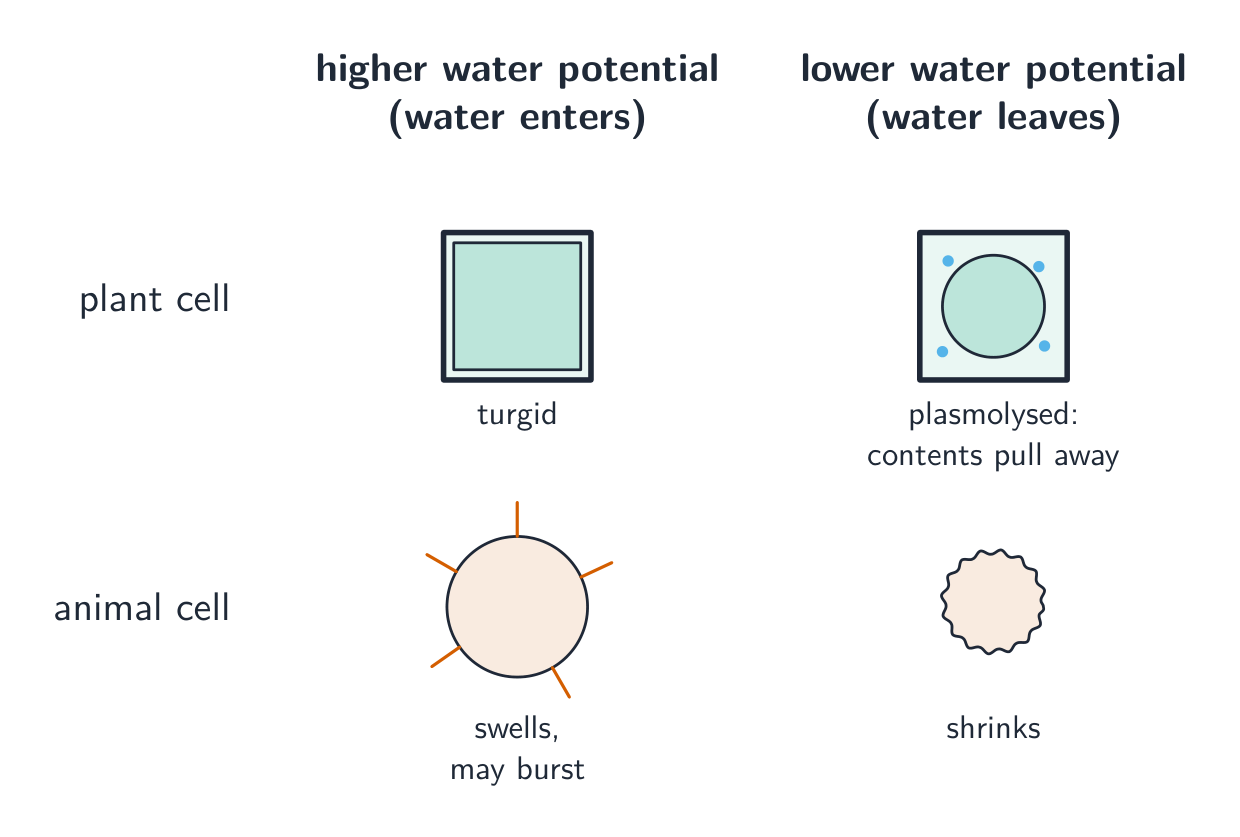
植物和动物细胞如何响应不同水势的溶液
Water potential · 水势
water follows the gradient · 水随梯度移动
Drag the concentrations. A water-potential gradient drives net movement — it stops only when the two sides match. · 拖动浓度。一个水势梯度驱动 净移动——它只在两侧匹配时停止。
Adding a solute to pure water: · 向纯水中加一种溶质:
Pure water has the highest water potential; dissolving a solute lowers it. · 纯水有最高的水势;溶解一种溶质降低它。
Pure water has the highest possible water potential, which is defined as zero. · 纯水有最高的可能水势,它被定义为零。
Pure water is defined as having a water potential of 0 kPa; adding solute makes it negative (lower). · 纯水被定义为有 0 kPa 的水势;加溶质使它变负(更低)。
When estimating the water potential of plant tissue, the matching solution causes ______ change in mass or length. · 在估计植物组织的水势时,匹配的溶液引起质量或长度的 ______ 变化。
No net osmosis (no mass/length change) means the solution and tissue have the same water potential. · 没有净渗透(没有质量/长度变化)意味着溶液和组织有相同的水势。
Plant cells
- In a higher water potential (e.g. distilled water): water enters, the cell swells and becomes turgid 膨胀 — the strong cell wall stops it bursting.
- In a lower water potential: water leaves, the contents shrink and the membrane pulls away from the wall — plasmolysis 质壁分离.
A potato osmometer: sugar solution rises up the tube as water enters by osmosis.
植物细胞
- 在 较高 水势中(例如蒸馏水):水 进入,细胞膨胀并变得 膨胀坚挺(turgid)——结实的 细胞壁 阻止它胀破。
- 在 较低 水势中:水 离开,内容物收缩,膜从壁上拉开——质壁分离(plasmolysis)。
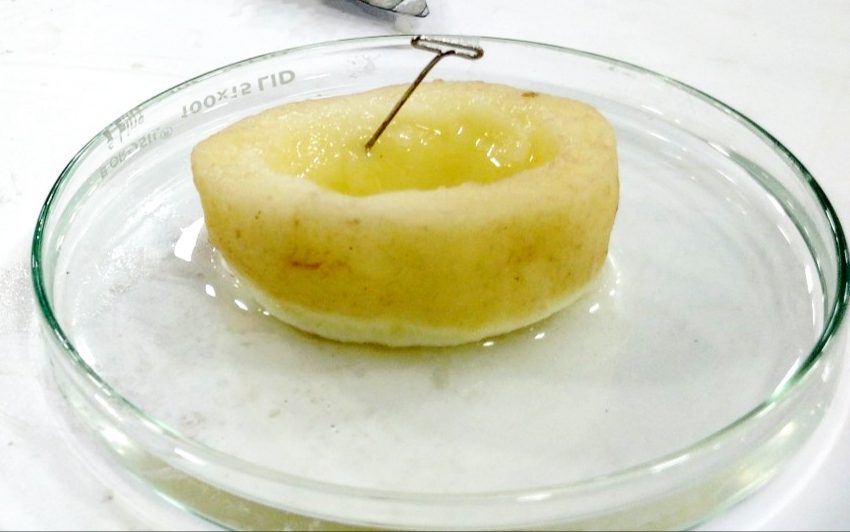
马铃薯渗透计:糖溶液随着水通过渗透进入而沿管上升。
A plant cell placed in distilled water becomes turgid rather than bursting because: · 一个放在蒸馏水中的植物细胞变得膨胀坚挺而不是胀破,因为:
Water enters (higher water potential outside), but the rigid cell wall stops the cell bursting — it becomes turgid. · 水进入(外面水势较高),但刚性的细胞壁阻止细胞胀破——它变得膨胀坚挺。
Plasmolysis happens when a plant cell is in a solution of LOWER water potential, because: · 当一个植物细胞处于较低水势的溶液中时发生质壁分离,因为:
Water leaves down the water-potential gradient; the contents shrink and the membrane peels away from the wall. · 水沿水势梯度离开;内容物收缩,膜从壁上剥离。
Animal cells
- Animal cells have no cell wall to protect them.
- In a higher water potential: water enters and the cell may burst — in a red blood cell this is haemolysis 溶血.
- In a lower water potential: water leaves and the cell shrinks.
Osmosis: water crosses a partially permeable membrane to the lower water potential
动物细胞
- 动物细胞 没有细胞壁 来保护它们。
- 在 较高 水势中:水进入,细胞可能 胀破——在一个红血球中这是 溶血(haemolysis)。
- 在 较低 水势中:水离开,细胞 收缩。
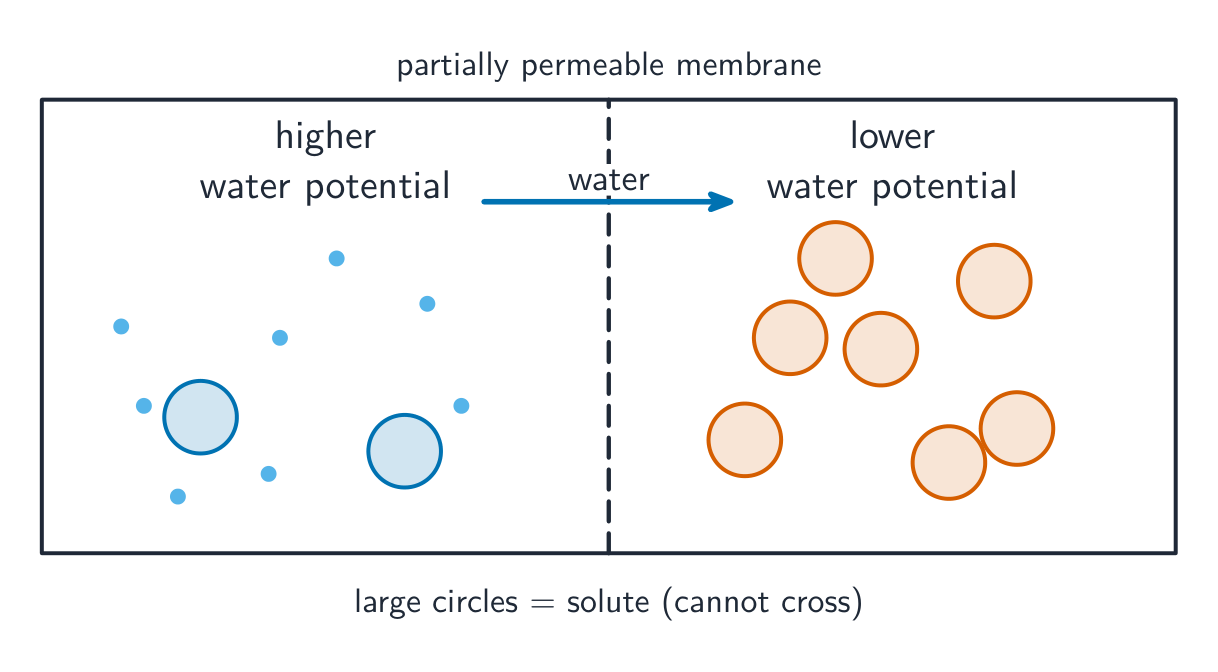
渗透:水穿过一个部分透性膜到较低的水势
Match each cell and solution to what happens. · 把每个细胞和溶液与发生的事配对。
The wall protects plant cells; without one, a red blood cell bursts in pure water and shrinks in a concentrated solution. · 壁保护植物细胞;没有壁,红血球在纯水中胀破,在浓溶液中收缩。
A red blood cell placed in pure water may undergo haemolysis. This is because it: · 一个放在纯水中的红血球可能发生溶血。这是因为它:
With no protective wall, water entering by osmosis swells the cell until the membrane bursts (haemolysis). · 没有保护性的壁,通过渗透进入的水使细胞膨胀,直到膜胀破(溶血)。
You've got it
- pure water = highest water potential; solute lowers it; water moves higher → lower
- estimate tissue water potential by the no-change solution (mass/length)
- plant cell: turgid (high WP, wall protects) ↔ plasmolysis (low WP)
- animal cell (no wall): bursts/haemolysis (high WP) ↔ shrinks (low WP)
你掌握了
- 纯水 = 最高 水势;溶质降低 它;水从 高 → 低 移动
- 用 无变化 的溶液(质量/长度)估计组织水势
- 植物 细胞:膨胀坚挺(高水势,壁保护)↔ 质壁分离(低水势)
- 动物 细胞(无壁):胀破/溶血(高水势)↔ 收缩(低水势)