Movement into and out of cells · 物质进出细胞
| English | 中文 | Pinyin · 拼音 |
|---|---|---|
| concentration gradient/ˌkɒnsənˈtreɪʃn ˈɡreɪdɪənt/ | 浓度梯度 | nóng dù tī dù |
| diffusion/dɪˈfjuːʒn/ | 扩散 | kuò sàn |
| facilitated diffusion/fəˈsɪlɪteɪtɪd dɪˈfjuːʒn/ | 易化扩散 | yì huà kuò sàn |
| osmosis/ɒzˈməʊsɪs/ | 渗透 | shèn tòu |
| water potential/ˈwɔːtə pəˈtenʃl/ | 水势 | shuǐ shì |
| active transport/ˈæktɪv ˈtrænspɔːt/ | 主动运输 | zhǔ dòng yùn shū |
| endocytosis/ˌendəʊsɪˈtəʊsɪs/ | 胞吞作用 | bāo tūn zuò yòng |
| exocytosis/eɡˌzɒsɪˈtəʊsɪs/ | 胞吐作用 | bāo tǔ zuò yòng |
Getting across the membrane
- Substances cross the membrane in six ways.
- Some are passive (no energy needed); some are active (use ATP).
- The key question is always: which way is the concentration gradient 浓度梯度?
穿过膜
- 物质用六种方式穿过膜。
- 有些是 被动的(passive)(不需要能量);有些是 主动的(active)(用 ATP)。
- 关键问题总是:浓度梯度朝哪个方向?
Simple diffusion 扩散
- Diffusion is the net movement of particles from high to low concentration, down the concentration gradient.
- In simple diffusion, small or non-polar molecules pass straight through the bilayer — e.g. oxygen and carbon dioxide.
- No energy is used: it is passive.
The main ways substances cross the cell membrane
简单扩散
- 扩散(diffusion) 是粒子从 高 到 低 浓度的净移动,沿着 浓度梯度(concentration gradient) 向下。
- 在 简单扩散(simple diffusion) 中,小的或非极性的分子 直接穿过双层——例如氧气和二氧化碳。
- 不使用能量:它是 被动的。
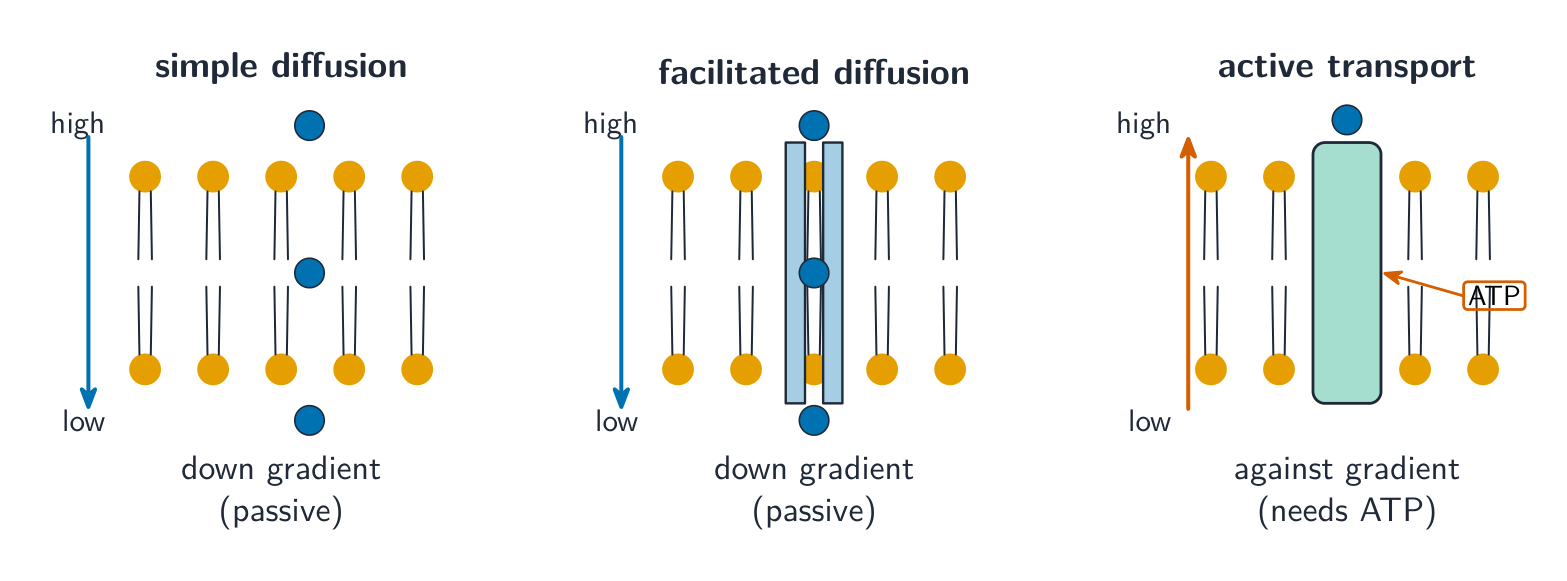
物质穿过细胞膜的主要方式
Movement into & out of cells · 物质进出细胞
net movement: high → low · 净移动:高 → 低
Drag the concentrations. Particles diffuse down their concentration gradient until both sides are equal. · 拖动浓度。粒子沿它们的浓度梯度 向下扩散,直到两侧相等。
Which molecules cross the membrane by simple diffusion through the bilayer? · 哪些分子通过简单扩散穿过双层跨过膜?
Only small or non-polar molecules can pass straight through the oily bilayer, down the gradient. · 只有小的或非极性的分子能直接穿过油性的双层,沿梯度向下。
Facilitated diffusion 易化扩散 and osmosis 渗透
- Charged ions and large polar molecules (like glucose) cannot cross the oily bilayer alone.
- Facilitated diffusion: they cross through channel or carrier proteins, still moving down the gradient — passive.
- Osmosis: the diffusion of water across a partially permeable membrane, from higher to lower water potential 水势 — also passive.
易化扩散和渗透
- 带电的 离子 和大的极性分子(像葡萄糖)不能独自穿过油性的双层。
- 易化扩散(facilitated diffusion):它们通过 通道 或 载体蛋白 穿过,仍然沿梯度 向下 移动——被动。
- 渗透(osmosis):水 穿过一个部分透性膜的扩散,从 较高 到 较低水势(water potential)——也是被动。
Match each way of crossing the membrane to its key feature. · 把每种穿过膜的方式与它的关键特征配对。
Diffusion and osmosis are passive (down the gradient); active transport pumps against the gradient using ATP. · 扩散和渗透是被动的(沿梯度向下);主动运输用 ATP 逆着梯度泵送。
Facilitated diffusion uses channel or carrier proteins but needs no energy — it is still passive. · 易化扩散使用通道或载体蛋白,但不需要能量——它仍然是被动的。
Ions and large polar molecules cross via proteins, but movement is still down the gradient, so no ATP is used. · 离子和大的极性分子通过蛋白质穿过,但移动仍然沿梯度向下,所以不使用 ATP。
Osmosis is the movement of water from: · 渗透是水从以下移动:
Water moves by osmosis down a water-potential gradient (higher → lower) across a partially permeable membrane. · 水通过渗透沿水势梯度(较高 → 较低)穿过一个部分透性膜移动。
Active transport 主动运输 and bulk transport
- Active transport moves a substance against its gradient (low → high), using carrier proteins and ATP.
- Bulk transport also needs ATP:
- endocytosis 胞吞作用 — the membrane folds in around material and pinches off a vesicle to bring it in.
- exocytosis 胞吐作用 — a vesicle fuses with the membrane to release contents out.
Endocytosis brings material in; exocytosis releases it out
主动运输和大批运输
- 主动运输(active transport) 把一种物质 逆着 它的梯度移动(低 → 高),使用 载体蛋白 和 ATP。
- 大批运输也需要 ATP:
- 内吞(endocytosis)——膜围绕物质向内折叠并掐出一个 囊泡(vesicle) 把它带 进来。
- 外排(exocytosis)——一个囊泡与膜融合,把内容物释放 出去。
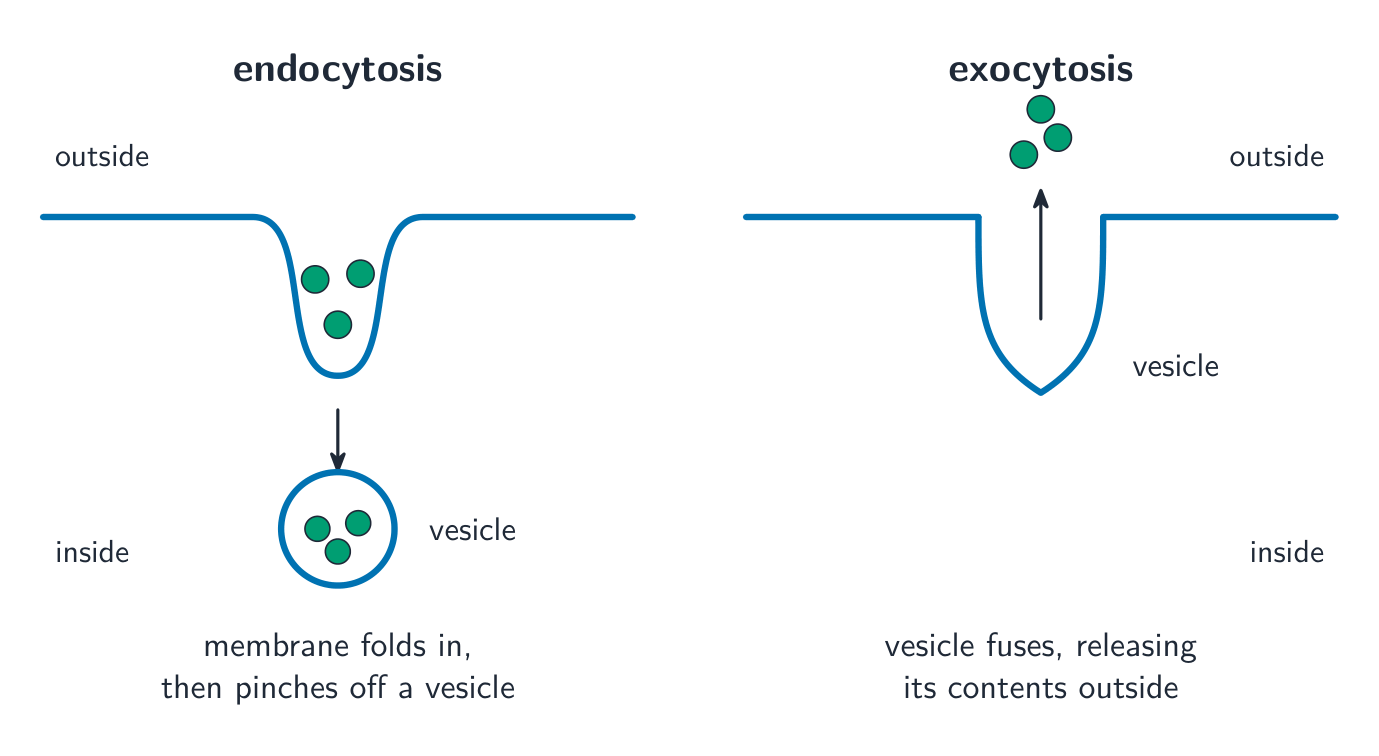
内吞把物质带进来;外排把它释放出去
Moving a substance against its gradient using carrier proteins and ATP is called ______ transport. · 使用载体蛋白和 ATP 逆着梯度移动一种物质叫做 ______ 运输。
Active transport pumps a substance from low to high concentration, so it needs carrier proteins and ATP. · 主动运输把一种物质从低浓度泵到高浓度,所以它需要载体蛋白和 ATP。
In exocytosis, a cell: · 在外排中,一个细胞:
Exocytosis releases material out (vesicle fuses with the membrane); endocytosis brings material in. · 外排把物质释放出去(囊泡与膜融合);内吞把物质带进来。
You've got it
- passive (no ATP): simple diffusion (through bilayer), facilitated diffusion (proteins), osmosis (water) — all down the gradient
- active (ATP): active transport (against the gradient, carrier proteins)
- endocytosis brings material in (vesicle forms); exocytosis sends it out (vesicle fuses)
- osmosis = water moving from higher to lower water potential
你掌握了
- 被动(无 ATP):简单扩散(穿过双层)、易化扩散(蛋白质)、渗透(水)——全都沿梯度 向下
- 主动(ATP):主动运输(逆着 梯度,载体蛋白)
- 内吞 把物质带进来(形成囊泡);外排 把它送出去(囊泡融合)
- 渗透 = 水从 较高 移动到 较低水势