Factors that affect enzyme action · 影响酶作用的因素
| English | 中文 | Pinyin · 拼音 |
|---|---|---|
| colorimeter/ˌkʌləˈrɪmɪtə/ | 比色计 | bǐ sè jì |
| initial rate/ɪˈnɪʃl reɪt/ | 初始速率 | chū shǐ sù lǜ |
| optimum/ˈɒptɪməm/ | 最适 | zuì shì |
| denature/ˈdenətʃə/ | 变性 | biàn xìng |
| buffer/ˈbʌfə/ | 缓冲液 | huǎn chōng yè |
| inhibitor/ɪnˈhɪbɪtə/ | 抑制剂 | yì zhì jì |
What changes an enzyme's speed
- Change the conditions and you change how fast an enzyme works.
- First, you need a fair way to measure the rate.
- Then we'll see how temperature, pH and concentration each affect it.
什么改变一个酶的速度
- 改变条件,你就改变酶工作的快慢。
- 首先,你需要一个公平的方式来 测量 速率。
- 然后我们会看温度、pH 和浓度各自如何影响它。
Measuring the rate
- Follow how fast product forms (e.g. collect the oxygen gas from catalase) or how fast substrate disappears (e.g. the iodine colour fading as amylase digests starch).
- A colorimeter 比色计 turns a colour change into an exact number you can plot.
- The reaction is fastest at the start (most substrate present), so the initial rate 初始速率 — the slope at time zero — is the fairest value to compare.
The initial rate — the slope at the very start — is the fairest value to compare.
测量速率
- 跟踪 产物 形成的快慢(例如收集过氧化氢酶放出的氧气)或 底物 消失的快慢(例如淀粉酶消化淀粉时碘的颜色褪去)。
- 比色计(colorimeter) 把一个颜色变化变成一个你能作图的精确数字。
- 反应在 开始 时最快(底物最多),所以 初速率(initial rate)——时间零处的斜率——是最公平的可比较的值。
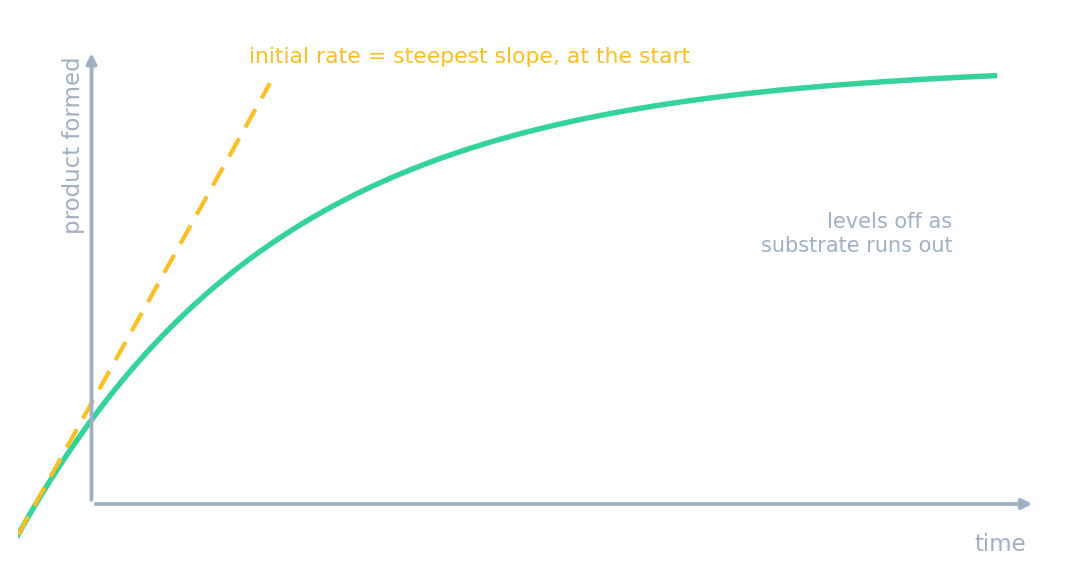
初速率——最开始处的斜率——是最公平的可比较的值。
Why is the initial rate (slope at time zero) the fairest value to compare? · 为什么初速率(时间零处的斜率)是最公平的可比较的值?
At the start the most substrate is present, so the rate is highest and not yet limited by substrate running out. · 在开始时底物最多,所以速率最高,还没有被底物用尽所限制。
Temperature
- Heating gives molecules more kinetic energy, so they collide more often — the rate rises.
- But past the optimum 最适, the heat breaks the bonds holding the enzyme's shape: it denatures 变性, the active site no longer fits, and the rate crashes.
温度
- 加热给分子更多 动能,所以它们碰撞更频繁——速率上升。
- 但过了 最适点(optimum),热量破坏维持酶形状的键:它 变性(denatures),活性位点不再契合,速率骤降。
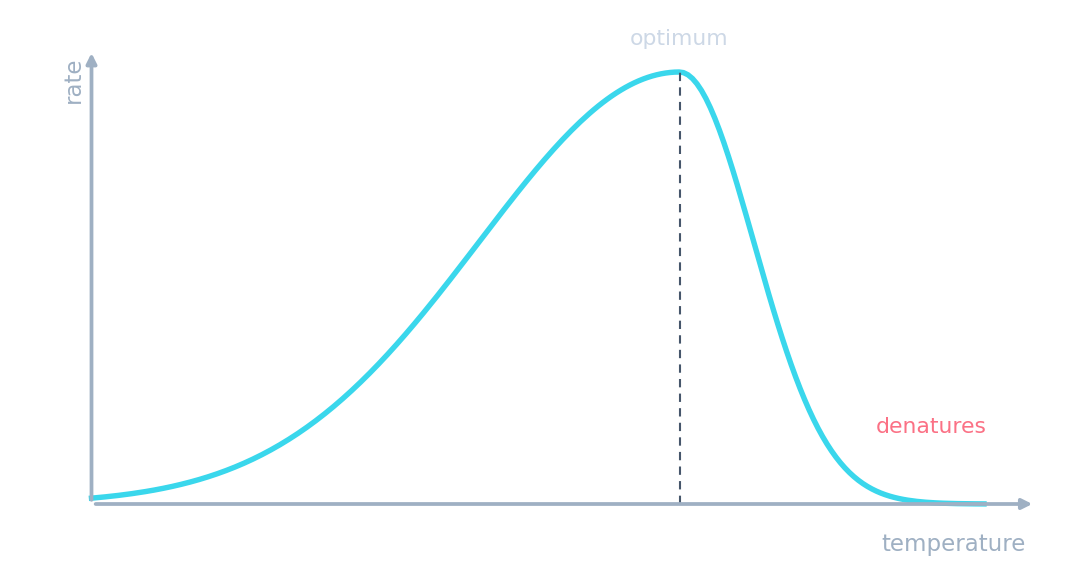
Temperature: warm, then too hot · 温度:温暖,然后太热
rate peaks at the optimum · 速率在最适点达到峰值
Drag the temperature. Warming speeds it up — until too hot denatures the enzyme and activity crashes past the optimum. · 拖动温度。升温加快它——直到太热使酶 变性,活性在最适点之后骤降。
As temperature rises from cold to very hot, put the events in order. · 当温度从冷上升到很热时,把这些事件按顺序排列。
Warming first speeds collisions (rate climbs to the optimum); past it the enzyme denatures and the rate crashes. · 升温先加快碰撞(速率攀升到最适点);过了它酶变性,速率骤降。
Above the optimum temperature, the rate falls steeply because the enzyme: · 在最适温度以上,速率陡降,因为酶:
Heat breaks the bonds holding the enzyme's shape; the active site changes and can no longer bind the substrate. · 热量破坏维持酶形状的键;活性位点改变,不再能结合底物。
pH
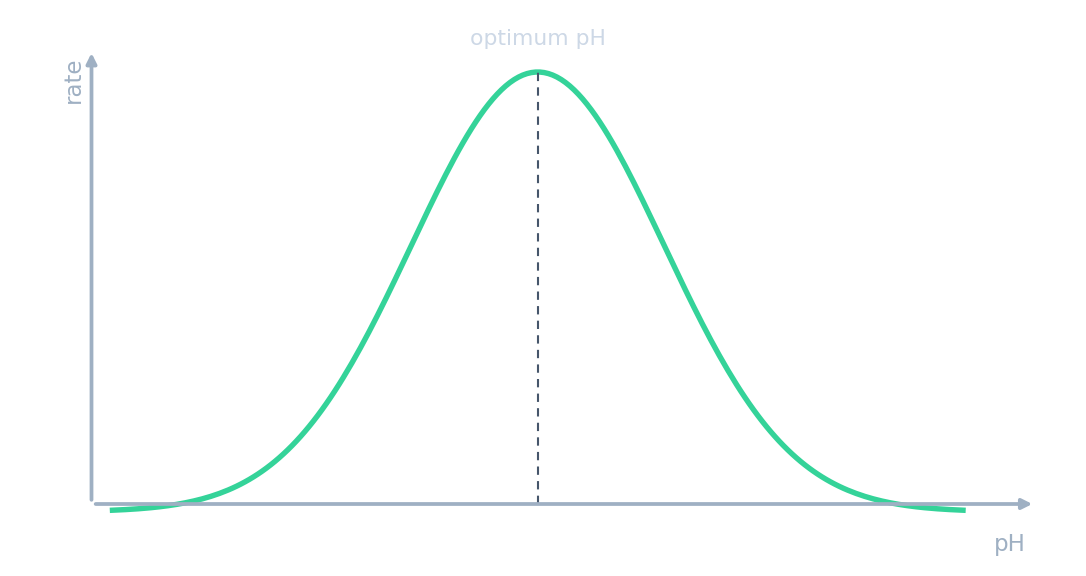
- Each enzyme has an optimum pH. Move too far either side and it denatures, so the rate drops.
- To study pH fairly, hold it steady with a buffer 缓冲液 solution.
pH
- 每个酶有一个 最适 pH(optimum pH)。偏离任一侧太远它就 变性,所以速率下降。
- 要公平地研究 pH,用一个 缓冲溶液(buffer solution) 把它保持稳定。
To stop pH changing while you vary temperature, keep it constant with a ______ solution. · 为了在你改变温度时阻止 pH 变化,用一个 ______ 溶液把它保持恒定。
A buffer resists pH change, so pH stays controlled while temperature is the only variable. · 缓冲液抵抗 pH 变化,所以 pH 保持受控,而温度是唯一的变量。
Enzyme and substrate concentration
- More enzyme (with substrate to spare) means more active sites, so the rate rises in proportion.
- More substrate speeds things up at first — but once every active site is busy, adding more makes no difference and the rate levels off.
- More inhibitor 抑制剂 lowers the rate.
- Explore it below: drag the substrate slider and watch the rate climb, then flatten once every active site is full.
酶和底物的浓度
- 更多酶(有富余的底物)意味着更多活性位点,所以速率 成比例 上升。
- 更多底物 起初加快进度——但一旦 每个活性位点都忙着,加更多不起作用,速率 变平。
- 更多 抑制剂 降低速率。
- 在下面探索它:拖动底物滑块,看速率攀升,然后在每个活性位点都满了之后变平。
Substrate concentration: rate then plateau · 底物浓度:速率然后平台
rate = Vmax·[S] / (Km + [S]) · 速率 = Vmax·[S] / (Km + [S])
Drag the substrate. The rate climbs, then levels off once every active site is busy — adding more substrate then does nothing. · 拖动底物。速率攀升,然后在每个活性位点都忙着之后 变平——这时加更多底物不起作用。
Match each change to its effect on the rate. · 把每个变化与它对速率的影响配对。
More enzyme adds active sites; once sites are saturated, extra substrate does nothing; extreme heat or pH denatures the enzyme. · 更多酶增加活性位点;一旦位点饱和,额外的底物不起作用;极端的热或 pH 使酶变性。
Adding more substrate eventually stops increasing the rate because: · 加更多底物最终停止增加速率,因为:
Once all active sites are occupied, the rate is at its maximum; more substrate cannot be processed any faster. · 一旦所有活性位点都被占据,速率达到最大;更多底物不能被更快地处理。
With plenty of substrate available, doubling the enzyme concentration roughly doubles the rate. · 在有充足底物可用时,把酶浓度加倍大致使速率加倍。
More enzyme means more active sites; with substrate to spare, the rate rises in proportion to enzyme concentration. · 更多酶意味着更多活性位点;在底物有富余时,速率与酶浓度成比例上升。
You've got it
- measure the initial rate (steepest, at the start) for a fair comparison; a colorimeter makes colour exact
- temperature: rises to the optimum, then denatures and crashes
- pH: bell curve about the optimum pH; use a buffer to keep it steady
- enzyme ↑ → rate ↑ (proportional); substrate ↑ → levels off when all sites are full
你掌握了
- 测量 初速率(最陡,在开始处)以公平比较;比色计 使颜色精确
- 温度:上升到 最适点,然后 变性 并骤降
- pH:围绕 最适 pH 的钟形曲线;用 缓冲液 保持稳定
- 酶 ↑ → 速率 ↑(成比例);底物 ↑ → 当所有位点都满时变平