Water · 水
| English | 中文 | Pinyin · 拼音 |
|---|---|---|
| polar/ˈpəʊlə/ | 极性 | jí xìng |
| hydrogen bond/ˈhaɪdrədʒn bɒnd/ | 氢键 | qīng jiàn |
| solvent/ˈsɒlvənt/ | 溶剂 | róng jì |
| specific heat capacity/spəˈsɪfɪk hiːt kəˈpæsɪti/ | 比热容 | bǐ rè róng |
| latent heat of vaporisation/ˈleɪtənt hiːt ɒv ˌveɪpəraɪˈzeɪʃn/ | 汽化潜热 | qì huà qián rè |
The molecule life can't do without
- Water seems ordinary, but life depends on its unusual behaviour.
- Almost everything about it comes from one fact: the water molecule is polar 极性.
- Polarity lets water molecules grip each other with hydrogen bonds 氢键.
生命离不开的分子
- 水看起来普通,但生命依赖于它不寻常的行为。
- 关于它的几乎一切都来自一个事实:水分子是 极性的(polar)。
- 极性让水分子用 氢键(hydrogen bonds) 互相抓住。
Water is a polar molecule that forms hydrogen bonds. · 水是一个形成氢键的极性分子。
Polarity (a slightly negative oxygen and slightly positive hydrogens) lets neighbouring molecules form hydrogen bonds, which explain water's properties. · 极性(一个略负的氧和略正的氢)让相邻的分子形成氢键,这解释了水的性质。
Polar molecule, hydrogen bonds
- In water the oxygen end is slightly negative and the hydrogen ends slightly positive — it is a polar molecule.
- Opposite charges attract, so each molecule forms weak hydrogen bonds with its neighbours.
- These many small bonds are the reason for water's special properties.
Water is polar, so each molecule forms hydrogen bonds with its neighbours
- Explore the molecule below — then see why this matters.
- Water is also a key reactant: it is removed when molecules join (condensation) and added when they are split (hydrolysis).
Water as a reactant: condensation removes it to join molecules; hydrolysis adds it to split them.
极性分子,氢键
- 在水中,氧的一端略 负,氢的两端略 正——它是一个 极性 分子。
- 相反的电荷互相吸引,所以每个分子与它的邻居形成弱的 氢键。
- 这许多小的键是水的特殊性质的原因。
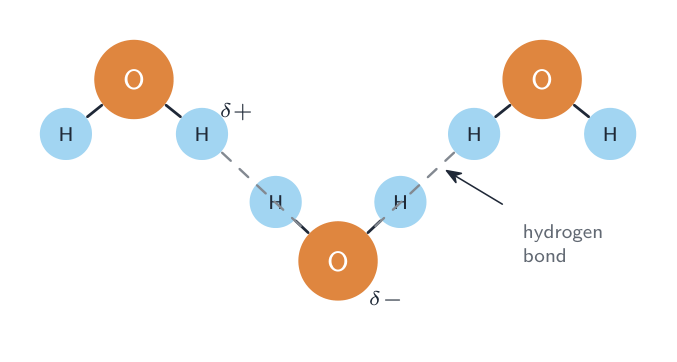
水是极性的,所以每个分子与它的邻居形成氢键
- 在下面探索这个分子——然后看为什么这重要。
- 水也是一个关键的 反应物:当分子连接时它被移除(缩合),当它们被分开时它被加入(水解)。
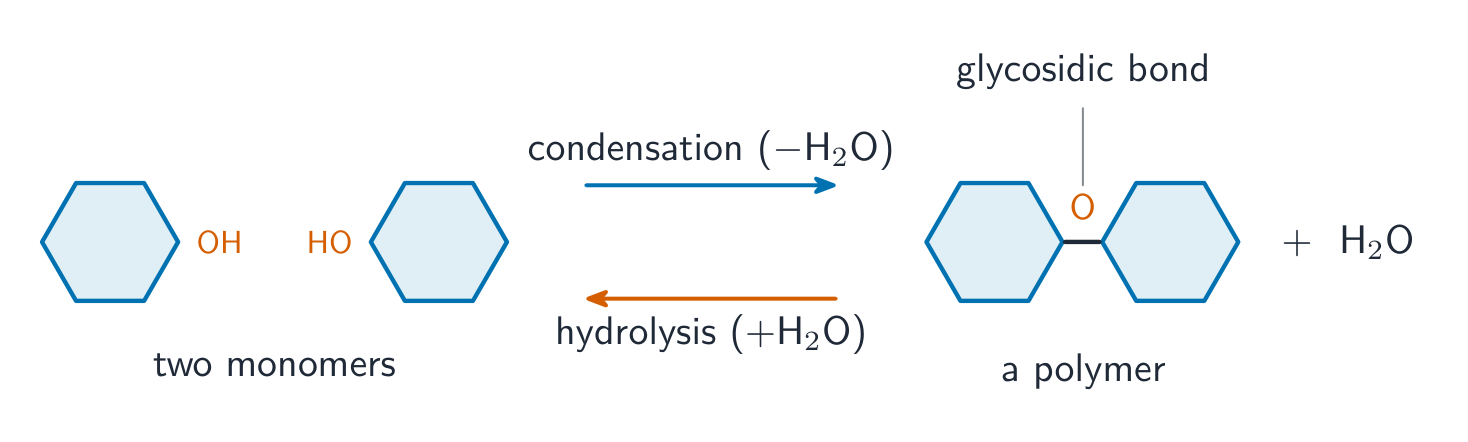
水作为反应物:缩合移除它以连接分子;水解加入它以分开它们。
Why water is polar · 为什么水是极性的
Tap each part. Oxygen pulls the shared electrons closer, so it is slightly negative and the hydrogens slightly positive — and these opposite charges form hydrogen bonds. · 点击每个部分。氧把共享的电子拉得更近,所以它略负,而氢略正——这些相反的电荷形成氢键。
Water molecules attract each other because water is: · 水分子互相吸引,因为水是:
Water is polar (slightly negative oxygen, slightly positive hydrogens), so neighbouring molecules form hydrogen bonds. · 水是极性的(略负的氧,略正的氢),所以相邻的分子形成氢键。
The weak attractions between water molecules, caused by its polarity, are called ______ bonds. · 由水的极性引起的、水分子之间的弱吸引叫做 ______ 键。
Each δ+ hydrogen is attracted to a δ− oxygen of a neighbour — a hydrogen bond. Many of these give water its special properties. · 每个 δ+ 氢被一个邻居的 δ− 氧吸引——一个氢键。许多这样的键给水特殊的性质。
Three life-giving properties
- Solvent 溶剂 — many substances dissolve in water, so reactions can happen and substances can be transported around the body.
- High specific heat capacity 比热容 — water needs a lot of energy to warm up, so temperatures stay steady and protect living things.
- High latent heat of vaporisation 汽化潜热 — water needs a lot of energy to evaporate, so sweating carries away a lot of heat and cools the body.
三个赋予生命的性质
- 溶剂(solvent)——许多物质溶解在水中,所以反应能发生,物质能在身体里被运输。
- 高比热容(high specific heat capacity)——水需要大量能量才能升温,所以温度保持 稳定 并保护生物。
- 高汽化潜热(high latent heat of vaporisation)——水需要大量能量才能 蒸发,所以出汗带走大量热并 冷却 身体。
Match each property of water to what it does for life. · 把水的每个性质与它为生命做的事配对。
All of water's life-supporting properties come back to its polarity and the hydrogen bonds it forms. · 水所有支持生命的性质都回到它的极性和它形成的氢键上。
Water has a high specific heat capacity, which means it: · 水有高比热容,这意味着它:
A high specific heat capacity means temperature changes slowly, protecting organisms from sudden changes. · 高比热容意味着温度变化缓慢,保护生物免受突然的变化。
Why does sweating cool the body? · 为什么出汗冷却身体?
Evaporating water needs a lot of energy (high latent heat of vaporisation); it takes that heat from the skin, cooling it. · 蒸发的水需要大量能量(高汽化潜热);它从皮肤取走那些热,冷却皮肤。
Water as transport and coolant
- Water's solvent property lets it carry dissolved substances in blood, xylem and cytoplasm.
- Its high specific heat capacity resists temperature change, and evaporation (sweating, transpiration) cools organisms.
水作为运输和冷却剂
- 水的 溶剂 性质让它在血液、木质部和细胞质中携带溶解的物质。
- 它的 高比热容 抵抗温度变化,而 蒸发(出汗、蒸腾)冷却生物。
You've got it
- water is a polar molecule → forms hydrogen bonds between molecules
- solvent: dissolves substances for reactions and transport
- high specific heat capacity: temperature stays stable
- high latent heat of vaporisation: evaporation (sweat) cools the body
你掌握了
- 水是一个 极性 分子 → 在分子之间形成 氢键
- 溶剂:溶解物质以进行反应和运输
- 高比热容:温度保持稳定
- 高汽化潜热:蒸发(出汗)冷却身体