Carbohydrates · 碳水化合物
| English | 中文 | Pinyin · 拼音 |
|---|---|---|
| monosaccharide/ˈmɒnəʊsækɑːraɪd/ | 单糖 | dān táng |
| disaccharide/ˌdɪsəkˈhɑːraɪd/ | 二糖 | èr táng |
| polysaccharide/ˌpɒlɪˈsækɑːraɪd/ | 多糖 | duō táng |
| cellulose/ˈseljuːləʊs/ | 纤维素 | xiān wéi sù |
| condensation/kɒndenˈseɪʃn/ | 缩合 | suō hé |
| glycosidic bond/ˌɡlaɪkəˈsɪdɪk bɒnd/ | 糖苷键 | táng gān jiàn |
| hydrolysis/haɪˈdrɒləsɪs/ | 水解 | shuǐ jiě |
The body's quick fuel
- Carbohydrates are the cell's quick energy molecules — and its building material.
- They come in three sizes, all built from sugar units.
- A tiny difference in one glucose shape decides everything that follows.
身体的快速燃料
- 碳水化合物是细胞的快速 能量 分子——也是它的建筑材料。
- 它们有三种大小,都由糖单元构成。
- 一个葡萄糖形状的微小差别决定了随后的一切。
Three sizes of sugar
- A monomer is a single small unit; a polymer is many monomers joined into a long chain.
- A monosaccharide 单糖 is one sugar unit — glucose, fructose.
- A disaccharide 二糖 is two units joined — maltose, sucrose.
- A polysaccharide 多糖 is many units joined into a polymer — starch, glycogen, cellulose 纤维素.
- Glucose, fructose and maltose are reducing sugars; sucrose is non-reducing.
Alpha- and beta-glucose differ only at carbon 1
三种大小的糖
- 单体(monomer) 是一个单独的小单元;聚合物(polymer) 是许多单体连接成一条长链。
- 单糖(monosaccharide) 是一个糖单元——葡萄糖(glucose)、果糖。
- 二糖(disaccharide) 是两个单元连接——麦芽糖、蔗糖(sucrose)。
- 多糖(polysaccharide) 是许多单元连接成一个聚合物——淀粉、糖原、纤维素。
- 葡萄糖、果糖和麦芽糖是 还原糖(reducing sugars);蔗糖是 非还原的。
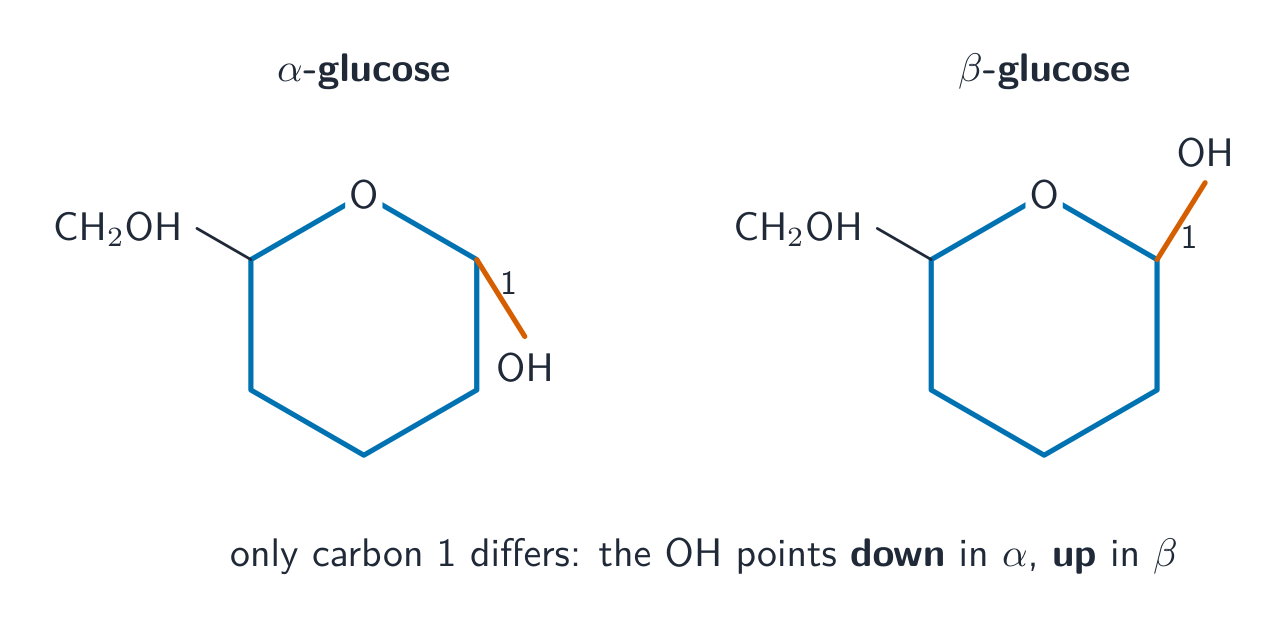
α-葡萄糖和 β-葡萄糖只在碳 1 处不同
Which is a monosaccharide? · 哪个是单糖?
Glucose is a single sugar unit (monosaccharide); sucrose is a disaccharide; starch and glycogen are polysaccharides. · 葡萄糖是一个单独的糖单元(单糖);蔗糖是一个二糖;淀粉和糖原是多糖。
Match each carbohydrate to what it is. · 把每种碳水化合物与它是什么配对。
Mono = one unit, di = two, poly = many. Cellulose is β-glucose; glycogen is α-glucose. · 单 = 一个单元,二 = 两个,多 = 许多。纤维素是 β-葡萄糖;糖原是 α-葡萄糖。
Sucrose is a non-reducing sugar, so it gives a negative Benedict's test unless it is first hydrolysed. · 蔗糖是一种非还原糖,所以除非它先被水解,否则它给出阴性的本尼迪克特测试。
Glucose and maltose are reducing sugars (positive Benedict's); sucrose is non-reducing, so you must hydrolyse it (acid + heat) first. · 葡萄糖和麦芽糖是还原糖(本尼迪克特阳性);蔗糖是非还原的,所以你必须先水解它(酸 + 加热)。
Joining and breaking: α and β glucose
- Glucose is a six-carbon sugar that folds into a six-membered ring (five carbons and one oxygen), with two forms: in α-glucose the –OH on carbon 1 points down; in β-glucose it points up.
- Two sugars join by condensation 缩合: a glycosidic bond 糖苷键 forms and one water molecule is removed.
- Hydrolysis 水解 is the reverse: adding water breaks the bond. (That's why the sucrose test needs acid + heat.)
- Step through it below to see one water leave as the bond forms.
连接和断开:α 和 β 葡萄糖
- 葡萄糖是一个六碳糖,折叠成一个六元环(五个碳加一个氧),有两种形式:在 α-葡萄糖 中碳 1 上的 –OH 指向 下;在 β-葡萄糖 中它指向 上。
- 两个糖通过 缩合(condensation) 连接:一个 糖苷键(glycosidic bond) 形成,一个水分子被移除。
- 水解(hydrolysis) 是反过程:加水断开这个键。(这就是为什么蔗糖测试需要酸 + 加热。)
- 在下面一步步走过去,看一个水在键形成时离开。
Condensation and hydrolysis · 缩合与水解
Step through how two sugars join. Condensation · 凝结 removes one water to make the bond; hydrolysis · 水解 is the reverse — adding water splits it again. · 一步步走过两个糖如何连接。缩合 移除一个水来形成键;水解 是反过程——加水又把它分开。
Two monosaccharides join by a ______ bond, removing one water molecule. · 两个单糖通过一个 ______ 键连接,移除一个水分子。
A glycosidic bond forms by condensation; one water molecule is removed for each bond. · 一个糖苷键通过缩合形成;每个键移除一个水分子。
Put the steps of condensation in order. · 把缩合的步骤按顺序排列。
Condensation removes one water to form the bond; hydrolysis (adding water) is the reverse. · 缩合移除一个水来形成键;水解(加水)是反过程。
α-glucose and β-glucose differ in: · α-葡萄糖和 β-葡萄糖的不同在于:
They are the same atoms — only the –OH on carbon 1 differs: down in α, up in β. This decides which polysaccharide forms. · 它们是相同的原子——只有碳 1 上的 –OH 不同:α 中向下,β 中向上。这决定形成哪种多糖。
Storage vs structure
- Starch (plants) and glycogen (animals) are made of α-glucose — coiled/branched, compact and insoluble, so they store energy without pulling in water by osmosis. Glycogen is the most branched, so it breaks down fastest.
- Cellulose is made of β-glucose: every other unit flips, giving long straight chains that bundle into strong microfibrils — the plant cell wall.
Amylose coils, amylopectin and glycogen branch, and cellulose forms straight bundled chains
储存与结构
- 淀粉(starch)(植物)和 糖原(glycogen)(动物)由 α-葡萄糖 构成——盘绕/分支,紧凑 且 不可溶,所以它们储存能量而不通过渗透拉入水。糖原分支最多,所以它分解最快。
- 纤维素(cellulose) 由 β-葡萄糖 构成:每隔一个单元翻转,给出长 直 链,捆成结实的 微纤维(microfibrils)——植物 细胞壁。

直链淀粉盘绕,支链淀粉和糖原分支,纤维素形成捆在一起的直链
Cellulose is strong and structural because it is made of: · 纤维素结实且具结构性,因为它由以下构成:
β-glucose chains are straight; many lie side by side and hydrogen-bond into strong microfibrils — the cell wall. · β-葡萄糖链是直的;许多并排排列并通过氢键结合成结实的微纤维——细胞壁。
Why is glycogen a good energy store in animals? · 为什么糖原在动物中是一个好的能量储存?
Storage polysaccharides are compact and insoluble (no osmotic effect); glycogen's many branches give many ends for fast glucose release. · 储存多糖紧凑且不可溶(没有渗透作用);糖原的许多分支给出许多末端以便快速释放葡萄糖。
You've got it
- mono → di → polysaccharide; reducing sugars (glucose, maltose) vs non-reducing (sucrose)
- α-glucose –OH down → starch/glycogen (storage); β-glucose –OH up → cellulose (structure)
- condensation joins monomers (glycosidic bond, water removed); hydrolysis splits them (water added)
- storage polysaccharides are compact + insoluble; glycogen is most branched (fast release)
你掌握了
- 单糖 → 二糖 → 多糖;还原糖(葡萄糖、麦芽糖)对非还原糖(蔗糖)
- α-葡萄糖 –OH 向下 → 淀粉/糖原(储存);β-葡萄糖 –OH 向上 → 纤维素(结构)
- 缩合 连接单体(糖苷键,移除水);水解 把它们分开(加水)
- 储存多糖是 紧凑 + 不可溶;糖原分支最多(快速释放)