Scope and prerequisites
IB Language A language and literature first assessment 2021; English focus. This supplemental reference covers only the listed preparation outcomes. School selections, full-guide procedures and required live or recorded performance are separate.
- Analyse audience, purpose, register 语域 and multimodal choices
- Support interpretations of a non-literary text with precise evidence 证据
Prerequisites: Text type; audience and purpose; distinguish intended and measured effects.
Explain and choose the method
Identify text type, audience and purpose, then analyse how choices construct meaning.
Visual hierarchy 视觉层级, diction 措辞, framing and register can guide attention and position the reader.
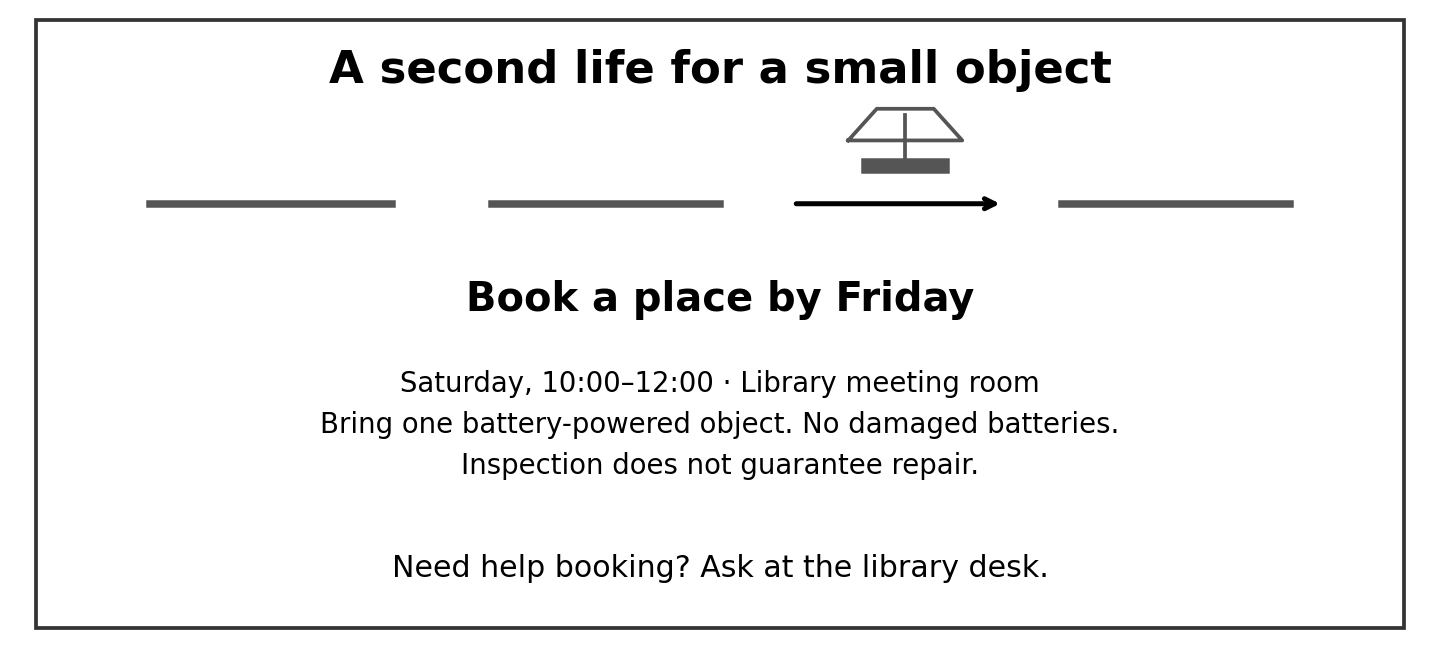
Visual hierarchy makes some information prominent. The large invitation draws attention; the smaller safety limit narrows the promise. Link a visible choice to a possible reader response using “may” or “invites”. Do not claim an actual booking increase without response data. Analyse the supplied image as well as its words.
Existing worked example: Only three days left combines a restrictive word with a time limit; the large countdown makes urgency visible. Explain how this could prompt quick action, while acknowledging that different readers may resist the message.
Complete original context
Original non-literary stimulus — Library repair session notice. Use the actual supplied notice image with this text.
Large heading: “A second life for a small object”. Main visual: a broken line becomes an unbroken line beside a lamp symbol. Prominent instruction: “Book a place by Friday”. Smaller text: “Saturday, 10:00–12:00. Library meeting room. Bring one battery-powered object. No damaged batteries. Inspection does not guarantee repair.” Footer: “Need help booking? Ask at the library desk.”
The notice is an original classroom design, not a real event announcement. Its audience is local library users who may have a small broken object. Its purpose is to encourage a booking while communicating limits. A reader's actual response has not been measured.
Independent practice and checked reasoning
Transfer 1
Analyse how heading, visual and booking instruction work together. Include two precise details and one qualification about audience response.
Reasoning: The heading's “second life” frames repair as renewal, while the broken-to-unbroken line beside the lamp gives that change a visual form. “Book a place by Friday” converts interest into a specific action and deadline. These choices may prompt users with broken objects to book, but no response data establishes that every reader will do so.
Transfer 2
Explain the relationship between the invitation and the smaller limitations. Does “Inspection does not guarantee repair” contradict the notice's purpose?
Reasoning: The invitation encourages participation, while the battery and repair limits define eligibility and avoid an unlimited promise. The qualification can support informed participation rather than cancel the purpose. Analyse its smaller prominence as a tension in how readily readers may notice it, without assuming they all miss it.
Transfer 3
Compare a reader comfortable booking online with one who needs help. Which visible feature broadens access, and what additional evidence would test its effect?
Reasoning: The desk-help footer gives a route for readers needing assistance. Its effect could be tested by observing enquiries and bookings or asking readers whether they noticed and understood it. The notice alone supplies an invitation, not measured inclusion.
Limits and next use
Do not list techniques without their function or assume an effect occurs for every reader. HL analyses both unseen texts in Paper 1; SL chooses one. Practise complete analysis rather than doubling an SL answer.
All tasks here are public original practice with authored guidance. They are not official questions or fresh diagnostics. Existing protected tests and mocks remain separate.