Scope and prerequisites
IB classical languages first assessment 2024; Latin focus. This supplemental reference covers only the listed preparation outcomes. School selections, full-guide procedures and required live or recorded performance are separate.
- Connect diction 措辞, syntax 句法 and literary form to meaning
- Support interpretations with precise Latin evidence 证据 and contextual knowledge
Prerequisites: Accurate translation 翻译 of the supplied vocabulary; distinguish speaker and author.
Explain and choose the method
Close reading 细读 links a visible linguistic feature to an interpretation of tone, argument 论证 or characterization.
Translate the relevant words accurately before arguing about the effect; distinguish the speaker's voice from the author's purposes.
Diction and syntax contribute to meaning together. “Semper laborat, semper sperat” means “always works, always hopes”. Repeated semper at both clause openings is anaphora 首语重复 ; it links two continuing actions. That relationship supports persistence. It does not alone prove happiness, success, or a particular ancient author's beliefs.
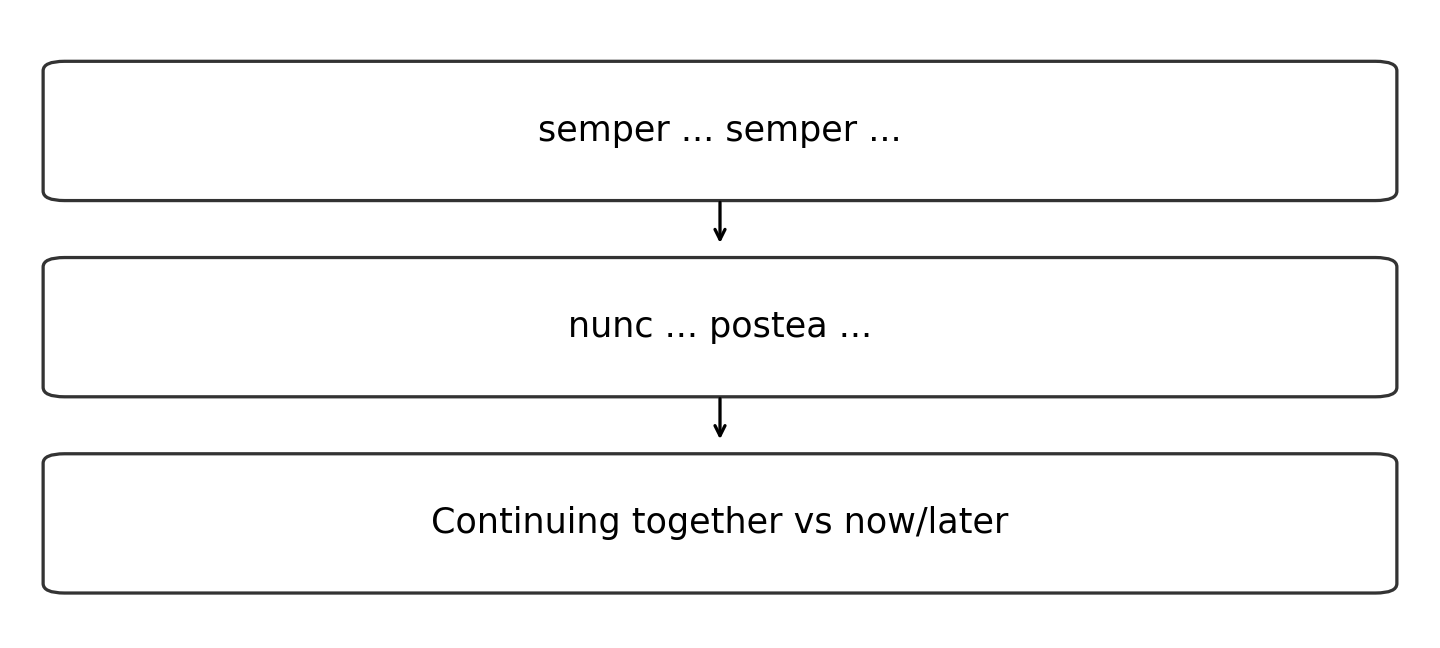
Existing worked example: For a classroom phrase, semper laborat, semper sperat, the repeated semper emphasizes persistence: always works, always hopes. Explain how the parallel clauses link labour and hope rather than saying repetition merely makes the text interesting.
Complete original context
Original Latin classroom pair: A: Semper laborat, semper sperat. (Always works, always hopes.) B: Nunc laborat; postea sperat. (Now works; later hopes.) Vocabulary: semper = always; nunc = now; postea = later; laborat = works; sperat = hopes. These are original prose phrases. They are not prescribed quotations and no metrical claim is made.
Independent practice and checked reasoning
Transfer 1
Compare the organisation of time in A and B using precise Latin evidence.
Reasoning: A repeats semper to present work and hope as continuing together. B contrasts nunc with postea to separate them into now and later. Both mention work and hope, but their time relationships differ.
Transfer 2
Explain why “repetition makes A vivid” is incomplete. Give a fuller interpretive sentence and one limit.
Reasoning: “Repeating semper at successive openings links ongoing labour with ongoing hope, suggesting persistence rather than a single completed effort.” The phrase does not establish the worker's eventual success, emotional state or a whole culture's values.
Transfer 3
What further evidence would be needed to analyse metre, an ancient audience and authorial purpose in an assessed passage?
Reasoning: The actual prescribed prose or verse, its edition and context, authorship and genre evidence, and appropriate linguistic or metrical knowledge. An English paraphrase cannot establish Latin metre. The original phrases here cannot stand in for prescribed textual evidence.
Limits and next use
This original phrase is not a prescribed quotation. Select real evidence from the school's approved core and companion texts for assessment. HL must work across prose and verse; rhythm analysis needs the actual verse, not an English paraphrase.
All tasks here are public original practice with authored guidance. They are not official questions or fresh diagnostics. Existing protected tests and mocks remain separate.