Historical perspectives and psychometric interpretation
Scope and prerequisites
Supported GRE topic 7 (VII). Use MM.1 for standard scores and EP.1 for conditional screening measures. Existing official questions are traced in bank_review_form.yaml; original tasks below are not ETS items.
Concepts and method
reliability 信度: Consistency of measurement under specified conditions. validity 效度: Evidence supporting a particular interpretation and use of scores.
Structuralism analysed conscious experience; functionalism asked how mental activity serves adaptation. Behaviourism emphasised observable learning; Gestalt psychology stressed organised perception. These are historical emphases, not interchangeable labels.
Psychoanalytic accounts emphasise unconscious conflict, humanistic accounts agency and growth, and cognitive accounts information processing. Compare the explanatory mechanism rather than matching every theory to a single familiar name.
Reliability concerns consistency across measurements. Validity concerns evidence for a proposed interpretation and use. A high reliability coefficient cannot prove that a test measures the intended construct fairly.
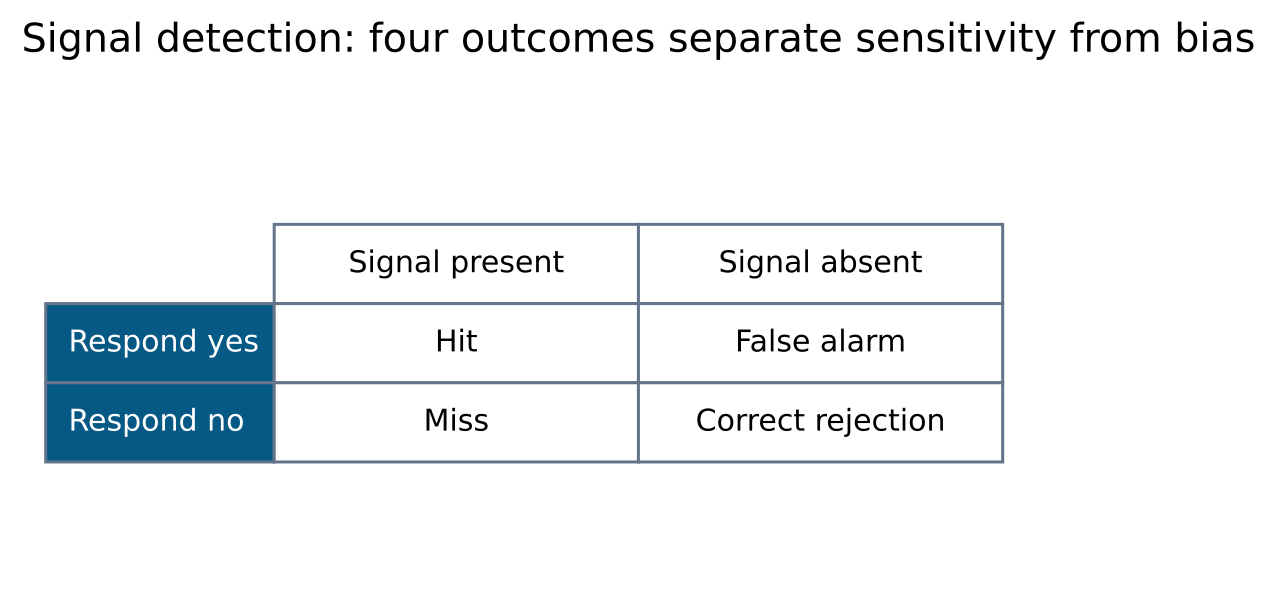
Standardisation supplies consistent administration and a relevant reference sample. Norm-referenced standing differs from criterion-referenced mastery. Predictive value depends on base rates as well as sensitivity and specificity.
A norm describes relative standing in a reference population; a mastery criterion describes a specified performance standard. A high percentile is not the same as a high percentage correct. Standardized administration reduces avoidable procedural variation, but the norm sample must still fit the intended use. Psychological perspectives can ask complementary questions; differences in emphasis do not make every observation decisive for one school.
Worked reasoning
In 1,000 people, suppose 10 have a target condition. A screening tool detects 9 of those 10, but falsely flags 99 of the other 990. Among 108 positive screens, only 9/108≈8.3% are true positives. This is a hypothetical methods example, not a diagnostic recommendation.
A learner is at the 80th percentile on a normed test and answers 60% correctly. Is this contradictory?
No. Percent correct compares correct responses with all items. Percentile compares the learner's score with scores in a reference group. A difficult test can produce both figures. State the norm population and the particular comparison rather than replacing one measure with the other.
Independent transfer
In 2,000 fictional cases, 20 meet a target definition. A screen flags 18 of these and 198 of the others. Compute the fraction of positive screens that meet the definition.
Attempt independently, then use the matching skill sheet solution.
Review and source limits
Avoid this error: Do not equate sensitivity with the probability that a positive result is correct, and do not use a classroom score to diagnose a disorder. Teaching scope comes from teaching.yaml and the source/key/crop review in bank_review_form.yaml. Detailed current diagnostic criteria require an authenticated manual; neither historical ETS practice nor this educational reference certifies them.