Attention limits and non-associative learning
Scope and prerequisites
Supported GRE topic 22 (AT.1). Use the overview measurement lesson VI when interpreting research evidence. Existing official questions are traced in bank_review_form.yaml; original tasks below are not ETS items.
Concepts and method
habituation 习惯化: Non-associative decline in response to a repeated stimulus, reversed by stimulus change. divided attention 分配性注意: Sharing limited central capacity across concurrent tasks, with costs set by load.
Attention is limited capacity. Early-selection accounts filter by physical features, late-selection accounts filter after meaning, and multimode theory (Johnston and Heinz) lets the selection point flex with task demands. Divided attention fails when combined demands exceed capacity: a hands-free call still slows driving because the bottleneck is central, not manual.
Load theory separates perceptual load from working-memory load: high perceptual load in the main task shuts out distractors, while high working-memory load invites them. Predictions follow the load, not the slogan that multitasking is always impossible.
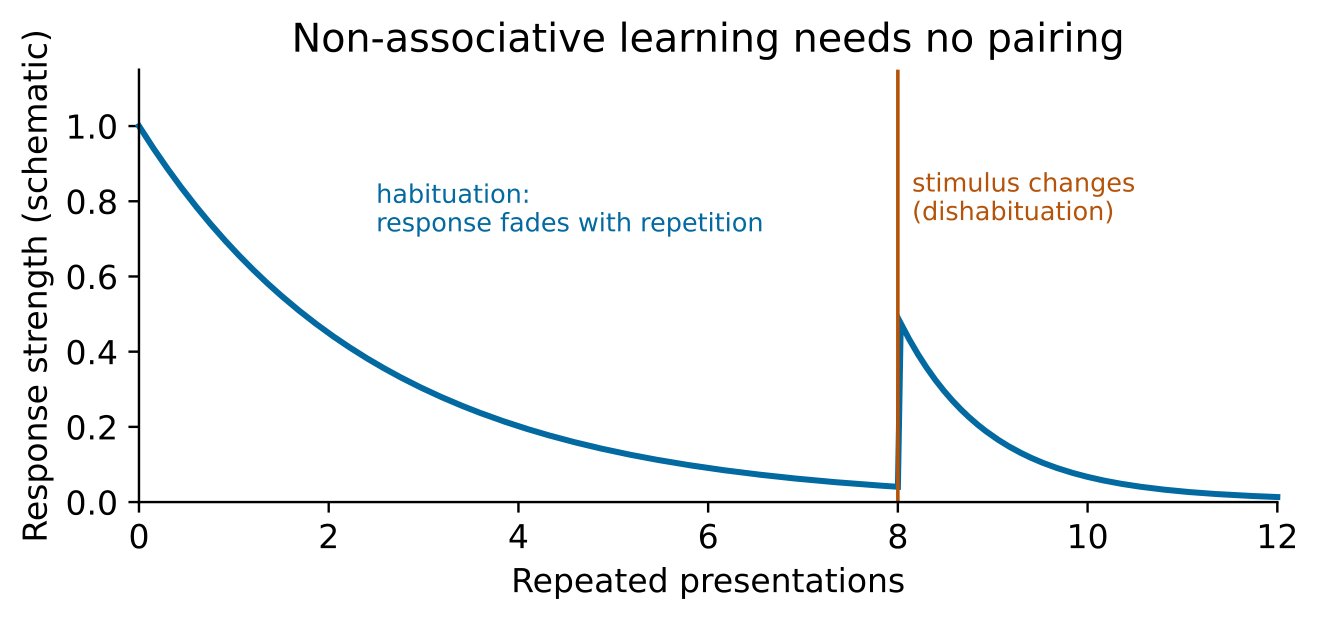
Habituation is non-associative learning: repeated presentation of a stimulus weakens the response, and a changed stimulus restores it (dishabituation). No pairing with another stimulus is involved, which separates it from classical conditioning. A commuter who stops hearing a scheduled train has habituated; the response returns if the train schedule changes.
Habituation is exploited as a measure: infants look longer at novel stimuli, so looking-time recovery after habituation indexes discrimination. Extinction in conditioning is different: there a learned association is withdrawn, not a repeated stimulus.
Attention models specify where and under what demands selection occurs. Perceptual load and working-memory control demands can make different predictions; a blanket claim that distraction always rises with load is inadequate. Habituation is a declining response after repeated exposure; renewed response to a change supports discrimination. Distinguish it from receptor adaptation, fatigue and conditioning extinction through the stimulus history and a suitable comparison.
Worked reasoning
A driver on a hands-free call brakes later because central capacity is shared, not because of occupied hands. City residents stop noticing constant traffic noise (habituation), but notice immediately when it stops or changes (dishabituation). An infant who looks longer at a changed display demonstrates discrimination through looking-time recovery.
Looking time falls across repeated displays and rises after the colour changes. What is supported, and what is not established?
The recovery is consistent with discrimination of the change after habituation. It does not show adult-like colour concepts or prove exactly how the display is represented. Control simple salience differences and compare suitable novel and familiar displays.
Independent transfer
A response falls with repeated sound presentations. Propose a check against fatigue and explain why extinction is not established.
Attempt independently, then use the matching skill sheet solution.
Review and source limits
Avoid this error: Calling habituation a form of conditioning, or claiming attention always fails under any dual task; the cost depends on load and the selection point. Teaching scope comes from teaching.yaml and the source/key/crop review in bank_review_form.yaml. Detailed current diagnostic criteria require an authenticated manual; neither historical ETS practice nor this educational reference certifies them.