Skip to content · ⁨ข้ามไปยังเนื้อหา⁩
Subjects · ⁨รายวิชา⁩
  • 1 Present perfect vs past simple · ⁨Present perfect เทียบกับ Past simple⁩
    1.1

    Past ที่ชัดเจน vs เกี่ยวข้องกับปัจจุบัน

    English

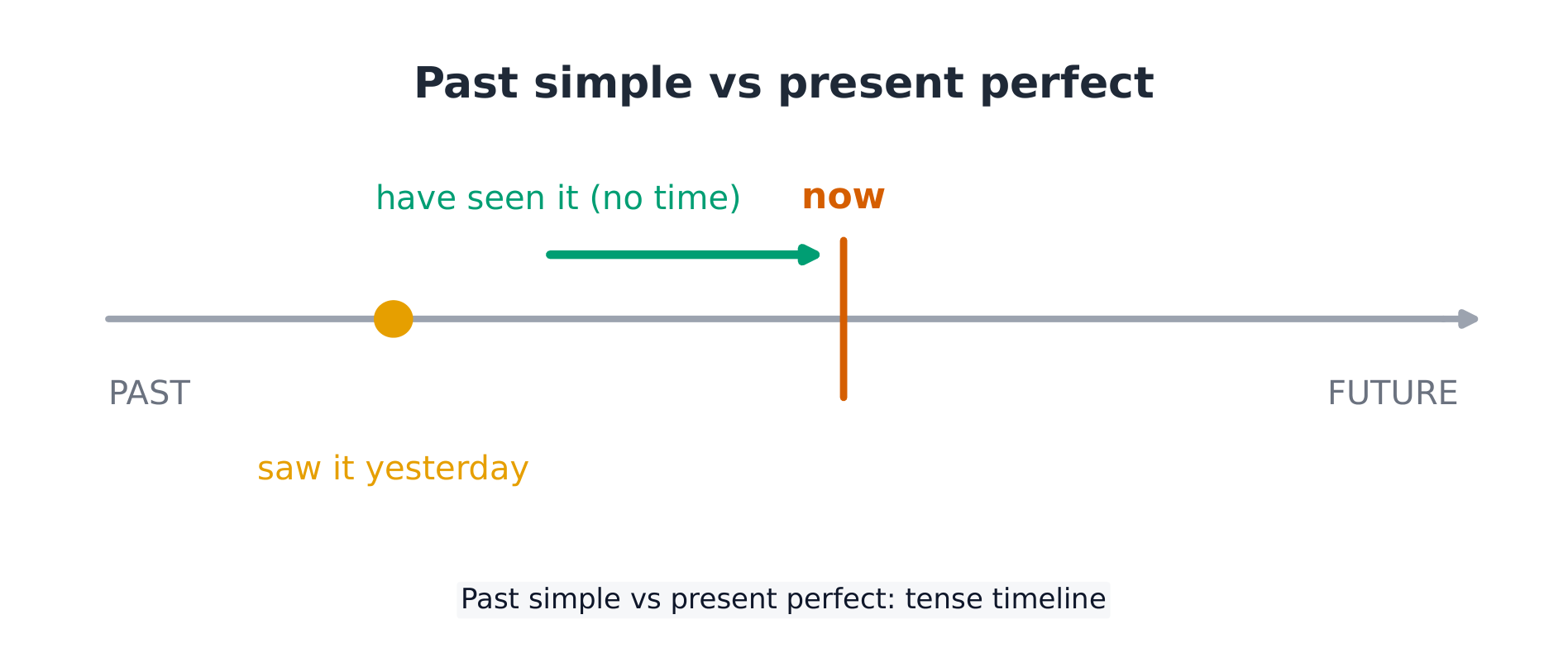
    Both tenses refer to the past, but they differ based on whether a specific time is mentioned and whether there is a connection to the present:

    • Past Simple: The action ended at a definite time in the past and has no relevance to the present.
    • Present Perfect: No specific time is mentioned; it emphasizes the impact on or experience related to the present.

    我I 看saw 他him 昨天yesterday.

    I saw him yesterday. (Definite time → Past Simple)

    我I (完成时)have 看seen 那部that 电影film.

    I have seen that movie. (Experience, no specific time mentioned → Present Perfect)

    Note: Once definite past time markers such as yesterday, last week, in 2019, or ago appear, use the Past Simple, not the Present Perfect.
    ไทย
    Past Simple vs Present Perfect

    ทั้งสอง tense พูดถึงอดีต แต่แตกต่างกันที่การระบุเวลาเฉพาะ, การเชื่อมโยงกับปัจจุบัน:

    • Past Simple: กิจกรรมสิ้นสุด在一个明确的过去时间, ไม่เกี่ยวข้องกับปัจจุบัน
    • Present Perfect: ไม่ระบุเวลา, เน้นถึงผลกระทบหรือประสบการณ์ที่มีต่อปัจจุบัน

    我I 看saw 他him 昨天yesterday.

    ฉันเคยเห็นเขาเมื่อวาน (ระบุเวลาชัดเจน → Past Simple)

    我I (完成时)have 看seen 那部that 电影film.

    ฉันเคยดูหนังเรื่องนี้ (ประสบการณ์ ไม่ระบุเวลา → Present Perfect)

    หมายเหตุ เมื่อปรากฏคำระบุเวลาในอดีตที่ชัดเจน เช่น yesterday, last week, in 2019, ago ให้ใช้ Past Simple ไม่ต้องใช้ Present Perfect

    1.2

    คำนำหน้าประโยค

    English

    Pay attention to these words to help you determine which tense to use:

    • Past Simple: yesterday, last night, ... ago, in 2019, then, when.
    • Present Perfect: just, already, yet, ever, never, so far, recently, since, for.

    她She (完成时)has 刚刚just 到达arrived.

    She has just arrived. (just → Present Perfect)

    他们They 离开left 一an 小时hour 前ago.

    They left an hour ago. (ago → Past Simple)

    Note: Do not mix them within the same sentence: ~~I have seen him yesterday~~ ✗ → I saw him yesterday ✓.

    ไทย

    สังเกตคำเหล่านี้ จะช่วยให้คุณตัดสินใจได้ว่าต้องใช้ tense ใด:

    • Past Simple: yesterday, last night, … ago, in 2019, then, when
    • Present Perfect: just, already, yet, ever, never, so far, recently, since, for

    她She (完成时)has 刚刚just 到达arrived.

    เธอเพิ่งมาถึง (just → Present Perfect)

    他们They 离开left 一an 小时hour 前ago.

    พวกเขาออกไปแล้วตั้งแต่หนึ่งชั่วโมงก่อน (ago → Past Simple)

    หมายเหตุ อย่าสับสนในประโยคเดียว: ~~I have seen him yesterday~~ ✗ → I saw him yesterday ✓

    1.3

    been กับ gone

    English

    Both are forms related to go, but they have different meanings:

    • Have been to: Have visited (and returned) — indicates experience.
    • Have gone to: Have gone (and are still there / on the way).

    他He (完成时)has 去过been (介词)to 日本Japan.

    He has been to Japan. (Visited, and has returned now)

    她She (完成时)has 去了gone (介词)to (冠词)the 银行bank.

    She has gone to the bank. (Not here now, still over there)

    Note: Use been to for "have visited somewhere"; use gone to for "have gone and haven't returned yet".

    Common Errors

    • ❌ ~~When have you arrived?~~ → ✓ When did you arrive? — When asks for a specific past time, so the Past Simple must be used.
    • ❌ ~~I have finished it just now.~~ → ✓ I finished it just now. / I have just finished it. — Just now (a moment ago) pairs with the Past Tense; just (very recently) pairs with the Present Perfect.
    • ❌ ~~I lost my keys — can you help me look?~~ → ✓ I have lost my keys… — The keys have not been found yet, and the effect continues into the present, so the Present Perfect is more accurate.
    • ❌ ~~This is the first time I go there.~~ → ✓ This is the first time I have been there. — The pattern "the first time / the best time" is fixed with the Present Perfect: the first time / the best film I have ever seen.
    ไทย

    ทั้งสองเป็นรูปของ go แต่มีความหมายต่างกัน:

    • have been to: ไปมา (กลับมาแล้ว) — แสดงประสบการณ์
    • have gone to: ไปแล้ว (ยังอยู่ที่นั่น / กำลังเดินทาง)

    他He (完成时)has 去过been (介词)to 日本Japan.

    เขาเคยไปญี่ปุ่นมา (ไปมาแล้ว กลับมาตอนนี้แล้ว)

    她She (完成时)has 去了gone (介词)to (冠词)the 银行bank.

    เธอไปธนาคารแล้ว (ตอนนี้ไม่ได้อยู่ที่นี่ ยังอยู่ที่นั่น)

    หมายเหตุ "ไปมา某地" ใช้ been to; "ไปแล้วแต่ยังไม่กลับ" ใช้ gone to

    ข้อผิดพลาดที่พบบ่อย

    • ❌ ~~When have you arrived?~~ → ✓ When did you arrive? — when ถามถึงเวลาในอดีตที่เฉพาะเจาะจง ต้องใช้ Past Simple เสมอ
    • ❌ ~~I have finished it just now.~~ → ✓ I finished it just now. / I have just finished it. — just now (เมื่อสักครู่) คู่กับ Past Simple; just (เพิ่ง) คู่กับ Present Perfect
    • ❌ ~~I lost my keys — can you help me look?~~ → ✓ I have lost my keys… — กุญแจหายและยังหาไม่เจอ ผลกระทบยังคงอยู่ปัจจุบัน ใช้ Present Perfect จะแม่นยำกว่า
    • ❌ ~~This is the first time I go there.~~ → ✓ This is the first time I have been there. — โครงสร้าง "ครั้งแรก / ดีที่สุด" ใช้ Present Perfect เป็นปกติ: the first time / the best film I have ever seen
  • 2 Present perfect continuous
    2.1

    โครงสร้าง (have been + V-ing)

    English

    The Present Perfect Continuous emphasizes an action that started in the past and continues up to the present, and often implies it is still ongoing.

    Structure: 主语 + have / has + been + 动词-ing

    我I (完成时)have (进行)been 等待waiting (持续)for 一an 小时hour.

    I have been waiting for an hour. (May still be waiting)

    (天气it)It (完成时)has (进行)been 下雨raining 整all 天day.

    It has been raining all day.

    Note: Negative form: haven't / hasn't been + V-ing. Question form: Have / Has + subject + been + V-ing?

    ไทย
    Present Perfect Continuous: เกิดขึ้นต่อเนื่องจนถึงปัจจุบัน

    Present Perfect Continuous เน้นการกระทำที่เริ่มตั้งแต่อดีตและดำเนินต่อเนื่องจนถึงปัจจุบัน มักยังกำลังเกิดขึ้นอยู่

    结构: 主语 + have / has + been + 动词-ing

    我I (完成时)have (进行)been 等待waiting (持续)for 一an 小时hour.

    ฉันรอมาหนึ่งชั่วโมงแล้ว (อาจยังรออยู่)

    (天气it)It (完成时)has (进行)been 下雨raining 整all 天day.

    ฝนตกมาทั้งวันแล้ว

    หมายเหตุ รูปปฏิเสธ: haven't / hasn't been + V-ing รูปคำถาม: Have / Has + ประธาน + been + V-ing?

    2.2

    เกิดขึ้นต่อเนื่องจนถึงปัจจุบัน

    English

    This tense focuses on the ongoing process and duration, and is frequently used with for and since:

    • For + duration: for two hours.
    • Since + starting point: since this morning.

    她She (完成时)has (进行)been 学习studying 自从since 九点nine.

    She has been studying since nine o'clock.

    Difference from Present Perfect:

    • Present Perfect Continuous: Emphasizes the process / duration (I have been reading —一直在读).
    • Present Perfect: Emphasizes the result / completion (I have read it — 读完了).

    Note: Stative verbs (know, like, be) generally do not use the continuous form: ~~I have been knowing~~ ✗ → I have known ✓.

    Common Errors

    • ❌ ~~I am waiting for an hour.~~ → ✓ I have been waiting for an hour. — To express "waiting for an hour and still waiting," the Present Perfect Continuous must be used; the Present Continuous cannot indicate how long something has already lasted.
    • ❌ ~~How long are you living here?~~ → ✓ How long have you been living here? — How long asks about duration, so it pairs with the Perfect (Continuous) tense.
    • ❌ ~~She has been finished her essay.~~ → ✓ She has finished her essay. — For active voice, simply use has/have + past participle (has finished); do not add been. Been is used in the continuous form (has been studying) or passive voice (Her essay has been finished, without an object), but never in an active perfect tense with an object.
    • ❌ ~~I have been reading three books this week.~~ → ✓ I have read three books this week. — To report a "completed quantity," use the Present Perfect; the continuous form only emphasizes the process, not the result.
    ไทย

    ไทม์นี้สนใจที่กระบวนการที่ยาวนาน และระยะเวลา มักใช้คู่กับ for และ since:

    • for + ช่วงเวลา: for two hours
    • since + จุดเริ่มต้น: since this morning

    她She (完成时)has (进行)been 学习studying 自从since 九点nine.

    เธอนั่งเรียนมาตั้งเก้าโมงเช้านี้

    แตกต่างจาก Present Perfect อย่างไร:

    • Present Perfect Continuous: เน้นกระบวนการ / ระยะเวลา (I have been reading — อ่านมาตลอด)
    • Present Perfect: เน้นผลลัพธ์ / ความเสร็จสิ้น (I have read it — อ่านจบแล้ว)

    หมายเหตุ State verbs (know, like, be) โดยทั่วไปไม่ใช้รูป Continuous: ~~I have been knowing~~ ✗ → I have known ✓

    ข้อผิดพลาดที่พบบ่อย

    • ❌ ~~I am waiting for an hour.~~ → ✓ I have been waiting for an hour. — "รอมาหนึ่งชั่วโมงและยังรออยู่" ต้องใช้ Present Perfect Continuous; Present Simple ไม่สามารถบอก duration ได้
    • ❌ ~~How long are you living here?~~ → ✓ How long have you been living here? — how long ถามถึงระยะเวลา ต้องใช้ Present Perfect (Continuous)
    • ❌ ~~She has been finished her essay.~~ → ✓ She has finished her essay. —主动语态直接用 has/have +过去分词(has finished),不要多加 been。been 用在进行时(has been studying)或被动语态(Her essay has been finished,无宾语)里,不能用在带宾语的主动完成时中。
    • ❌ ~~I have been reading three books this week.~~ → ✓ I have read three books this week. — บอก"จำนวนที่เสร็จแล้ว" ใช้ Present Perfect; Continuous เน้นเพียงกระบวนการ ไม่พูดถึงผลลัพธ์
  • 3 Past perfect
    3.1

    โครงสร้าง (had + 过去分词)

    English

    The Past Perfect expresses the "past of the past" — an action that was completed before a specific point in the past.

    Structure: 主语 + had + 过去分词(same for all persons)

    当...时When 我I 到达arrived (冠词), the 火车train (过去完成)had 离开left.

    By the time I arrived, the train had already left. (Left first, then arrived)

    她She (过去完成)had 完成finished 她的her 工作work 在...之前before 午饭lunch.

    She had finished her work before lunch.

    Note Contraction: I'd, she'd, they'd (= had).

    ไทย
    Past Perfect: อดีตของอดีต

    Past Perfect表示“过去的过去”——在某一个过去时间点之前已经完成的动作。

    结构: 主语 + had + 过去分词(所有人称都一样)

    当...时When 我I 到达arrived (冠词), the 火车train (过去完成)had 离开left.

    ฉันมาถึงแล้ว รถไฟก็ออกไปแล้ว (ออกก่อน มาทีหลัง)

    她She (过去完成)had 完成finished 她的her 工作work 在...之前before 午饭lunch.

    เธอทำเสร็จก่อนมื้อเที่ยง

    หมายเหตุ คำย่อ: I'd, she'd, they'd (= had)

    3.2

    เหตุการณ์ในอดีตที่เกิดขึ้นก่อนหน้าอีกเหตุการณ์หนึ่ง

    English

    The past perfect tense is used along with the simple past tense to indicate which of two past events happened first or second:

    • The earlier event → Past Perfect Tense (had done).
    • The later event → Simple Past Tense (did).

    (冠词)The 电影film (过去完成)had 开始started 当...时when 我们we 到达got 那里there.

    We got there, and the movie had already started.

    Timeline Comparison: had started (earlier) → got there (later).

    Note The past perfect is only used when it is necessary to emphasize the sequence; for straightforward chronological narration, the simple past can be used for both actions.

    Common Errors

    • ❌ ~~After he had left, I had cleaned the room.~~ → ✓ After he had left, I cleaned the room. — Only the action that happened earlier takes the past perfect, not both.
    • ❌ ~~When I had arrived, the train left.~~ → ✓ When I arrived, the train had left. — Whichever happened first uses had done; reversing them reverses the timeline.
    • ❌ ~~I had seen this film.~~ (standalone sentence) → ✓ I have seen this film. — The past perfect requires a "past reference point"; without one, use the present perfect or simple past.
    • Remember strong signal words: by the time + simple past, the main clause usually takes the past perfect: By the time we arrived, the film had started.
    ไทย

    Past Perfect มักใช้คู่กับ Past Simple เพื่อชี้ให้เห็นว่าเหตุการณ์ในอดีตสองอย่างไหนเกิดขึ้นก่อน: *

    • เกิดก่อน → Past Perfect (had done)
    • เกิดทีหลัง → Past Simple (did)

    (冠词)The 电影film (过去完成)had 开始started 当...时when 我们we 到达got 那里there.

    เราไปถึงแล้ว หนังก็เริ่มแล้ว

    เปรียบเทียบเส้นเวลา: had started (更早) → got there (更晚)

    ข้อควรระวัง ใช้ Past Perfect เฉพาะเมื่อต้องการเน้นลำดับเหตุการณ์; หากเล่าเรียงตามลำดับเวลา สามารถใช้ Past Simple ทั้งคู่ก็ได้

    ข้อผิดพลาดที่พบบ่อย

    • ❌ ~~After he had left, I had cleaned the room.~~ → ✓ After he had left, I cleaned the room. — มีเพียงการกระทำที่เกิดขึ้นก่อนเท่านั้นที่ใช้ Past Perfect ไม่ใช่ทั้งสองอย่าง
    • ❌ ~~When I had arrived, the train left.~~ → ✓ When I arrived, the train had left. —谁先发生谁用 had done;标反了,先后顺序就反了。 —谁先发生ใช้ had done;ถ้าสลับกัน的顺序จะผิด
    • ❌ ~~I had seen this film.~~(单独一句)→ ✓ I have seen this film. — Past Perfect必须有“过去参照点”;没有参照,就用现在完成时或一般过去时。 — Past Perfectต้องมี“จุดอ้างอิงในอดีต”;หากไม่มีให้ใช้ Present Perfect หรือ Past Simple แทน
    • จำสัญญาณสำคัญ:by the time + Past Simple, ประโยคหลักมักใช้ Past Perfect: By the time we arrived, the film had started.
  • 4 used to
    4.1

    عاداتและสถานะในอดีต

    English

    used to indicates habits that were done frequently in the past but are no longer done now, or past states.

    Structure: 主语 + used to + 动词原形

    我I 过去常used to 踢play 足球football.

    I used to play football. (I don't anymore now)

    (有)There 过去used to 有be 一家a 电影院cinema 这里here.

    There used to be a cinema here.

    Note used to refers only to the past; for current habits, use the simple present (I play football now).

    ไทย
    used to:过去的习惯

    used to表示过去经常做、但现在不再做的习惯,或过去的状态。

    结构: 主语 + used to + 动词原形

    我I 过去常used to 踢play 足球football.

    ฉันชอบเล่นฟุตบอลมาตลอด (ตอนนี้ไม่เล่นแล้ว)

    (有)There 过去used to 有be 一家a 电影院cinema 这里here.

    ที่นี่เคยมีโรงภาพยนตร์

    หมายเหตุ used to讲的是过去;讲现在的习惯,用一般现在时(I play football now)。

    4.2

    การปฏิเสธและการตั้งคำถาม

    English

    For negation and questions, auxiliary did is required, and used reverts to use:

    • Negation: didn't use to + base verb.
    • Question: Did + subject + use to + base verb ?

    我I (否定)didn't 过去use to 喜欢like 咖啡coffee.

    I didn't use to like coffee.

    (助动词)Did 你you 过去use to 住live 这里here?

    Did you use to live here?

    Note In negatives / questions it is use to (without d): ~~didn't used to~~ ✗ → didn't use to ✓.

    Common Errors

    • ❌ ~~I am used to play football.~~ → Do not mix up these two distinct structures: ✓ I used to play football. (Used to do, but don't now) vs ✓ I am used to playing football. (Accustomed to doing)— Here, to is a preposition followed by -ing; also note get used to (gradually becoming accustomed).
    • ❌ ~~I use to get up early.~~ (meaning current habit) → ✓ I usually get up early. — use to has no present tense form; use usually for current habits.
    • ❌ ~~She used to living in Shanghai.~~ → ✓ She used to live in Shanghai. — used to is followed by the base verb.
    ไทย

    否定和疑问要借助 did,并把 used 变回 use:

    • 否定: didn't use to + 动词原形
    • 疑问: Did + 主语 + use to + 动词原形 ?

    我I (否定)didn't 过去use to 喜欢like 咖啡coffee.

    ฉันไม่ชอบกาแฟมาก่อน

    (助动词)Did 你you 过去use to 住live 这里here?

    *คุณเคยอยู่ที่นี่ไหม?

    หมายเหตุ 否定 / 疑问里是 use to(没有 d):~~didn't used to~~ ✗ → didn't use to ✓

    ข้อผิดพลาดที่พบบ่อย

    • ~~I am used to play football.~~ → 两个不同的说法别混:✓ I used to play football.(过去常踢,现在不踢)vs ✓ I am used to playing football.(习惯于踢)— 后者的 to 是介词,接 -ing;还有 get used to(逐渐习惯)。 —สองรูปแบบนี้ไม่ผสมกัน:✓ I used to play football.(เคยเล่นบ่อยๆแต่ตอนนี้ไม่เล่น) vs ✓ I am used to playing football.(ชินกับการเล่น) —to ของ am used to เป็น preposition ตามด้วย -ing;ยังมี get used to(ค่อยๆชิน)
    • ❌ ~~I use to get up early.~~(想说现在的习惯)→ ✓ I usually get up early. — use to ไม่มี present tense;习惯用 usually
    • ❌ ~~She used to living in Shanghai.~~ → ✓ She used to live in Shanghai. — used to ตามด้วย动词原形
  • 5 Future forms review
    5.1

    will vs be going to

    English

    When talking about the future, will and be going to each have specific focuses:

    • will: spontaneous decisions, predictions, promises.
    • be going to: existing plans, predictions based on evidence.

    我I 觉得think (天气it)it 会will (是)be 冷cold.

    I think it's going to be cold. (Prediction → will)

    我们We (be)are 打算going to 搬move 家house.

    We are going to move house. (Plan → be going to)

    Note Spontaneous decisions made at the moment always take will: The bag is heavy — I'll carry it.

    ไทย
    将来形式:will / going to / 进行时

    谈论将来,will 和 be going to 各有侧重:

    • will: ตัดสินใจทันที, คาดการณ์, สัญญา
    • be going to: แผนที่มีอยู่แล้ว, การคาดการณ์ที่มีหลักฐานรองรับ

    我I 觉得think (天气it)it 会will (是)be 冷cold.

    ฉันคิดว่าจะหนาว (预测 → will)

    我们We (be)are 打算going to 搬move 家house.

    เราวางแผนจะย้ายบ้าน (计划 → be going to)

    หมายเหตุ การตัดสินใจทันทีต้องใช้ will เท่านั้น:The bag is heavy — I'll carry it.

    5.2

    Present Continuous สำหรับแผนการ

    English

    The present continuous can express future arrangements that have already been booked/confirmed (often with specific times or locations):

    我I (be)am 见meeting (冠词)the 医生doctor 在at 三点three.

    I'm seeing the doctor at three o'clock. (Appointment confirmed)

    Note be going to emphasizes "intention," while the present continuous emphasizes "already arranged." They are often interchangeable.

    ไทย

    Present Continuous สามารถใช้บอกแผนการในอนาคตที่ยืนยันแล้ว (มักมีเวลา/สถานที่ที่ชัดเจน):

    我I (be)am 见meeting (冠词)the 医生doctor 在at 三点three.

    ฉันนัดพบหมอสามโมง (นัดไว้แล้ว)

    ข้อควรระวัง "be going to" เน้นว่า "ตั้งใจ" ส่วน "Present Continuous" เน้นว่า "จัดเตรียมไว้แล้ว" โดยทั่วไปทั้งสองรูปแบบสามารถใช้แทนกันได้

    5.3

    ประโยคบอกเวลา

    English

    In time clauses introduced by when, as soon as, before, after, until, even when referring to the future, use the simple present tense:

    我I 会will 打电话call 你you 当...时when 我I 到达arrive.

    I'll call you as soon as I arrive.

    等Wait 这里here 直到until (冠词)the 雨rain 停stops.

    Wait here until the rain stops.

    Note Do not use will in time clauses: ~~when I will arrive~~ ✗ → when I arrive ✓.

    Common Errors

    • ❌ ~~I will meeting him tomorrow.~~ → ✓ I will meet him. / I am meeting him. — will + base verb, be + -ing; these two structures cannot be combined.
    • ❌ ~~What will you do tonight?~~ (asking about someone else's arrangement) → ✓ What are you doing tonight? — For asking about established arrangements, the present continuous sounds more natural.
    • ❌ ~~I'll go to the dentist tomorrow — I booked it last week.~~ → ✓ I am going to the dentist tomorrow. — For things already scheduled, do not use the spontaneous decision marker will.
    • Use Shall for suggestions in questions: Shall we go? (Shall we go?) Shall I open the window? (Shall I open the window?)
    ไทย

    ในประโยคบอกเวลาที่นำด้วย when, as soon as, before, after, until แม้จะหมายถึงอนาคต ก็ใช้ Present Simple:

    我I 会will 打电话call 你you 当...时when 我I 到达arrive.

    ฉันโทรหาคุณทันทีที่ถึง

    等Wait 这里here 直到until (冠词)the 雨rain 停stops.

    รออยู่ตรงนี้จนกว่าฝนจะหยุด

    ข้อควรระวัง ในประโยคบอกเวลาห้ามใช้ will: ~~when I will arrive~~ ✗ → when I arrive ✓

    ข้อผิดพลาดที่พบบ่อย

    • ❌ ~~I will meeting him tomorrow.~~ → ✓ I will meet him. / I am meeting him. — will + คำกริยาต้นแบบ, be + -ing เป็นสองโครงสร้างที่ไม่สามารถรวมกันได้
    • ❌ ~~What will you do tonight?~~(ถามแผนการของอีกฝ่าย) → ✓ What are you doing tonight? — การถามถึงแผนที่มีอยู่แล้ว ใช้ Present Continuous จะเป็นธรรมชาติมากกว่า
    • ❌ ~~I'll go to the dentist tomorrow — I booked it last week.~~ → ✓ I am going to the dentist tomorrow. — สิ่งที่ได้จองไว้ล่วงหน้าไม่ต้องใช้ will ที่สื่อถึงการตัดสินใจทันที
    • ประโยคเสนอ建议使用 Shall: Shall we go? (เราไปกันเลยไหม?) Shall I open the window? (ให้ฉันเปิดหน้าต่างไหม)
  • 6 Conditionals · ⁨เงื่อนไข⁩
    6.1

    ประโยคเงื่อนไขประเภทศูนย์และประเภทหนึ่ง

    English
    • Zero Conditional (general truths): If + 一般现在时, 一般现在时.
    • First Conditional (future possibilities): If + 一般现在时, will + 动词原形.

    如果If 你you 加热heat 水water (它), it 沸腾boils.

    If you heat water, it boils. (General truth)

    如果If (天气it)it 下雨rains 我们, we 将will 留stay (在内)in.

    If it rains, we will stay at home. (Possible future)

    Note Use the simple present tense in the if-clause, even when referring to the future: ~~If it will rain~~ ✗ → If it rains ✓.

    ไทย
    เงื่อนไขประเภทหนึ่งและสอง
    • ประโยคเงื่อนไขศูนย์(ความจริงทั่วไป):If + 一般现在时, 一般现在时。
    • เงื่อนไขประเภทหนึ่ง (ความเป็นไปได้ในอนาคตที่แท้จริง): If + 一般现在时, will + 动词原形。

    如果If 你you 加热heat 水water (它), it 沸腾boils.

    ถ้าทำให้น้ำร้อน น้ำจะเดือด (ความจริงสากล)

    如果If (天气it)it 下雨rains 我们, we 将will 留stay (在内)in.

    ถ้าฝนตก เราจะอยู่บ้าน (ความเป็นไปได้ในอนาคต)

    ข้อควรระวัง ในประโยคเงื่อนไขที่นำด้วย if ใช้Present Simple แม้จะพูดถึงอนาคต: ~~If it will rain~~ ✗ → If it rains ✓

    6.2

    เงื่อนไขประเภทสอง

    English

    The Second Conditional describes hypothetical situations regarding the present or future that are unreal or unlikely:

    Structure: If + 一般过去时, would + 动词原形

    如果If 我I 有had (冠词)a 很多lot (的)of 钱money 我, I 会would 旅行travel.

    If I had a lot of money, I would travel. (But I don't actually)

    Note In the Second Conditional, the verb be is typically standardized as were: If I were you, I would rest. (If I were you, I would rest.)

    ไทย

    เงื่อนไขประเภทสอง บอก tentangสมมติฐานที่ไม่เป็นจริงในปัจจุบัน / ในอนาคต หรือ** unlikely**: *

    结构: If + 一般过去时, would + 动词原形

    如果If 我I 有had (冠词)a 很多lot (的)of 钱money 我, I 会would 旅行travel.

    ถ้าฉันมีเงินเยอะ ฉันจะเที่ยว (แต่จริงๆ ไม่มี)

    ข้อควรระวัง ใน Second Conditional กริยา be มักใช้ were เสมอ: If I were you, I would rest. (ถ้าฉันเป็นคุณ ฉันจะพักผ่อน)

    6.3

    unless

    English

    unless means "except if / if ... not", equivalent to if … not:

    你You 会will (是)be 迟到late 除非unless 你you 快点hurry.

    You'll be late unless you hurry. (= if you don't hurry)

    Note unless already contains a negative meaning, so do not add not afterwards: ~~unless you don't hurry~~ ✗.

    Common Errors

    • ❌ ~~If I would be rich, I would travel.~~ → ✓ If I were rich, I would travel. — would appears only in the main clause; use the past tense in the if-clause.
    • ❌ ~~If it rains, we would stay home.~~ → ✓ If it rains, we will stay home. / If it rained, we would stay home. — Do not mix First and Second Conditionals; the entire sentence must follow one pattern.
    • ❌ ~~If I was you, I would rest.~~ → While heard in spoken English, use ✓ If I were you for exams and writing.
    • Comma Rule: If the if-clause comes before, add a comma (If it rains**,** we stay in.); if it comes after, no comma is needed (We stay in if it rains.).
    ไทย

    unless แปลว่า "ยกเว้น / ถ้าไม่" เทียบเท่ากับ if … not:

    你You 会will (是)be 迟到late 除非unless 你you 快点hurry.

    คุณไม่รีบก็สาย (= if you don't hurry)

    ข้อควรระวัง除非本身就含否定,后面不再加 not: ~~unless you don't hurry~~ ✗。

    ข้อผิดพลาดที่พบบ่อย

    • ❌ ~~If I would be rich, I would travel.~~ → ✓ If I were rich, I would travel. — would ปรากฏเฉพาะ在主句;if从句里用过去时。
    • ❌ ~~If it rains, we would stay home.~~ → ✓ If it rains, we will stay home. / If it rained, we would stay home. — First Conditionals และ Second Conditionals ไม่สามารถผสมกัน ต้องจับคู่ทั้งประโยค
    • ❌ ~~If I was you, I would rest.~~ → ฟังได้ในภาษาพูด แต่ในการสอบและเขียนต้องใช้ ✓ If I were you
    • กฎการใช้เครื่องหมายจุลภาค: ถ้า if clause อยู่หน้าต้องใส่逗号 (If it rains**,** we stay in.);如果在后则不加 (We stay in if it rains.)。
  • 7 The passive · ⁨ประโยคกัมมันต์ (Passive)⁩
    7.1

    Passive voice ใน Present Simple / Past Simple

    English

    The passive voice places the receiver of the action in the subject position, emphasizing "what happened to" rather than who performed the action.

    Structure: 主语 + be + 过去分词(the tense of be determines the sentence's tense)

    • Present Simple Passive: am / is / are + past participle.
    • Past Simple Passive: was / were + past participle.

    英语English (被动)is 说spoken 这里here.

    English is spoken here.

    (冠词)The 窗户window (被动)was 打破broken.

    The window was broken.

    Note Active to Passive: The object moves to the subject position, and the verb changes to be + past participle. They built it. → It was built.

    ไทย
    Active → Passive

    Passive Voice (the passive) นำผู้ถูกกระทำมา放在主语位置,强调“被怎么样”,而不是谁做的。

    结构: 主语 + be + 过去分词(be 的时态决定句子时态)

    • Present Simple Passive: am / is / are + Past Participle
    • Past Simple Passive: was / were + Past Participle

    英语English (被动)is 说spoken 这里here.

    ภาษาอังกฤษถูกพูดที่นี่ / ที่นี่พูดภาษาอังกฤษ

    (冠词)The 窗户window (被动)was 打破broken.

    หน้าต่างแตก

    ข้อควรระวัง Active变被动:宾语提前作主语,动词变 be + Past Participle。They built it. → It was built.

    7.2

    by +动作执行者

    English

    To specify "by whom" the action was done, use by + agent:

    这This 书book (被动)was 写written 被by 鲁迅Lu Xun.

    This book was written by Lu Xun.

    When to use the passive?

    • When the doer is unknown or unimportant: The road was repaired.
    • To emphasize the receiver: The painting was bought by a museum.

    Note If the agent is unimportant, by … is often omitted: The shop is closed.

    Common Errors

    • ❌ ~~The window was broke. / The book was wrote by him.~~ → ✓ was broken / was written — Use the past participle for the passive, not the past simple; memorize the third column of irregular verbs.
    • ❌ ~~It was happened last night.~~ → ✓ It happened last night. — Intransitive verbs like happen, appear, and die do not have a passive form.
    • ❌ ~~My phone was stolen by someone.~~ → ✓ My phone was stolen. — by someone / by people is redundant; delete it directly.
    • Chinese says "I was born in…" using an active structure, but English always uses the passive: ✓ I was born in Chengdu.
    ไทย

    如果想说明"被谁"做的,用 by + 动作执行者:

    这This 书book (被动)was 写written 被by 鲁迅Lu Xun.

    หนังสือเล่มนี้เขียนโดยหลูซิน

    เมื่อไหร่ควรใช้ Passive?

    • 不知道、或不重要是谁做的:The road was repaired.(路被修好了。)
    • 想强调承受者:The painting was bought by a museum.

    ข้อควรระวัง 如果执行者不重要,常常省略 by …:The shop is closed.(店关门了。)

    ข้อผิดพลาดที่พบบ่อย

    • ❌ ~~The window was broke. / The book was wrote by him.~~ → ✓ was broken / was written — 被动用Past Participle,不是过去式;不规则动词的第三列要背熟。
    • ❌ ~~It was happened last night.~~ → ✓ It happened last night. — happen、appear、die这类不及物动词没有被动语态。
    • ❌ ~~My phone was stolen by someone.~~ → ✓ My phone was stolen. — by someone / by people是废话,直接删掉。
    • 中文说"我出生在……"是主动,英语永远用被动:✓ I was born in Chengdu.
  • 8 Reported speech · ⁨Reported speech (การบอกต่อ)⁩
    8.1

    ประโยคreported speech

    English

    Reported speech is used to report what someone said, without quotation marks. Common reporting verbs are said or told:

    • say is followed without the listener: He said (that) …
    • tell is followed with the listener: He told me (that) …

    他He 说said (连词)that 他he (过去)was 累tired.

    He said he was tired. (Original quote: "I am tired.")

    Note that can be omitted: He said he was tired. The meaning remains the same.

    ไทย
    Direct → Indirect Speech

    Reported Speech (间接引语)用来转述别人说过的话,不用引号。常用 said 或 told:

    • say 后面不接听话人: He said (that) …
    • tell 后面要接听话人: He told me (that) …

    他He 说said (连词)that 他he (过去)was 累tired.

    他说他累了。(原话:"I am tired.")

    ข้อควรระวัง that可省略: He said he was tired. 意思一样。

    8.2

    Backshift of tenses

    English

    When reporting, if the reporting verb is in the past tense (said / told), the tense in the reported clause usually shifts back one step:

    • am / is → was; are → were; do / does → did.
    • will → would; can → could; present perfect / past simple → past perfect.

    Direct Speech: "I will help you," she said.

    Indirect Speech:

    她She 说said 她she 会would 帮help 我me.

    She said she would help me. (will → would, I → she, you → me)

    Pronouns and time expressions also change: I → he / she, now → then, today → that day, tomorrow → the next day.

    Note If reporting a general truth, tenses need not shift: He said the sun rises in the east.

    Common Errors

    • ❌ ~~He said me the truth.~~ / ~~He told that he was busy.~~ → ✓ He told me… / He said (that)… — say does not take a listener, tell must take a listener; this is the opposite of common mistakes.
    • ❌ ~~He asked me where did I live.~~ → ✓ He asked me where I lived. — Reported questions must change to statement word order, removing did.
    • ❌ ~~She asked me that I was hungry.~~ → ✓ She asked me if / whether I was hungry. — Report yes/no questions using if / whether, not that.
    • ❌ ~~He said he will come tomorrow.~~ → ✓ He said he would come the next day. — Tenses and time expressions must shift together.
    ไทย

    转述时,如果引述动词是过去时(said / told),从句的时态通常往后退一步:

    • am / is → was; are → were; do / does → did。
    • will → would; can → could; Present Perfect / Past Simple → Past Perfect。

    Direct Speech:"I will help you," she said.(原话)

    Indirect speech:

    她She 说said 她she 会would 帮help 我me.

    她说她会帮我。(will → would, I → she, you → me)

    人称和时间词也要变: I → he / she, now → then, today → that day, tomorrow → the next day。

    ข้อควรระวัง 如果转述的是普遍真理,时态可以不后移:He said the sun rises in the east.

    ข้อผิดพลาดที่พบบ่อย

    • ❌ ~~He said me the truth.~~ / ~~He told that he was busy.~~ → ✓ He told me… / He said (that)… — say不接听话人,tell必须接听话人,正好相反。
    • ❌ ~~He asked me where did I live.~~ → ✓ He asked me where I lived. — 转述疑问句要变回陈述语序,did消失。
    • ❌ ~~She asked me that I was hungry.~~ → ✓ She asked me if / whether I was hungry. — 转述一般疑问句用 if / whether,不用 that。
    • ❌ ~~He said he will come tomorrow.~~ → ✓ He said he would come the next day. — 时态和时间词要一起后移。
  • 9 Relative clauses · ⁨Relative clauses (ประโยคขยาย)⁩
    9.1

    who 与 which / that

    English

    Relative clauses provide additional information about a preceding noun. They are introduced by relative pronouns:

    • who: refers to people.
    • which: refers to things.
    • that: refers to either people or things (common in informal speech).

    (冠词)The 女人woman (关系代词)who 住lives 隔壁next door 是is 一名a 医生doctor.

    The woman living next door is a doctor.

    这This 是is (冠词)the 书book (关系代词)which 获得won (冠词)the 奖prize.

    That is the award-winning book.

    Note Relative pronouns go immediately after the noun they refer to, introducing supplementary information.

    ไทย
    关系代词:who/which/where/whose

    Relative Clauses (定语从句)用来补充说明前面的名词。用关系代词引导:

    • who:指人。
    • which:指物。
    • that:人或物都可以(口语常用)。

    (冠词)The 女人woman (关系代词)who 住lives 隔壁next door 是is 一名a 医生doctor.

    ผู้หญิงที่อยู่ข้างๆ เป็นหมอ

    这This 是is (冠词)the 书book (关系代词)which 获得won (冠词)the 奖prize.

    นี่คือนิทานรางวัล

    ข้อควรระวัง Relative pronoun วางไว้หลังคำนามที่มันอ้างอิง เพื่อเพิ่มข้อมูลเสริม

    9.2

    where, when, whose

    English
    • where: refers to place. when: refers to time. whose: indicates possession ("'s").

    那是That's (冠词)the 镇town (在那里)where 我I 长大grew up.

    That is the town where I grew up.

    她是She's (冠词)the 作家writer (谁的)whose 书books 我I 喜爱love.

    She is the writer whose works I like.

    Note whose is followed directly by a noun (whose books), indicating "that person's books".

    ไทย
    • where:指地点。when:指时间。whose:表示所属("……的")。

    那是That's (冠词)the 镇town (在那里)where 我I 长大grew up.

    นั่นคือนครที่ฉันเติบโตขึ้น

    她是She's (冠词)the 作家writer (谁的)whose 书books 我I 喜爱love.

    เธอคือนักเขียน whose works ฉันชอบ

    ข้อควรระวัง whose后面直接跟名词(whose books),表示"那个人的书"。

    9.3

    การละ Relative pronoun

    English

    When the relative pronoun acts as the object in the clause, it can be omitted (common in both speech and writing):

    (冠词)The 电影film 我们(that) we 看saw (是)was 很棒great.

    The movie (that) we watched was great.

    How to decide:

    • If the relative pronoun is the subject (followed immediately by a verb) → cannot omit.
    • If the relative pronoun is the object (followed by "subject + verb") → can omit.

    Note Must be retained when acting as subject: the man who called (cannot omit who).

    Common Errors

    • ❌ ~~The man which lives next door…~~ → ✓ The man who / that… — Do not use which for people.
    • ❌ ~~The book what I read…~~ → ✓ The book that / which I read… — English has no usage of what as a relative pronoun.
    • ❌ ~~This is the house which I live.~~ → ✓ …the house where I live / …the house which I live in. — When the clause lacks a preposition, either use where or supply the missing preposition.
    • ❌ ~~The friend who I met him yesterday…~~ → ✓ The friend who I met yesterday… — Since the relative pronoun already replaces the object, him / it cannot appear again in the clause.
    ไทย

    เมื่อ Relative pronoun ทำหน้าที่เป็น宾格 dalam从句 สามารถละได้ (พบบ่อยทั้งพูดและเขียน):

    (冠词)The 电影film 我们(that) we 看saw (是)was 很棒great.

    我们看的那部电影很棒。(that可省略)

    วิธีตรวจสอบ:

    • Relative pronoun ทำหน้าที่เป็น主语 (ตามด้วยกริยาโดยตรง) → ไม่สามารถละได้
    • Relative pronoun ทำหน้าที่เป็น宾格 (ตามด้วย "主语 + กริยา") → สามารถละได้

    ข้อควรระวัง 作主语时必须保留:the man who called(不能省略 who)。

    ข้อผิดพลาดที่พบบ่อย

    • ❌ ~~The man which lives next door…~~ → ✓ The man who / that… — 指人不用 which。
    • ❌ ~~The book what I read…~~ → ✓ The book that / which I read… — ในภาษาอังกฤษไม่มีการใช้ what เป็นคำเชื่อม (relative pronoun)
    • ❌ ~~This is the house which I live.~~ → ✓ …the house where I live / …the house which I live in. — เมื่อประโยครองขาดคำนำหน้าชื่อ (preposition) ให้ใช้ where หรือเติม in กลับเข้าไป
    • ❌ ~~The friend who I met him yesterday…~~ → ✓ The friend who I met yesterday… — คำเชื่อม (relative pronoun) แทนที่กรรมไปแล้ว ไม่สามารถใส่ him / it กลับไปในประโยครองได้อีก
  • 10 Modals of deduction
    10.1

    must กับ can't(ความมั่นใจ)

    English

    Modal verbs can also express deduction. When you are very certain:

    • must: must be (definite positive deduction).
    • can't: can't be (definite negative deduction).

    她She 一定must 是be 累tired.

    She must be very tired. (Very certain)

    他He 不可能can't 是be 饿hungry 他; he 刚just 吃ate.

    He can't be hungry; he just ate.

    Note Use can't for negative deduction (impossible), not mustn't (which means "prohibited").

    ไทย
    Modal verbs for deduction: ระดับความแน่นอน

    Modal verb ยังสามารถใช้บอกลักษณะการเดา. เมื่อคุณมั่นใจมาก:

    • must: ต้องเป็นแน่ๆ (การคาดเดาเชิงบวกที่มั่นใจ)
    • can't: ต้องไม่เป็นแน่นอน (การคาดเดาเชิงลบที่มั่นใจ)

    她She 一定must 是be 累tired.

    เธอย่อมเหนื่อยแน่ๆ (มั่นใจมาก)

    他He 不可能can't 是be 饿hungry 他; he 刚just 吃ate.

    เขาก่อหิวไม่ได้ เขาทานไปばかり

    ข้อควรระวัง การแสดงการคาดเดาเชิงลบใช้ can't (ไม่อาจจะเป็นไปได้) ไม่ใช่ mustn't (ซึ่งหมายถึง "ห้าม")

    10.2

    might, may, could(ความเป็นไปได้)

    English

    When you are not entirely sure, but only feel that something is possible:

    • might / may / could: possible, perhaps.

    (天气it)It 可能might 下雨rain 稍后later.

    It might rain later.

    他们They 可能may 在be (在)at 家home.

    They might be at home.

    Degree of Certainty Comparison:

    • Very certain: must (is) / can't (is not).
    • Uncertain: might / may / could (possible).

    Note All these modal verbs are followed by the base form of the verb: might be, must be (not might is).

    Common Errors

    • ❌ ~~It can be John at the door.~~ → ✓ It could / might be John. — Use could / might for speculation about a specific instance; can only indicates "general possibility."
    • ❌ ~~He might not can come.~~ → ✓ He might not be able to come. — Two modal verbs cannot be used together; replace the second with be able to / have to.
    • ❌ ~~Maybe he be late. / It may be rain.~~ → ✓ Maybe he is late. / It may rain. — maybe is an adverb and follows normal sentence structure; may is a modal verb and is followed by the base form. Do not mix them up.
    • ❌ ~~She must is tired.~~ → ✓ She must be tired. — A modal verb is always followed by the base form of the verb.
    ไทย

    เมื่อคุณไม่มั่นใจนัก เพียงแค่รู้สึกว่ามีความเป็นไปได้:

    • might / may / could: อาจจะเป็น / น่าจะ

    (天气it)It 可能might 下雨rain 稍后later.

    อาจจะมีฝนตกเร็วๆ นี้

    他们They 可能may 在be (在)at 家home.

    พวกเขาน่าจะอยู่บ้าน

    ตารางเปรียบเทียบระดับความแน่นอน:

    • มั่นใจมาก: must(ต้องเป็น) / can't(ต้องไม่เป็น)
    • ไม่มั่นใจ: might / may / could(อาจจะ)

    ข้อควรระวัง Modal verbs เหล่านี้ตามด้วย กริยาต้นแบบ เสมอ: might be, must be (ไม่ใช่ might is)

    ข้อผิดพลาดที่พบบ่อย

    • ❌ ~~It can be John at the door.~~ → ✓ It could / might be John. — ใช้ can/could/might ในการคาดเดาใน กรณีเฉพาะ; can ใช้บอกความเป็นไปได้โดยทั่วไปเท่านั้น
    • ❌ ~~He might not can come.~~ → ✓ He might not be able to come. — Modal verb สองตัว不能用; ตัวที่สองเปลี่ยนเป็น be able to / have to
    • ❌ ~~Maybe he be late. / It may be rain.~~ → ✓ Maybe he is late. / It may rain. — maybe เป็น adverb ประโยคปกติ; may เป็น modal verb ตามด้วยกริยาต้นแบบ อย่าสับสนกัน
    • ❌ ~~She must is tired.~~ → ✓ She must be tired. — Modal verb ตามด้วยกริยาต้นแบบเสมอ
  • 11 Gerunds and infinitives · ⁨Gerunds and infinitives (Gerund และ Infinitive)⁩
    11.1

    กริยา + -ing

    English

    Some verbs are followed by a gerund (verb-ing). Common examples include: enjoy, like, love, hate, finish, stop, mind, suggest, avoid.

    我I 喜欢enjoy 阅读reading.

    I enjoy reading.

    她She 完成finished 做doing 她的her 作业homework.

    She finished her homework.

    Note A gerund functions as a noun; its form is verb-ing.

    ไทย
    หลังกริยา:-ing หรือ to

    บางกริยาตามด้วย Gerund (กริยา-ing) เช่น: enjoy, like, love, hate, finish, stop, mind, suggest, avoid

    我I 喜欢enjoy 阅读reading.

    ฉันชอบอ่านหนังสือ

    她She 完成finished 做doing 她的her 作业homework.

    เธอทำแบบฝึกหัดเสร็จแล้ว

    ข้อควรระวัง Gerund คือกริยาทำหน้าที่เหมือนคำนาม รูปคือ กริยา-ing

    11.2

    Verb + Infinitive

    English

    Other verbs are followed by an infinitive (to + base form). Common examples include: want, need, decide, hope, promise, learn, would like, plan.

    我I 想want (不定式)to 学learn 英语English.

    I want to learn English.

    他们They 决定decided (不定式)to 留下stay.

    They decided to stay.

    Note Some verbs accept both forms with similar meanings: like, love, start, begin. I like swimming. = I like to swim.

    ไทย

    อีกกลุ่มกริยาตามด้วย Infinitive (to + กริยาต้นแบบ) เช่น: want, need, decide, hope, promise, learn, would like, plan

    我I 想want (不定式)to 学learn 英语English.

    ฉันอยากเรียนภาษาอังกฤษ

    他们They 决定decided (不定式)to 留下stay.

    พวกเขาตัดสินใจอยู่ต่อ

    ข้อควรระวัง บางกริยาใช้ได้ทั้งสองรูป ความหมายใกล้เคียงกัน: like, love, start, begin I like swimming. = I like to swim.

    11.3

    หลัง preposition ใช้ -ing

    English

    After a preposition (in, on, at, of, about, for, good at, interested in…), the verb must take the -ing form:

    她She's 擅长good at 画画drawing.

    She is good at painting.

    谢谢Thank you 因为for 帮助helping 我me.

    Thank you for helping me.

    Note The base form of a verb never follows a preposition: ~~good at draw~~ ✗ → good at drawing ✓.

    Common Errors

    • ❌ ~~I enjoy to read.~~ / ~~I want reading.~~ → ✓ I enjoy reading. / I want to read. — Which verb takes which form is fixed; memorize the collocations, do not swap them.
    • Distinguish the two meanings of stop: He stopped smoking. (Quit smoking) vs. He stopped to smoke. (Stopped what he was doing to go smoke)— The meanings are completely different.
    • ❌ ~~I look forward to see you.~~ → ✓ I look forward to seeing you. — Here, to is a preposition and is followed by -ing.
    • ❌ ~~Swim is good exercise.~~ → ✓ Swimming is good exercise. — When a verb acts as the subject, use the -ing form.
    ไทย

    หลัง preposition (in, on, at, of, about, for, good at, interested in…) กริยาต้องใช้ -ing

    她She's 擅长good at 画画drawing.

    เธอเก่งวาดรูป

    谢谢Thank you 因为for 帮助helping 我me.

    ขอบคุณที่ช่วยฉัน

    ข้อควรระวัง หลัง preposition ห้ามใช้กริยาต้นแบบ: ~~good at draw~~ ✗ → good at drawing ✓

    ข้อผิดพลาดที่พบบ่อย

    • ❌ ~~I enjoy to read.~~ / ~~I want reading.~~ → ✓ I enjoy reading. / I want to read. — กริยาแต่ละตัวมีรูปแบบตายตัว จำคู่ศัพท์ อย่าสลับ
    • แยกความหมายของ stop: He stopped smoking.(เลิกสูบบุหรี่) vs He stopped to smoke.(หยุดงานเพื่อไปสูบบุหรี่)— ความหมายต่างกันสิ้นเชิง
    • ❌ ~~I look forward to see you.~~ → ✓ I look forward to seeing you. — to ใน اینجاเป็น preposition ตามด้วย -ing
    • ❌ ~~Swim is good exercise.~~ → ✓ Swimming is good exercise. — กริยาทำหน้าที่主语ต้องใช้ -ing
  • 12 too, enough, so, such
    12.1

    too กับ enough

    English

    too and enough indicate degree, but their position and meaning differ:

    • too + adjective = "too..." (negative excess), placed before the adjective.
    • enough = "sufficient," placed after the adjective and before the noun.

    这This 咖啡coffee 是is 太too 烫hot.

    This coffee is too hot.

    他He 不够isn't 大old 足够enough (不定式)to 开车drive.

    He isn't old enough to drive.

    Note enough comes after the adjective (old enough) but before the noun (enough money).

    ไทย
    too กับ enough

    too และ enough บอกระดับ แต่ตำแหน่งและความหมายต่างกัน:

    • too + adjective = "เกิน...ไป" (ความเกินกว่าที่ปฏิเสธได้), วางหน้า adjective
    • enough = "เพียงพอ", วางหลัง adjective หน้า noun

    这This 咖啡coffee 是is 太too 烫hot.

    กาแฟนี้ร้อนเกินไป

    他He 不够isn't 大old 足够enough (不定式)to 开车drive.

    เขายังเล็กเกินที่จะขับรถ

    ข้อควรระวัง enough วางหลัง adjective (old enough) แต่วางหน้า noun (enough money)

    12.2

    so กับ such

    English

    so and such both mean "so / such," used to intensify the tone:

    • so + adjective / adverb: so hot, so quickly.
    • such + (a/an) + (adjective) + noun: such a hot day.

    (冠词)The 电影film (是)was 如此so 无聊boring.

    That movie was so boring.

    (这)It 是was 如此such 一个a 好good 主意idea.

    That was really such a good idea.

    Note Follow so with an adjective (so good); follow such with a noun phrase (such a good idea).

    Common Errors

    • ❌ To praise "very happy" but say ~~I'm too happy!~~ → ✓ I'm so happy! — too carries a negative connotation ("excessively, to the point of being bad"); use so for praise and exclamation.
    • ❌ ~~The box is too much heavy.~~ → ✓ The box is much too heavy. — To intensify too, use much too; the word order is much first.
    • ❌ ~~The tea is too hot to drink it.~~ → ✓ The tea is too hot to drink. — In the too…to structure, the sentence subject serves as the object of drink, so do not write it.
    • ❌ ~~It was so a good idea.~~ → ✓ It was such a good idea. / The idea was so good. — If there is a noun, switch to such.
    ไทย

    so และ such都表示"如此/那么",用于加强语气:

    • so + 形容词 / 副词: so hot, so quickly。
    • such + (a/an) + (形容词) + 名词: such a hot day。

    (冠词)The 电影film (是)was 如此so 无聊boring.

    หนังเรื่องนั้นน่าเบื่อเหลือเกิน

    (这)It 是was 如此such 一个a 好good 主意idea.

    นั่นเป็นไอเดียที่ดีจริงๆ

    注意 so 后面跟形容词(so good), such 后面跟名词词组(such a good idea)。

    ข้อผิดพลาดที่พบบ่อย

    • ❌ 想夸"太开心了"却说 ~~I'm too happy!~~ → ✓ I'm so happy! — too自带否定含义("过头了,以至于不行"),夸奖和感叹用 so。
    • ❌ ~~The box is too much heavy.~~ → ✓ The box is much too heavy. — 加强 too 用 much too,语序是 much 在前。
    • ❌ ~~The tea is too hot to drink it.~~ → ✓ The tea is too hot to drink. — too…to 结构里,句子主语就是 drink 的宾语,不再写 it。
    • ❌ ~~It was so a good idea.~~ → ✓ It was such a good idea. / The idea was so good. — 带名词就换 such。

Log in or create account · ⁨เข้าสู่ระบบหรือสร้างบัญชี⁩

IGCSE, A-Level & AP